The Epic Disaster of Operation Epic Fury
Robin Wright The New Yorker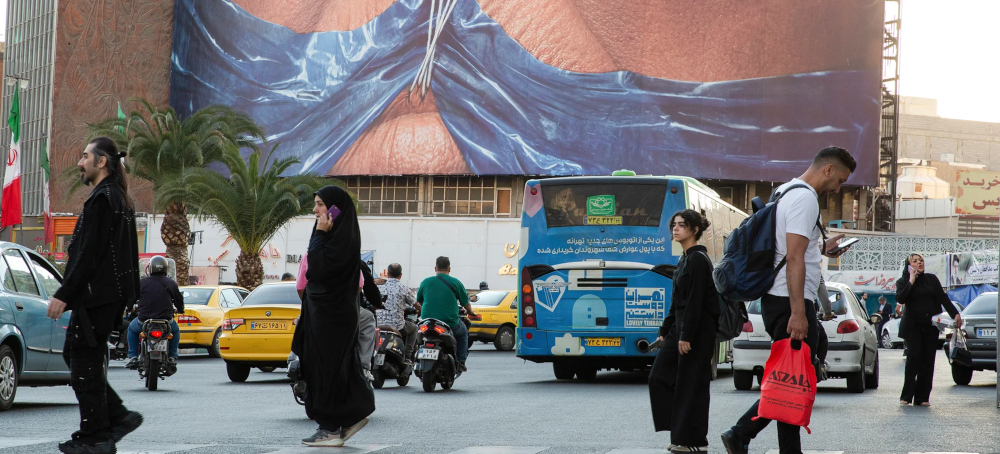 A billboard in Tehran depicting the closure of the Strait of Hormuz superimposed over President Donald Trump’s face. (photo: Arash Khamooshi/NYT)
Trump says that a deal to end the war with Iran is imminent. On key issues, it’s back to square one—or worse.
It’s hard not to think of Trump’s tweet as he navigates his own deal, to end an ill-considered, ill-prepared, and ill-timed war with Iran. During the Obama Administration, the United States did not have to launch a military crusade against the Islamic Republic to win significant concessions on its nuclear program, although diplomacy took two years of sometimes tortuous talks. Trump’s war has so far cost at least twenty-eight billion dollars, thirteen American and thousands of Iranian lives, the crippling closure of the Strait of Hormuz, the interruption of global energy supplies, an economic crisis that has impacted hundreds of millions of people across the world, and possibly irreversible reputational damage to the United States. And Trump may not get a whole lot more than what was agreed to in that first deal, which he unilaterally withdrew from in 2018, calling it “horrible.”
Over the weekend, the U.S. and Iran said they were in the final stages of negotiating a “memorandum of understanding,” or M.O.U.—the first step in eventually ending the conflict. The framework is expected to contain few specifics on how to resolve the most complex issues. Iran is playing the long game, despite incurring heavy losses that include the killing of its Supreme Leader and other senior political and military officials, in addition to huge damage to its infrastructure. Trump is playing the short game, with midterm elections looming, and public disapproval of the war growing. For him, Operation Epic Fury is turning into an epic disaster.
The terms reportedly include a thirty-to-sixty-day extension of the current ceasefire and the lifting of the duelling blockades of the Strait of Hormuz. Almost two thousand ships, with billions of dollars in assets and some twenty thousand sailors aboard, have been trapped in the Persian Gulf for months. A fifth of the world’s oil and gas would begin transiting again. Iran would also pledge future limits on its controversial nuclear program. The U.S. would pledge to lift some sanctions and unfreeze some Iranian assets. But even the sequencing of steps has been problematic: which country moves first, at what pace, with what reciprocity, when? The White House has vowed “No dust, no dollars,” meaning that Iran has to surrender almost a thousand pounds of enriched uranium before it gets sanctions relief.
The nuclear concessions were available in February, before the war began, when the U.S. and Iran were in the middle of negotiations. On the eve of a scheduled meeting in Geneva, the U.S. aborted diplomacy and joined Israel in launching a full-scale war. “The main irony is that we’ve gone through this very costly conflict to end up in a place where we’re getting a one-pager that lacks any kind of technical details,” Ali Vaez, the Iran project director for the International Crisis Group, told me. “A lot of the points are absolutely meaningless.”
“Non-aggression is something I’ve been advocating for a long time,” he continued. “But if it’s not verifiable, not enforceable, it doesn’t mean anything, really. A lot of this is just superficial, and really a pity that we had to go through so much pain to get to this point.”
Vaez compared the memorandum with Iran to the Trump-brokered deal to end the war in Gaza between Israel and Hamas. That agreement went into effect in October but never moved beyond Phase One. Israel continues to strike Gaza, and Hamas, which has refused to disarm, still controls about forty per cent of the territory. Trump has a record of heralding his diplomatic breakthroughs, arguing that they merit a Nobel Peace Prize, and then losing interest, delegating, or punting rather than providing leadership on the difficult details.
This pattern stretches back to Trump’s first term. In 2018, he held a summit in Singapore with Kim Jong Un, the leader of North Korea. Afterward, the President extolled the end of the threat from North Korea and his “very special bond” with Asia’s most dictatorial leader. Kim pledged an “unwavering commitment to complete denuclearization” and to return the remains of some five thousand missing Americans who had died in the Korean War. But the summit produced a four-hundred-word document that led nowhere. To revive diplomacy, in June, 2019, Trump became the first sitting President to visit North Korea, dramatically stepping across the border with South Korea to shake hands with Kim. This initiative collapsed, too. Since then, Pyongyang is estimated to have produced twenty additional nuclear warheads. It has returned only fifty-five boxes of human remains. Today, the threat from North Korea is far greater—and in some ways militarily greater than that from Iran.
The U.S. talking points on a possible M.O.U. in Iran, so far, fail to address many of Trump’s original justifications for going to war, Barbara Leaf, a former U.S. Ambassador and Assistant Secretary of State for the Middle East, said on Monday. There’s no reference to Iran’s vast drone and ballistic-missiles arsenals. (Tehran has been rebuilding missile-production sites during the ceasefire.) These are a more imminent threat to the region than a nuclear weapon, as demonstrated by the thousands of strikes Iran has conducted on its Gulf neighbors during the war. Iran reportedly still has seventy per cent of its prewar missile stockpile.
There has also been no mention of Iran cutting off support for its regional proxies, Leaf noted. Iran has instead stipulated that any deal include a parallel end to Israel’s war with Hezbollah, the Lebanese Shiite political party and paramilitary group, long backed by Iran. Israel has announced its intention to occupy ten per cent of Lebanon, and Prime Minister Benjamin Netanyahu has vowed to continue military operations until Hezbollah is no longer a threat—the same pledge he made about Hamas, in Gaza.
In mid-February, two weeks before the war, Trump told reporters that regime change in Iran “would be the best thing that could happen.” That notion is now moot. On the first day of the war, Israeli air strikes killed Ayatollah Ali Khamenei, who had led the country for nearly forty years, and severely injured his son Mojtaba, the new Supreme Leader, who has not been seen in public since then. In March, Trump claimed that “one regime was decimated, destroyed. They’re all dead. The next regime is mostly dead. And the third regime, we’re dealing with different people than anybody’s dealt with before. It’s a whole different group of people. So I would consider that regime change.”
The current government in Tehran is, however, even more hard-line than the last, with the Islamic Revolutionary Guard Corps holding outsized influence, including in the negotiations, Leaf said. The I.R.G.C. has control over the nuclear program. The lead envoy in negotiations is Mohammad Bagher Ghalibaf, a former Revolutionary Guard commander who is now speaker of parliament. Trump underestimated “the regime’s resilience,” she said. The war has only made the regime “more cohesive.”
Having survived punishing U.S. and Israeli air strikes, Iran now has more confidence that the Islamic Republic can survive, albeit at a cost. “Paradoxically, one of the most serious consequences of this campaign may be the erosion of deterrence vis-à-vis Iran, specifically, the loss of the implicit sword hanging over Tehran as it considers whether to move toward nuclear-weapons capability,” Danny Citrinowicz, a former Israeli-military-intelligence specialist on Iran, wrote on X on Monday.
One of the main factors preventing the regime from openly pursuing a nuclear weapon was “the fear that doing so could trigger a large-scale military campaign aimed not merely at damaging Iran’s capabilities but at threatening the regime itself,” he said. “From Tehran’s perspective, however, Iran has now endured precisely such a confrontation and survived it.” Now the U.S. and Israel know their own military limitations in dealing with Tehran.
On Hormuz, Iran has demonstrated audacity and generated unprecedented leverage. The country’s leaders now know that they have the ability to close the strait again and again, at enormous cost for the U.S. Tehran has even proposed charging ships to cross the narrow waterway, which had been free to navigate in the past. On Monday, a spokesman for its Foreign Ministry said that discussions were under way with Oman on a new protocol to provide “services” on “safeguarding the environment” through the Hormuz waters. “All these acts entail certain expenses,” he said.
Over the weekend, in a perplexing gambit, Trump abruptly expanded the U.S. goals in a phone call with eight Middle East leaders—by calling on them to normalize relations with Israel in exchange for his efforts to end a war that he started. “After all the work done by the United States to try and pull this very complex puzzle together, it should be mandatory that all of these Countries, at a minimum, simultaneously, sign onto the Abraham Accords,” he said, in a Truth Social post.
“It will be a Document respected like no other that has ever been signed, anywhere in the World. Its level of Importance and Prestige will be unparalleled!” he wrote. The Abraham Accords, which originated during Trump’s first term, are designed to get Arab countries to recognize Israel. Several have balked at the idea until there is a Palestinian state. Leaf noted that Trump’s proposal, during the call, was met with “a stunned silence . . . There are no takers.”
Daniel Shapiro, a former U.S. Ambassador to Israel, mocked Trump. “There’s a concept in diplomacy. When the problem is too hard, expand the pie. Bring in more stakeholders, and solve one problem by packaging it with others,” he wrote on X. “That would be the charitable interpretation of this post. The realistic interpretation is that this pie is as delusional as a moon made of green cheese.”
Trump’s boast on Truth Social that an agreement with Iran was imminent met with a noisier reception in Washington. It unleashed a pissing contest among Republicans and fury among Democrats. None seemed to consider Trump much of a winner. Mark Dubowitz, the C.E.O. of the Foundation for Defense of Democracies and a leading hawk on Iran, did argue that the U.S. and Israel won the war. “But,” he acknowledged, on X, “if the reported terms are accurate, the regime is now winning the ceasefire. Another 60-day extension would only deepen Tehran’s advantage.” He added, “Imagine achieving all of this on the battlefield only to surrender it at the negotiating table.” Senator Roger Wicker, the Mississippi Republican and a former Air Force officer who serves on the Armed Services Committee, warned that the agreement “would be a disaster. Everything accomplished by Operation Epic Fury would be for naught!”
Mike Pompeo, who headed the C.I.A. and served as Secretary of State during Trump’s first term, blasted his former boss. “Not remotely America First,” he posted. He urged Trump to just “open the damned” Strait of Hormuz, deny Iran access to any of its billions of dollars in frozen assets, and continue to weaken Iranian military capacity. The Administration is on the defensive. Steven Cheung, the current White House Director of Communications, fired back, “Pompeo has no idea what the fuck he’s talking about. He should shut his stupid mouth and leave the real work to the professionals.”
Early Tuesday morning, the U.S. struck southern Iran, near the Strait of Hormuz, reflecting the fragility of the ceasefire—and the diplomacy. The targets were Iranian boats deploying mines and missile-launch sites, according to the Pentagon. “U.S. Central Command continues to defend our forces while using restraint during the ongoing ceasefire,” Captain Tim Hawkins said. The I.R.G.C. vowed a “decisive reciprocal response.” It claimed to have fired on a U.S. fighter jet and shot down a drone. In a statement to mark the beginning of Islam’s annual hajj pilgrimage on Tuesday, Mojtaba Khamenei warned that nations in the Middle East “will no longer serve as shields for American bases.”
Amid both the intensifying diplomacy and new military air strikes, the most tragic and overlooked factor of the war is “the epic betrayal” of the ninety-three million Iranian people “who Trump promised to ‘rescue,’ ” Suzanne Maloney, an Iran scholar and the vice-president of the Brookings Institution, noted. “Instead they’re suffering intensified repression … economic deprivation.” Incompetence, indeed.