The DOJ Has Been Taking Down Epstein Files. Here’s What Remains.
Elliott Ramos, Julia Ingram and Taylor Johnston CBS News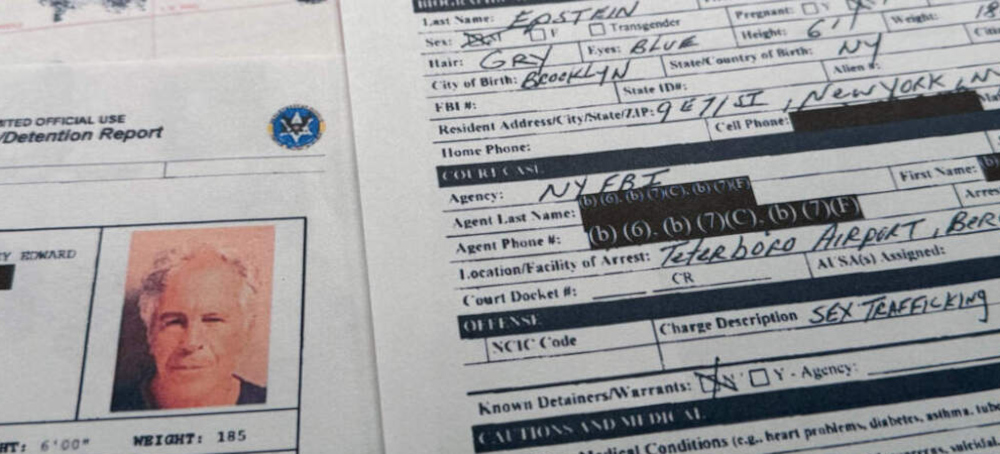 A document that was included in the U.S. Department of Justice release of the Jeffrey Epstein files is photographed Sunday, Feb. 1, 2026, shows the report when Epstein was taken into custody on July 6, 2019. (photo: Jon Elswick/AP)
ALSO SEE: Pam Bondi Subpoenaed by US House in Jeffrey Epstein Investigation
The massive tranche of files the Justice Department currently maintains is more than 65,000 pages shorter than what the agency initially released.
The Justice Department initially said that its release, made in response to a law passed by Congress compelling the agency to disclose nearly all files related to Epstein, comprised more than 3 million pages. Combined with previously released materials, the Department put the total at 3.5 million pages.
And now, in part in response to widespread criticism and concern from survivors and their attorneys that the files contain nearly 100 survivors’ personal information and photos, the DOJ has scrambled to remove documents. A CBS News analysis found that as of late February, the Justice Department has taken down more than 47,000 files comprising about 65,500 pages. Links to those files now return a "page not found" error on the department’s website.
Some of those removed documents contained explicit images or survivor information — including one document with unredacted photos of 21 survivors along with most of their birthdates. But the reasons for other files’ removal is unclear, such as a call log with all names redacted and images of Epstein’s jail bunk where investigators say he hanged himself. The Justice Department appears to be putting some removed files back up.
Deputy Attorney General Todd Blanche said the department reviewed 6 million total pages, meaning what it initially released constitutes less than half of the total. He said the DOJ withheld files to protect survivors and ongoing investigations, but lawmakers, who have access to the unredacted trove, have criticized the redactions, arguing that some protect powerful men instead of survivors.
In response to inquiries from CBS News, Department of Justice spokesperson Natalie Baldassarre said that "CBS’s analysis appears to be fundamentally flawed" and that the department has "not deleted any files from the library." But she also wrote that more than 47,000 files remain offline for further review, a file-count similar to what CBS News found had been removed. She added that the files will be ready for re-production by the end of the week.
"Our team is working around the clock to address victim concerns, redact personally identifiable information and any images of a sexual nature," Baldassarre wrote. "All responsive documents will be repopulated online once proper redactions are made."
The records that the Justice Department have released have led to international fallout and high-profile resignations. Journalists, investigators and online sleuths are continuing to uncover new details of Epstein’s sex trafficking operation and the figures that remained in his orbit even after his crimes were exposed.
But in many ways, the enormous tranche of files remains a black box due to its scale and lack of organization. The vast majority of the total pages the Justice Department released in response to the new law were made in a massive, three-part document dump on Jan. 30 that lacked chronology or categorization and was rife with duplicates. In addition to removing files, the Justice Department removed the ability to download the files en masse. Although it provided a search engine as mandated by law, the results it returns are inconsistent.
To help readers navigate the Epstein files, CBS News broke them down by their origin and release date. Click on any of the inner circles in the visualizations below to see details on a release and what the documents inside reveal.
Justice Department disclosures
With one document dump on Jan. 30, the Justice Department dwarfed in size any prior Epstein file release. The documents released at or shortly after the deadline required by law numbered about 39,000 pages. The more recent release was initially 2.7 million pages, CBS News’ analysis found.
The release joined multiple others made in response to the new federal law. These documents are split into 12 "data sets," or file repositories, although their separation appears arbitrary. The first eight "data sets" were released between Dec. 19 and Dec. 22, while the remaining four were posted on Jan. 30 and Jan. 31.
The files contain a mix of photos, emails, audio, videos, investigative transcripts and other files, including:
- Years of emails and messages between Epstein and his associates, showing how the disgraced financier amassed power and influence and used his network to further his sex trafficking scheme.
- Epstein’s communication with high-profile figures including Elon Musk, former Prince Andrew, Larry Summers, and Commerce Secretary Howard Lutnick, as well as President Trump’s confidant Tom Barrack and former advisor Steve Bannon.
- Several documents and emails that mention President Trump, including one that said he flew on Epstein’s private jet "many more times" than previously known, and a spreadsheet of tips to the FBI, including one that alleged Trump sexually assaulted a minor. Mr. Trump has consistently denied any wrongdoing.
- Prison surveillance footage from Epstein’s incarceration before his death by suicide, and the federal investigators’ analysis of the video.
- More than 2,000 videos that Epstein recorded himself, received from others or downloaded from the internet, including many of young women.
- Thousands of images of Epstein’s Manhattan mansion, his private island, and himself with friends and prominent figures, such as Bill Gates and former President Bill Clinton from across the worlds of politics, business and entertainment.
- Investigative memos, including one from the Drug Enforcement Agency revealing Epstein was the subject of a probe for money transfers linked to narcotics.
- Testimony from Ghislane Maxwell in response to a limited immunity deal from the government.
Because the release includes a huge archive of Epstein’s emails, many pages are not informative and several are duplicated. Some are printed such that only one letter appears on each line. Many contain no more than news clippings or nondescript file names for attachments, the content of which is not included or stored elsewhere in the release.
Congressional Oversight Committee files
These documents were released by the House Oversight Committee in 2025, before Congress passed the law in November compelling the Justice Department to release all files. Many of these documents were held by Epstein’s estate, which turned them over to the Congressional committee. The releases include thousands of pages of emails, including some that referenced President Trump, flight logs and court documents. It also contains Epstein’s 50th "birthday book" with messages from associates, including Trump. The congressional committee also released photos, including several showing high-profile figures including President Trump, former President Bill Clinton, Woody Allen and Bill Gates. All denied any criminal wrongdoing in relation to Epstein.
However, most of these documents had already been public by the time the committee released them last fall, including the investigative records, court files and videos from the Metropolitan Correctional Center in Manhattan, where Epstein was incarcerated. As a result, many are duplicative of files stored elsewhere in the DOJ’s online tranche of Epstein files.
Court records
Epstein, his estate, and his associate Ghislane Maxwell have been defendants in several lawsuits brought by survivors of their sex trafficking operation. Most of the female plaintiffs are referred to as "Jane Doe," but a few, such as Virginia Giuffre and Maria Farmer, filed suit using their real names.
The first lawsuits against Epstein were filed from 2008 to 2010 by anonymous women who said they were recruited to give Epstein massages, but were sexually assaulted. All were dismissed. But in 2019, after federal charges were filed and Epstein died by suicide, another wave of survivors filed lawsuits against his estate, many of which were settled through the Epstein Victims’ Compensation Fund by 2021. The fund offered payments to nearly 150 people, paying out over $121 million, it said in a press release.
In one suit, two survivors sued the U.S. government for its handling of Epstein's initial prosecution and the 2008 non-prosecution agreement that allowed him to serve 13 months in a county jail, most of it on work release.
Other lawsuits are battles over public records, including one brought by the Palm Beach Post that ultimately led to the release of the long-secret 2006 grand jury transcripts from the initial Florida state prosecution of Epstein. The DOJ collected the released records from 51 total cases and published links to them on its website, although it has periodically removed and reposted links to these files.
Freedom of Information Act
Before the Epstein files became a flashpoint in Congress, journalists have sought to bring them to light through public records act requests. In response, just under 10,000 pages were released between 2017 and 2024 from three federal agencies and from Palm Beach County in Florida. These documents, along with court files, were some of the records relied on for the initial journalistic investigations into Epstein’s sex trafficking that kickstarted the public conversation around him and subsequent federal investigation.
The Florida files contain records from state prosecutors' investigations into Epstein from 2005 to 2006, including recordings of several interviews.
The federal records include logs from the Department of Homeland Security on Epstein’s flights to his private islands in the U.S. Virgin Islands and records about his 2019 incarceration in New York City’s Metropolitan Correctional Center, where he killed himself. They also include files from FBI investigations into Epstein, which date back to 2005. But much of the material from those FBI investigations was redacted, including interview summaries with associates, survivors and other key witnesses, subpoenaed phone and social media records and bank records.
What’s missing?
Deputy Attorney General Todd Blanche said that the DOJ withheld duplicate files, files that they would jeopardize active investigations, child sexual abuse material, and files that would reveal survivors’ personal information. The Justice Department said they are preparing written justifications for the redactions and will publish them in the Federal Register.
But questions remain on what those files contain. The Justice Department appears to have withheld records from an interview with a woman who accused President Trump of sexually assaulting her when she was a minor, NPR first reported. Serial numbers stamped on the bottom of each document indicate several from this interview are missing. The DOJ is now reviewing whether these files were wrongly withheld.
A White House spokesperson told NPR in response that the president "has done more for Epstein's victims than anyone before him" and has been "totally exonerated on anything relating to Epstein."
The DOJ has also removed at least 65,527 pages, CBS News found. Several are photos from the Metropolitan Correctional Center, where Epstein was held and died in 2019, including photos of his cell and prescription medications found there. Others are photos of hard drives and computers, and other evidence investigators gathered on the cases, like file folders whose contents are unclear or a bag whose label said it contained the ligature discovered around Epstein’s neck. Some are photos of women or girls that were already redacted. One removed photo, which has since been restored, showed Commerce Secretary Howard Lutnick with Epstein on Epstein’s private island. Lutnick has not been accused of any wrongdoing in relation to Epstein, and in a congressional hearing said he had "nothing to hide."
Some redactions in files that remain online obscure some broad swaths of documents without explanation, including FBI interviews with witnesses and a document labeled as a grand jury transcript. Lawmakers can request to review the full, unredacted files in person. Rep. Ro Khanna (D-CA) was among those who made a request, and came back with the names of six men in contact with Epstein whose names had been redacted, but did not accuse them of criminal wrongdoing.
The unreleased documents likely include files obtained from Epstein’s computers, hard drives and other electronic devices. Emails from FBI engineers described terabytes of data that the FBI obtained from phones, tablets, cameras, servers and laptops. Some of the files list some of those devices seized from Epstein. While a vast tranche of emails, photos and videos included in the most recent release, their combined file size is far smaller than what investigators described, CBS News’s analysis found. Many emails contain attachments that were not released.