The Delusion of Easy Victory From the Air May Have Seduced the US Into Another War
Aram Roston Guardian UK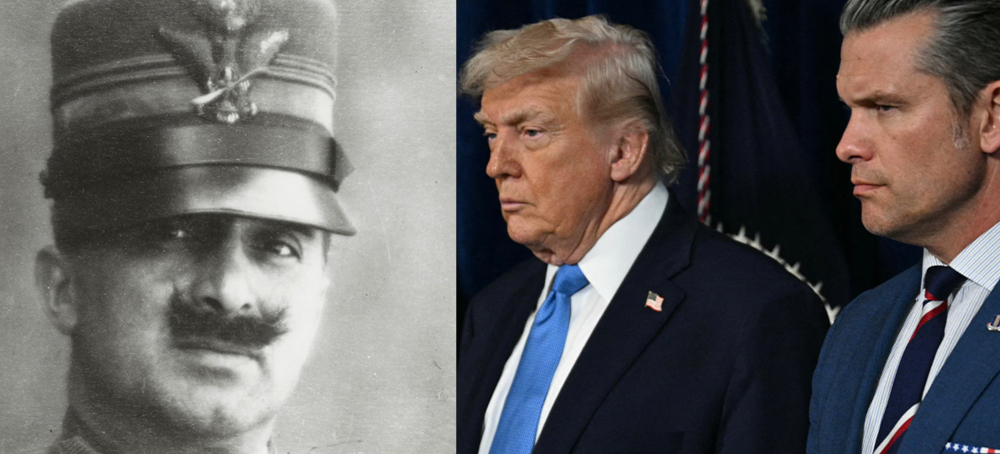 Gen Giulio Douhet of the Italian army, who wrote The Command of the Air in 1921. Donald Trump and Pete Hegseth seem to have absorbed his faulty message. (photo: Getty)
Air superiority is supposed to deliver a quick triumph. But history has shown that promise to be written on the wind
Victory in the future, he said, would no longer come from the grinding trench combat of the Great War. Instead it meant large-scale aerial bombardments, targeting not just combatants but civilians and civilian infrastructure and logistics.
“[It] is much more important to destroy a railroad station, a bakery, a war plant, or to machine-gun a supply column, moving trains, or any other behind-the-lines objective, than to strafe or bomb a trench.”
“[It] is not enough to shoot down all birds in flight if you want to wipe out the species;” he wrote, with a grim metaphor. “The most effective method would be to destroy the eggs and the nests systematically.”
Douhet’s theories, which emphasized “blows to the morale of civilian populations”, inspired Hitler’s deployment of airpower – and attacks such as that seen in Guernica and the sustained bombing of London. But likewise it attracted technologically bent American air strategists such as Gen Curtis LeMay, who oversaw the firebombing of dozens of Japanese cities, the aerial mining of Japan’s waterways called Operation Starvation, and the nuclear attacks on Hiroshima and Nagasaki, and who later ran the US Air Force Strategic Air Command.
It is unclear if Pete Hegseth has ever heard of the book Douhet wrote, but the threads of the long-dead Italian officer’s thinking appear woven through the secretary’s bombastic briefings about Epic Fury, the air war Trump is waging against Iran.
In spite of Hegseth’s claims of a new type of American strategy, and his slap-down of the “foolish political leaders and foolish military leaders of the past”, his promise of “the most lethal and precise air power campaign in history” appears to be less an innovative approach to warfare than a recycled version of the same old thing.
In the 1991 Desert Storm attacks on Iraq, the 1999 air war against Serbia and the 2003 launch of Operation Iraqi Freedom, there’s a clear pattern where military leaders seem convinced that the increasing might and airpower and breakthroughs in technology have finally allowed them to revolutionize warfare, again and again.
Douhet was obsessed with promoting a sheer volume of bombs from the sky, “to inflict the greatest damage in the shortest possible time”. Hegseth’s briefings are resonant with that theme of more and more and more. “Quantity has a quality all its own,” he said. “In fact, today will be yet again the highest volume of strikes that America has put over the skies … The number of sorties and number of bomber pulses, the highest yet, ramping up and only up.”
And then there was Douhet’s focus on bombing civilian infrastructure – a practice he thought would cause the population to revolt against their leaders. “The time would soon come when, to put an end to horror and suffering, the people themselves, driven by the instinct of self-preservation, would rise up and demand an end to the war,” he wrote.
Hegseth, too, dwells on that destruction of civilian morale, though he has not pushed for striking civilians themselves. “We are warriors, trained to kill the enemy and break their will … Speaking of people, we hope the Iranian people take advantage of this incredible opportunity. President Trump has been clear: now is your time.”
One of the differences between the boasts of Hegseth and his predecessors was that they were more polite about it, said Winslow Wheeler, a former Government Accountability Office (GAO) official who later ran the Center for Defense Information. It’s style more than substance, he said.
“What they don’t appreciate,” Wheeler said, “is that human nature is unchanging. The technology gets more and more sophisticated and they find that we’re capable of more and more precision but that doesn’t change human nature.” In other words, said Wheeler, people on the ground react in unpredictable ways. Bombing them often builds resistance and solidarity. “Think of the German attacks on the British, did that weaken the British resolve? No. It caused the population to unite,” he said. “Surrender was unthinkable.”
North Vietnamese urine to outwit technology
Delusions of omniscient control from the skies were a feature of the air war during Vietnam. In Kill Chain, the Rise of the High-Tech Assassins, Andrew Cockburn describes how air power and technology advocates of that day thought they could shut down the Ho Chi Minh trail, the jungle supply line used to arm and equip the North Vietnamese army. The American plan: use arrays of remote ground sensors to detect trucks and soldiers. Once the detectors went off, bombers could wipe out the soldiers below. (One type of sensor “’sniffed’” the air for telltale traces of ammonia, denoting urine and therefore people.) The North Vietnamese caught on quickly with low-tech solutions – they even tricked the ammonia-sniffing sensors with bottles of animal urine. The Ho Chi Minh trail was never shut.
The US war that introduced the now commonplace black and white videos of targets exploding, the same type of videos released now in Epic Fury, was Desert Storm in 1991, the effort to liberate Kuwait after Saddam Hussein invaded his small oil-rich neighbor.
As Cockburn wrote, “For the first time, the public at home could watch and thrill at the air force’s ’precision and lethality’ administered with cool professional efficiency.”
The early US press accounts in the opening days of war were enthusiastic. “With a lethal air strike of historic accuracy and potency, the United States and allies rained death and devastation on Iraq Wednesday,” wrote USA Today.
The technological hero of the show was the previously secret F-117A stealth attack aircraft, which dropped the very first bomb of the war, and the Pentagon shared the videos gladly. But the boasts at the air war turned out to be just shades of truth. In 1996 a GAO study found that the claimed success rate of 80% on bombing runs by the stealth F-117A was exaggerated: the true rate was between 41% and 60%. And claims about targeting were inflated too. “The claim by [the Department of Defense] and contractors,” wrote the GAO, “of a one-target, one-bomb capability for laser-guided munitions was not demonstrated in the air campaign where, on average, 11 tons of guided and 44 tons of unguided munitions were delivered on each successfully destroyed target.”
In the end, after 43 days, Hussein withdrew from Kuwait, leaving tanks and soldiers and wreckage behind. But it also left Hussein firmly in charge, back in Iraq, his regime intact.
In March 1999, the next big air war was under way: Operation Allied Force to end the Serb war crimes in Kosovo. This war had its own set of weapons system celebrities. The hi-tech B2 bomber was deployed, with two of the planes flying thousands of miles from the US and back to drop precision bombs. A report in the Los Angeles Times said: “Within the Air Force, there was nothing but elation.”
But in the end, as the Guardian reported the next year, “Nato’s bombing campaign, with thousands of sorties and the dropping of tens of thousands of bombs, including sophisticated precision weapons, succeeded in damaging just 13 of the Serbs’ 300 battle tanks in Kosovo.”
The most well-known exaggeration of US air power may well be the “shock and awe” campaign of 2003 under George Bush and his secretary of defense, Donald Rumsfeld. In many ways the language used as the war started could have been used by Hegseth.
Rumsfeld boasted that the airstrikes “will be of a force and scope and scale … beyond what has been seen before”. The Pentagon told reporters that it had planned a 48-hour campaign with 3,000 precision guided bombs to devastate Iraqi command and control and military infrastructure and sap morale.
When the airstrikes failed to topple Hussein without ground troops, Rumsfeld denied he personally had promised the regime would fall quickly, though he allowed that some planners might have given that impression. As he put it, “is it possible that someone might have said something that led some person to believe that? I suppose so.”
All the claims in Vietnam, Iraq and Kosovo of omniscient technology, precision bombing and air domination never actually won a war, the critics say. Hegseth and the other proponents of the current conflict are just the most recent to brag about US weaponry and all-knowing technology. “The most fighters, the most bombers, the most strikes,” Hegseth said less than a week into the war, “intelligence more refined and better than ever.”
The newest boasts about the latest whiz-bang ingredient in the US arsenal is the claim that AI is helping defeat Iran. “We’ve got a lot of autonomous systems,” Hegseth said, “incorporated with smart AI aspects to them.”
But does that mean Hegseth has finally solved the very same problem in air superiority that the US has faced for decades? It may be that the delusion of easy victory – that same alluring 100-year-old theory of warfare – has sucked the US into its latest violent muddle.