The Complicated Evacuation of the Wounded From the Ukrainian Frontline
Rémy Ourdan Le Monde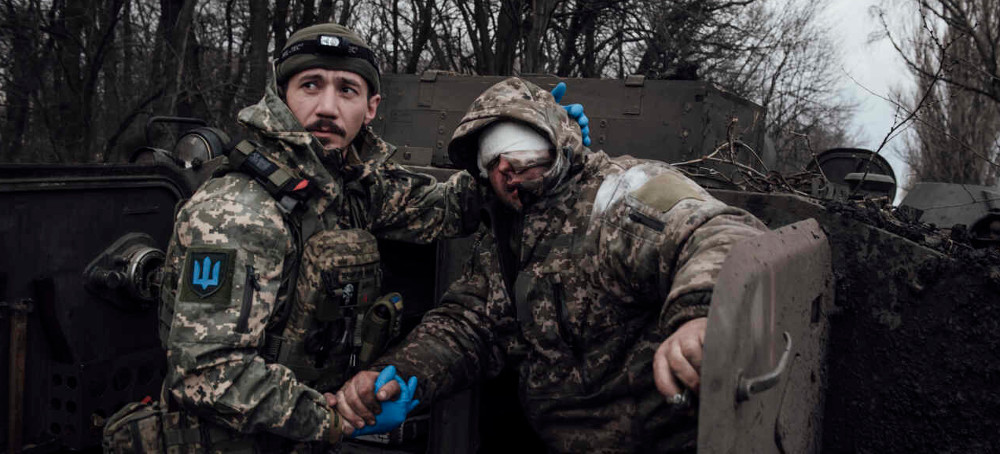 'While the number of wounded soldiers, like that of the deceased, is kept secret by the Ukrainian government, it amounts to tens of thousands of men, increasingly subjected to Russia's firepower.' (photo: Adrien Vautier/Le Monde)
While the number of wounded soldiers, like that of the deceased, is kept secret by the Ukrainian government, it amounts to tens of thousands of men, increasingly subjected to Russia's firepower. Society cares what happens to them.
In the carnage that is the war in Ukraine for soldiers on both sides, doctors, nurses and paramedics are facing the worst influx of wounded victims on a European battlefield since the Second World War.
"The main difficulty in this war is extracting wounded soldiers from the frontline. It takes between six to 24 hours," said Migulev. That's plenty of time to bleed to death, or for a wound to become infected. Once they arrive at the stabilization point, however, the wounded are not only quickly treated but are promptly dispatched to a military hospital because, in these cramped spaces with few stretchers and beds, room must be made for the next wave.
A debate is currently raging in Ukraine over the treatment of wounded combatants. The government keeps the number secret, as it does with that of the deceased, but it amounts to tens of thousands. And society cares what happens to them. President Volodymyr Zelensky acknowledged "the need for a renewed effort in medical support for the army" when he announced on November 19 that General Anatoly Kazmirchuk would replace General Tetyana Ostaschenko at the helm of the Armed Forces Health Service. Previously, Kazmirchuk had been head of Kyiv's main military hospital.
Poor quality emergency equipment
Zelensky changed defense minister in September and has made a series of armed forces-related announcements in recent months. His intervention comes in a context where the political leadership is attempting to both organize the country for a prolonged war and address scandals or suspicions of corruption.
In the medical field, officers and soldiers do not hide the fact that some of the equipment supplied, such as first-aid kits, is of poor quality. A large number of tourniquets made in China have proved unusable. Many fighters have to buy their own equipment or obtain it from civilian organizations supporting the army. "The changes will happen quickly," promised the new defense minister, Rustem Umerov.
"Even though no one is ever ready for such a war, after eight years of conflict in the East, we were, to some extent, prepared," said Ostaschenko in February, taking stock of the first year of the war. "When the invasion began, we created a unified system involving the ministries of defense, interior, health, and medical universities. And people are working day and night, with the support of thousands of volunteers."
Better training for fighters
In the Chasiv Yar underground, Doctor Sergey Dramaretskiy tended to the 1st Special Brigade's wounded at the 5th Assault Brigade's stabilization point. He acknowledged an influx of wounded, "from 60 a day to sometimes as many as 30 an hour." The majority are hit by shrapnel from rockets, shells, grenades and mines.
At the time, Ostaschenko was not allowed to disclose how many wounded her services had treated, but she did acknowledge that she had already mobilized "20,000 people and 40,000 beds," giving an idea of the scale of daily needs.
Under close combat, when one side launches an assault on the enemy trench, gunshot casualties often arrive. The challenge, apart from saving as many lives as possible, is to evacuate them. "We treat the wounded in an average of 20 minutes," said Dramaretskiy, "and stabilize the most severe cases in less than an hour."
Ukrainian war medicine is highly regarded by humanitarian organizations and foreign surgeons offering their help, and the army's medical services have never faced accusations of incompetence. However, it appears that the country's challenge is more linked to the inherent nature of conventional warfare and Russian firepower.
In this war, Colonel Oleh Kymchuk is without doubt the man who has seen the most wounded in need of surgery. As chief surgeon for the eastern region, where the front lines are both the most extensive and the most violent, he works in the main military hospital in Dnipro. "Many of the most seriously wounded soldiers die in the trenches," he said bluntly, explaining that this was due to two problems: "lack of first-aid training for soldiers and nurses in combat units," and "delays in evacuating from the front line."
The war surgeon would like to see better training for combatants. "The soldier rarely understands that his best rescuer is first himself and then his comrades." Men, he added, should learn "how to better stop bleeding, how to apply bandages, tourniquets," and also "some anti-shock and anti-stress therapies," as the wounded have a greater chance of survival if they remain calm and confident.
Wounded waiting on the front
Kymchuk is adamant that the problem "is not medical," but is primarily due to "the intensity of fire and battles," which forces each brigade to "keep the wounded on the front for too long." "On the other hand, once the soldier reaches hospital, we have less than 1% casualties," he said.
As the commander of a combat unit on the Bakhmut front, B. confirmed this observation. "From the stabilization point to the hospital, and even if the paramedics are sometimes overwhelmed, the care is perfect. My concern is, on the one hand, the lack of armored ambulances for evacuations, and on the other, the fact that you first have to walk several kilometers under enemy fire," where the ambulances wouldn't be able to go anyway. It is sometimes necessary to wait for a break in the fighting, or at night, to evacuate a wounded soldier.
The first sergeant of an infantry unit, Z., said: "The medical side is great; evacuation is hell." The non-commissioned officer pointed out that "to carry a wounded man for five kilometers through snow and mud, I need four stretcher-bearers and a fifth man who carries their weapons. Sometimes it takes hours to evacuate the wounded, so as not to risk their lives too." He also pointed out the other problem this poses. "That's six men out of action for a while. One day, I had 10 wounded at once, so 60 men had to leave the trench." Sixty out of 200: That's sometimes how a unit loses its position.
On the way to Kostiantynivka, the day Migulev gave a tour of the Chasiv Yar stabilization point, a shell hit the side of the evacuation road and just missed the 1st Special Brigade doctor's car. The driver accelerated. "It's a tracker shell. There must be a drone transmitting the coordinates. The artillery fire is coming," he predicted. Every evacuation of the wounded, first on foot for the combat unit, then by car for the medical unit, means exposure to open terrain. The first hospital was still an hour's drive away. At the front, other wounded were already waiting.