The Clever New Lawsuit That Could Finally End ICE’s Reign of Terror in Blue States
Mark Joseph Stern Slate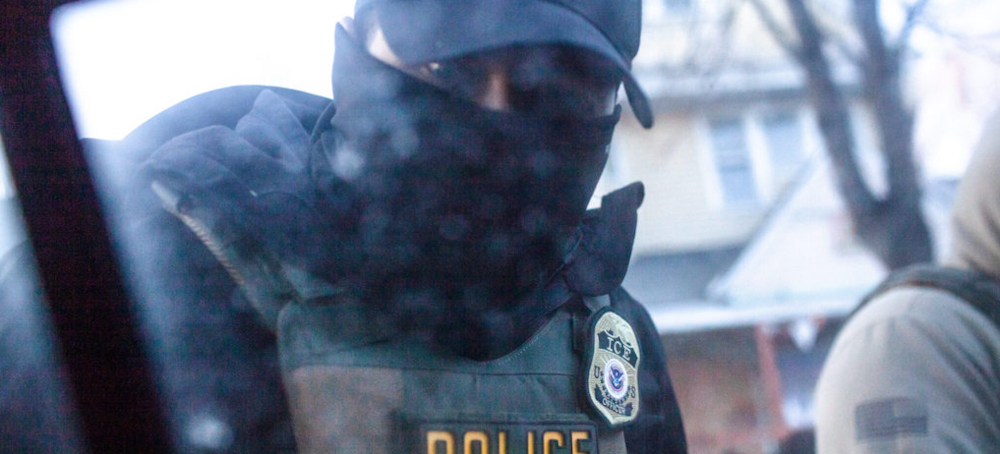 A masked U.S. Immigration and Customs Enforcement agent knocks on a car window in Minnesota on Jan. 12. (photo: Nicole Neri/Minnesota Reformer)
Such accounts have become all too familiar since Donald Trump returned to office and unleashed the Department of Homeland Security to assault, kidnap, and imprison anyone who appears Latino. What makes Carvajal-Muñoz’s story different is that he is fighting back against the agents who violated his rights—and stands a real chance of winning. On Tuesday, a group of civil rights lawyers, including the ACLU and its Maine chapter, filed a lawsuit against these agents, seeking damages for the immense harm they allegedly inflicted on Carvajal-Muñoz. It is notoriously difficult to sue federal officers under recent Supreme Court precedents. But Carvajal-Muñoz’s attorneys are testing a legal theory that circumvents these roadblocks by suing officers under state law for violations of his constitutional rights. This strategy is largely untested, but it may be the only remaining way to hold ICE accountable in court. And if it works, it could open the door to a flood of similar suits by ICE’s many other victims.
Although ICE agents don’t have absolute immunity from legal liability, as Stephen Miller has claimed, they do enjoy broad protections thanks to an odd gap in federal law: Congress has enabled individuals to demand damages from state and local officers who infringe upon their constitutional rights, but it has not authorized these lawsuits against federal officers. In 1971, the Supreme Court began to patch this hole in a case called Bivens, approving monetary damages against federal agents who violated the Fourth Amendment’s guarantee against unreasonable search and seizure. The court later extended Bivens to other constitutional freedoms. In recent years, however, the court’s Republican-appointed majority has radically cut back so-called Bivens remedies to an ever-shrinking set of cases. As a result, it is nearly impossible for individuals to sue federal officers, including immigration agents, who run afoul of the Constitution.
But many legal scholars, and at least some judges, believe there is a path around this obstacle. As the New York Times’ Adam Liptak explained in February, this idea was put forth by Yale Law professor Akhil Amar in a 1987 law review article (though it was largely overlooked at the time). Professors Carlos Manuel Vázquez and Steve Vladeck fleshed out the theory in an important 2013 article that has only grown more relevant since. These scholars argue that states can authorize lawsuits against federal officials who violate constitutional rights. In other words, state law can provide for monetary damages where federal law does not.
Carvajal-Muñoz is now putting this theory to the test. It turns out that Maine already has a law on the books that authorizes damages against federal officials who deprive people of their constitutional rights. (So do several other states, including California.) Carvajal-Muñoz sued his kidnappers under this statute, alleging that they stopped, arrested, and imprisoned him on the basis of race in violation of the Fourth and Fifth amendments. (He is Latino.) He sued one ICE officer, Jack Cory Ravencamp—who can be seen on video pointing a Taser at Carvajal-Muñoz—by name. If his suit moves forward, he will likely uncover the identities of the many masked agents who participated in his abduction. He has demanded both compensatory damages to redress his own harms as well as punitive damages “to deter future unconstitutional conduct.”
Will it work? The central question is not whether states can, in principle, authorize lawsuits against law-breaking federal agents: For most of American history, that is exactly how victims of federal misconduct collected damages, and it remains permissible under the Constitution. The issue is that, in 1988, Congress enacted a law known as the Westfall Act that curtailed such suits. Its goal was to limit state tort claims, like assault and trespass, against federal officials acting under federal authority. But it included an exception for suits “brought for a violation of the Constitution.” Under a straightforward reading of the act, then, a plaintiff like Carvajal-Muñoz cannot sue ICE agents for assault, battery, or false imprisonment under Maine law. But he can sue these agents for violating the Constitution by committing these wrongful acts.
The Supreme Court has never endorsed this theory, and has arguably implied that the Westfall Act’s exception was meant to preserve Bivens, not remedies under state law. But in another opinion, the court suggested the opposite; which is to say, it appears the justices just haven’t given the issue much thought. Some lower court judges have, though. In 2023, Judge Justin Walker—a conservative Donald Trump appointee—declared that states can still empower plaintiffs “to directly allege federal constitutional violations” against federal officials. Walker, of all people, wrote that the Supreme Court has never closed off this route to relief, leaving states free to pursue it. Reading the Westfall Act with close “attention to its text,” he concluded, shows that Congress has not precluded laws like Maine’s.
The ACLU is currently pressing blue states to enact these statutes, and Illinois passed a version of one in 2025. Maine’s has been on the books since 1989, and it is a perfect test case for this long-overlooked path to accountability. The statute does not discriminate between state and federal officers, an issue that has tripped up other states trying to rein in immigration agents. And ICE’s crackdown in Maine, dubbed Operation Catch of the Day, was an unconstitutional travesty that local law enforcement condemned as “bush league.” The constitutional violations alleged in Carvajal-Muñoz’s lawsuit run afoul of rights that are clearly established; no reasonable officer could possibly think it is permissible to stop, arrest, and use violence against a man simply because he appears Latino. (Indeed, in his otherwise notorious opinion green-lighting racist immigration stops, Justice Brett Kavanaugh maintained that “remedies should be available” when officers use excessive force.) Plus, Maine has a left-leaning federal district court, and falls within the progressive 1st U.S. Circuit Court of Appeals, whose judges may be eager to impose restraints on out-of-control ICE crackdowns.
Carvajal-Muñoz, of course, did not set out to be the test case for this theory. An immigrant from Colombia, he works as a civil engineer specializing in bridge construction, and was deemed to “perform services of exceptional merit and ability” by the federal government. He was one of about 200 people ensnared in Operation Catch of the Day, the overwhelming majority of whom had no criminal record. If courts deny him relief, they will send the chilling message that ICE operates above the law. If courts allow his suit to proceed, they will finally compel immigration agents to operate within the Constitution—or face consequences for defying it.