The Challenges Facing the New Anti-Houthi Coalition in the Red Sea
Elise Vincent Le Monde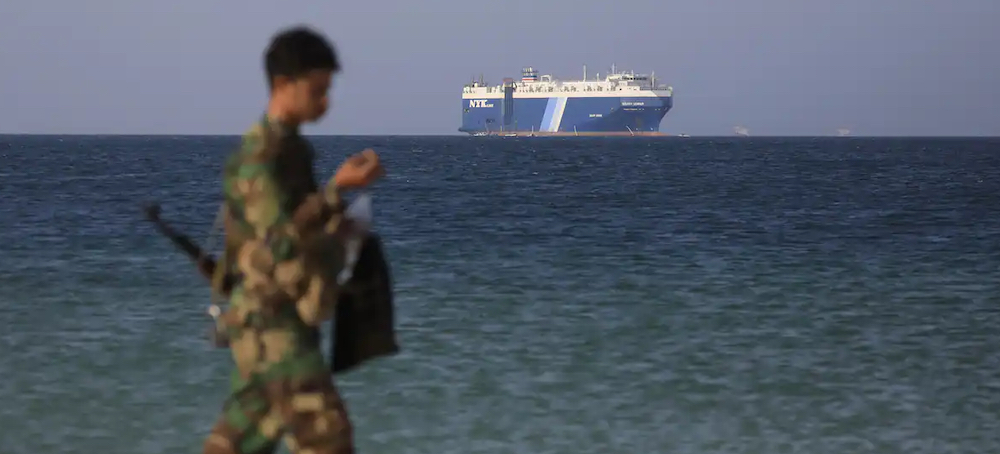 A Houthi fighter walks along Yemen's Red Sea coast with the seized cargo ship Galaxy Leader in the background. (photo: Yahya Arhab/EPA-EFE/Shutterstock)
According to the Pentagon, 10 countries – including the US, France and the UK – are forming a naval task force designed to counter Yemeni rebel attacks on ships transiting the Bab Al-Mandab strait.
The Pentagon announced on Monday evening that 10 countries will be part of this coalition: the United Kingdom, Bahrain, Canada, Italy, the Netherlands, Norway, Spain and the Seychelles, as well as France and, of course, the United States. "The recent escalation in reckless Houthi attacks originating from Yemen threatens the free flow of commerce, endangers innocent mariners, and violates international law," said US Defense Secretary Lloyd Austin in Israel, where he was visiting before heading to Bahrain and Qatar. The operation to be carried out by this coalition has been dubbed "Operation Prosperity Guardian."
The contours of this new naval alliance remain unclear. At this stage, the coalition is simply an extension of one of the five combined task forces (CTFs) that the US has been commanding between the Red Sea and the Persian Gulf for some 20 years, from a base in Bahrain, and of which the navies from 39 countries are members. In practice, all the countries announced by the Pentagon are already associated with one or other of these CTFs, and some, like France and Spain, already have vessels in the area. Operation Prosperity Guardian will be under the aegis of CTF 153.
Compromising peace
In a region of divergent interests, several countries are conspicuous by their absence from this coalition. Egypt, for example, is normally a member of CTF 153 and even took command for the first time at the end of 2022, for a six-month period. While Cairo derives a large part of its revenue from Suez Canal passage rights (more than €8.5 billion in 2022) and is one of the two biggest recipients – along with Israel – of American military support every year, Egypt has refrained from any condemnation of the Houthi attacks until now.
The same goes for Saudi Arabia, one of the major powers in the Red Sea. At a time when the conflict between Israel and Hamas is hardening divisions, the Saudis know that an overly overt display in favor of the United States could compromise the peace they have been laboriously negotiating for many months with the Houthis to emerge from 10 years of war in Yemen.
Even the details of France's participation were still under discussion on Tuesday morning. "We'll have to see how things are put together. We can do more, but this coalition shouldn't just be made up of Western countries," said the French Ministry of the Armed Forces. This is especially true as "doing more" in the Red Sea could mean the French navy having to give up other operational commitments. In this particular context, French Armed Forces Minister Sébastien Lecornu is due to receive a visit from Saudi Defense Minister Khaled bin Salman on Tuesday and Wednesday to discuss "freedom of navigation" in the Red Sea.
Regional climbing
The US has also remained silent on the exact purpose of Operation Prosperity Guardian. Will it be used to escort the commercial vessels that have now deserted the waters of the Red Sea? Or to form an air protection "bubble" against attacks by drones, ballistic missiles or even seaplanes, a tool used on Monday by the Houthis to target two civilian vessels, including a Norwegian tanker, and a Panamanian-flagged container ship? While many observers fear a regional escalation, so far there has been no military response against the Houthis, even after they shot down an American Reaper drone on November 9.
Iran, however, takes a very dim view of this new naval coalition. While discussions had not yet been concluded, Iranian Defense Minister Mohammad Reza Ashtiani directly threatened the project on December 14. "If they [the US and its allies] take such an irrational decision, they will be faced with extraordinary problems," he had told the official ISNA agency, even though Tehran officially denies any involvement in the ship attacks.
Thorny questions
The Houthis and their Iranian sponsor thus appear to be in a position of strength. Jean-Loup Samaan, associate researcher at the Middle East Institute of the National University of Singapore, pointed out that "this movement, which was still a rudimentary militia in 2014-2015, has seriously moved up the military scale, having rallied part of the Yemeni state apparatus to its cause, including officers from the former regime."
The size of their arsenals is not known, but according to military experts, the Yemeni rebels have a wide range of equipment, including ballistic missiles of various ranges, such as the Iranian-made Ghadr. An example of this projectile was fired at Israel on November 6, which intercepted it. In 2023, the Houthis also showed off underwater drones (known as "Nazir 1" and "Nazir 2"). This sophisticated weaponry, available to very few armies, obliged the United States to deploy specific anti-submarine warfare resources.
Last but not least, the creation of this naval coalition poses thorny questions of ammunition supply. "Faced with the multiple sensitivities of the countries in the region, obtaining access to land aircraft with missiles on board, then bringing a ship into port to refuel it, is by no means easy," said a source close to the matter. In the French case, stocks of Aster missiles used on frigates, as fired by the Languedoc frigate against drones on December 9 and 12, are also limited, even though a major order was launched in January, in partnership with Italy. "The problem of ammunition for the Red Sea is the same as for the war in Ukraine," added the same source.