The Baffling Disaster Unfolding at the Washington Post
Justin Peters Slate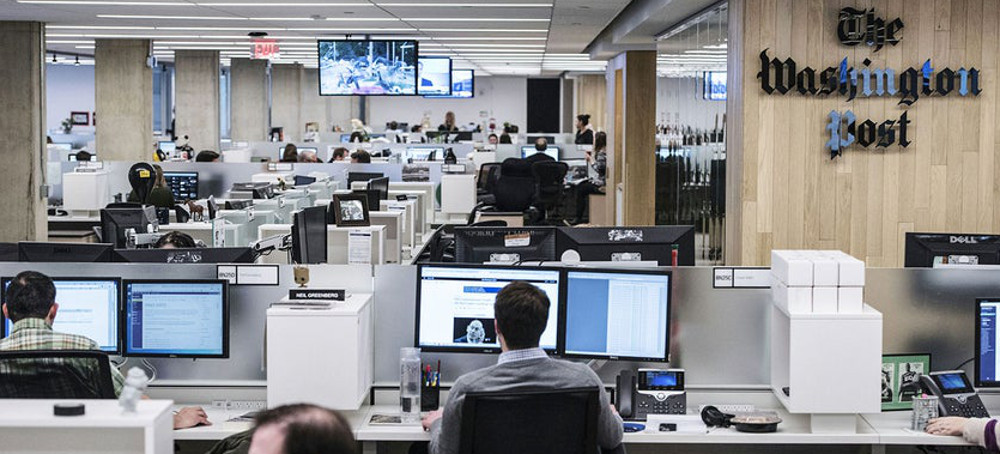 The Washington Post newsroom. (photo: Mandel Ngan/Getty)
What is Jeff Bezos for, if not to solve this problem?
Before coming to the Post, Lewis had held executive roles at Dow Jones and at various British news organizations. He was working for the parent company of the British tabloid News of the World when that newspaper was accused of hacking into the voicemail accounts of various prominent people, including members of the British royal family. On Wednesday night, the New York Times reported that Buzbee and Lewis had recently argued over the Post’s plan to report on a lawsuit’s allegations that Lewis was involved in concealing evidence of a British tabloid’s phone-hacking efforts involving Prince Harry. According to the Times, Lewis did not want the Post to include him in its coverage of this story. The Post did so anyway, in an article that ran on May 21. Less than two weeks later, Buzbee resigned her position.
While Lewis has challenged the Times’ characterization of his meeting with Buzbee, it is still pretty embarrassing for the Post to have its publisher and CEO accused of attempting to interfere with a story that reflected poorly on him. (He reportedly also tried to quash a story at NPR.) I’ll leave it up to you to decide whether that saga is more embarrassing than Lewis’ recently announced turnaround plan for the beleaguered newspaper. It’s called the “ ‘Build It’ plan,” and the “it” that Lewis hopes to build is a forward-looking “third newsroom” at the Post: an entity focused on service journalism and social media, meant to appeal to people “who feel traditional news is not for them but still want to be kept informed.” (Lewis reportedly wanted to change Buzbee’s role and put her in charge of this third newsroom—a move that Buzbee reasonably saw as a demotion.) According to a Post press release, the Build It plan will incorporate “video storytelling” and “flexible payment methods.” As you might guess, the plan will also make use of A.I.
I am trying very hard not to be reflexively cynical about the Build It plan and its goal of catering to people who do not care about the news—at the indirect expense of those who have spent their entire lives caring very much about the news. There is certainly a world in which the Build It plan positions the Post to lead the news business through the A.I. age while securing the newspaper’s future for decades to come. There is also a world in which Buzbee was not actually the editorial leader that the Post needed right now—although the paper won six Pulitzers during her tenure, it also got scooped on several prominent Washington-centric stories while seeing several prominent reporters get poached by other outlets. But there is definitely a world in which it is very, very depressing to realize that not even the patronage of the current third-wealthiest man in the entire world is enough to spare the Washington Post from the sort of business-book buzzword bullshit that has recently been responsible for many of the worst ideas in news.
For about as long as I’ve been a journalist, journalism has been in crisis. (Clearly, I am the problem, and should retire from Slate immediately, thus saving the industry for everyone else.) This ongoing crisis is directly related to the rise of the internet, and the ways in which it has complicated the news industry’s traditional business models. And yet despite the countless conference-hours that have been spent on brainstorming new business models for news, there are still really only three models that have been proven to work: get people to pay for your product, get advertisers to pay money to spread the word about their products, and/or get some civic-minded rich guy to underwrite the whole thing.
Since potential subscribers can always get their news for free elsewhere on the internet, and since advertisers have plenty of other, more cost-effective options for where to spend their money, the “rich guy” model has become especially appealing over the past 20 years. There are very few news outlets in existence today that have not at least attempted to court a patron or two: a wealthy person who, either under the auspices of a charitable foundation or from the depths of their own personal checking accounts, will bankroll a newsroom and, if necessary, cover its losses.
Some outlets have been very successful in attracting wealthy patrons. In 2007, a recurring $10 million pledge from the Sandler family led to the creation of the small nonprofit newsroom ProPublica, which continues to produce the sort of stellar and necessary investigative work that ads and subscriptions alone would not underwrite. Former journalist and hedge-fund guy Neil Barsky co-founded the nonprofit Marshall Project, which has done standout work reporting on the criminal justice system.
It’s not just nonprofit newsrooms that have benefited from plutocrats’ largesse. In 2017, under the auspices of her company Emerson Collective, Laurene Powell Jobs reportedly paid over $100 million for a majority stake in the Atlantic. In 2018, billionaire Patrick Soon-Shiong paid $500 million to save the Los Angeles Times from the indignities of “tronc,” vowing to give the paper “the tools and resources to produce the high-quality journalism that our readers need and rely upon.” That’s exactly the sort of thing that an under-resourced journalist hopes to hear from a civic-minded rich guy.
But there are rich guys, and then there are rich guys—and few rich guys are richer than Amazon founder Jeff Bezos. When Bezos decided to buy the Washington Post in 2013 from the family that had owned it for 80 years, it seemed like the best-case outcome for one of the biggest names in news. (Slate is owned by the Graham Holdings Co., which is run by the family that sold Bezos the Post.) The $250 million purchase price was a small fraction of Bezos’ ever-expanding net worth—in 2013, according to Forbes, Bezos was worth $25.2 billion—which, combined with his assertion that “the values of The Post do not need changing,” seemingly made him the ideal steward for the newspaper.
More to the point, Bezos’ purchase of the Post theoretically solved that newspaper’s business-model dilemma forever. Despite the paper’s ambitions to expand its reach and become sustainably profitable, despite its ongoing efforts to sell subscriptions and ads and forge various partnerships, everyone at the Post surely knew that its new owner could afford to prop the paper up indefinitely even if those efforts failed. When Bezos buys a newspaper, it should tacitly mean that that newspaper no longer has to struggle to develop a radically new business model.
From 2013 until 2021, Bezos’ money worked synergistically with the newsroom leadership of executive editor Marty Baron to deliver both editorial and financial successes. Under Baron, the Post won 10 Pulitzer Prizes, broke many big stories, almost doubled the size of its newsroom, and saw meaningful increases in page views and subscriptions. (Baron also clashed with some of the paper’s younger staffers over social media policies and their differing interpretations of the notion of objectivity.)
Baron announced his retirement days after Joe Biden was sworn in as U.S. president in January 2021; Buzbee, formerly the executive editor of the Associated Press, was named Baron’s successor that May. Since then, though, Bezos’ fortunes and the Post’s fortunes have diverged. The Amazon founder has just gotten wealthier—as of this writing, the Forbes Real-Time Billionaires List says that Bezos is worth $202.5 billion. The Post, meanwhile, has regressed to the mean. Star reporters such as David Fahrenthold and Eli Saslow were poached by the New York Times; layoffs and buyouts shrank the Post newsroom. Roughly simultaneously, the Post started not breaking certain stories that it should have been competing for, such as the story of Samuel Alito’s flags, and the stories about Clarence Thomas accepting gifts from billionaire Harlan Crow. Ad revenue and subscription numbers have both declined. The paper lost an estimated $77 million in 2023.
$77 million is a meaningful loss for pretty much any company, let alone a newspaper. It is not, however, a meaningful loss for a newspaper that is owned by Jeff Bezos. $77 million is roughly 0.04 percent of Bezos’ $201.3 billion fortune. To put that in perspective, let’s say that you had $10,000—which is a lot of money to most of us, but still an approachable sum. 0.04 percent of $10,000 is $4. Four dollars. In other words, $77 million is the equivalent of pocket change to Jeff Bezos, who could conceivably cover a loss 10 times that amount and still not notice that the money was missing. Come to think of it, Bezos could cover a $77 million loss every single year for the next 100 years and not notice that the money was missing.
Most rich people didn’t get rich by throwing good money after bad businesses, and these days there are few business ventures worse than owning a major metropolitan newspaper. Many of the rich people whose senses of civic virtue inspire them to step in and save dying news outlets eventually get tired of playing the white knight. In January of this year, Los Angeles Times owner Patrick Soon-Shiong triggered layoffs of at least 115 Times staffers amid reported annual losses of $30 million to $40 million per year.
But again, there’s rich, and then there’s rich. Soon-Shiong is rich—he’s worth $6.3 billion, according to the Forbes Real-Time Billionaires List—but his vast fortune is roughly 3 percent of Bezos’ inconceivably vast fortune. There are very few people on Earth who could underwrite a gold-standard newspaper’s core mission in effective perpetuity. Bezos is one of those people—which is why it is so profoundly depressing that, instead of just opening his checkbook to bankroll one of the best newspapers in the world, he has chosen to install a CEO who seems determined to prove his mettle by implementing a slew of disruptive and imprecise “turnaround” ideas.