The Architect of Our Divided Supreme Court
Jill Lepore The New Yorker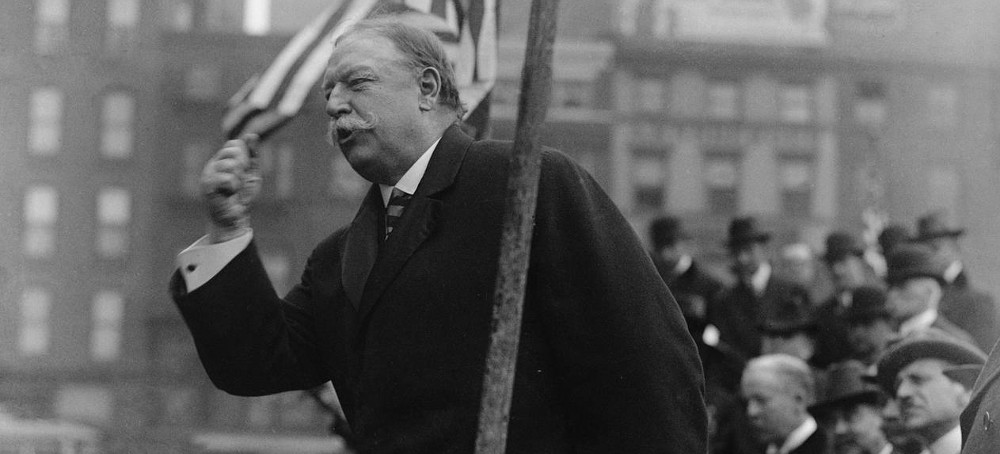 A new book by Robert C. Post details denunciations, dissents, proposals, and power plays from an era previously lost to obscurity. (photo: Bettmann Archive)
A hundred years ago, Chief Justice William Howard Taft made the Court more efficient and more powerful. His interventions marked a turning point whose effects are still being felt.
William Howard Taft is the only Chief Justice of the United States to have served as its President. If he cannot be said to have had the keenest legal mind, he had the strong and steady arm of an experienced executive. He ran the Court for only nine years, but during that time he ushered in sweeping reforms, changing not only how many cases the Court hears but also where it operates, elevating its power, its prestige, and, not least, its mystique. Originally, the Supreme Court heard essentially every case that reached its chambers; it had little choice. “Questions may occur which we would gladly avoid; but we cannot avoid them,” John Marshall, the longest-serving Chief Justice, wrote in 1821. A century later, in a country whose population had grown tenfold, the Court, still obliged to hear most cases brought before it, was overwhelmed by its backlog. Taft convened a committee that he charged with drafting legislation that would rationalize the Court’s docket. In what became known as the Judges’ Bill, the Justices proposed the certiorari system, by which they would, in most areas of law, be able to exercise their discretion to choose which cases they deemed worthy of their attention. Taft went before the House Judiciary Committee to explain the importance of “letting the Supreme Court decide what was important and what was unimportant.” Congress passed the bill in 1925. “Easily one-half of certiorari applications now presented have no justification at all,” Taft reported in the Yale Law Journal nine months later.
The executive branch had the White House and the legislature the Capitol, but the Court had no home of its own and had long met in a cramped room, the old Senate chamber. Taft persuaded Congress to authorize funds for the construction of a building for the Court alone, befitting the status of the judiciary. Taft himself chose the seven-acre site. The new building was touted as having more marble than any structure in the world, an austere and imposing monument to the rule of law. It looks like a Grecian temple, restored.
Taft, in short, got things done. In May, 1929, when Holmes’s wife died, Taft wrote to his son, “I have had really to take charge of the funeral arrangements, because Holmes can not attend to anything of that sort with any comfort.” But Taft also had the good sense to know that Holmes, however distraught, wasn’t helpless, and that what he needed most was something to do. He’d already assigned Holmes at least one opinion that term, but Taft told his son, “I don’t know but I shall give him another one before the month ends.”
In an age of efficiency, Taft made the Supreme Court more efficient, and mightier, but it remains the most secretive branch of the federal government. When it grants or denies cert, it offers no explanation; it simply follows a “rule of four”—if at least four Justices want to hear the case, the Court takes it. This past December, the special counsel Jack Smith asked the Court to grant cert in a case concerning the question of whether Donald Trump, as a former President, is immune from prosecution for actions undertaken during his Presidency. In January, Trump asked the Court to grant cert to hear an appeal of a decision by the Colorado Supreme Court which banned him from the Republican primary ballot. The Court said no to the first, for now, and yes to the second. No word or hint as to its motivations is ever offered. Supreme Court deliberations are held behind closed doors. Its sessions are not broadcast. The Justices are expected to avoid the glare of public attention. They don’t campaign, or at least they’re not supposed to. They don’t write tell-alls. No law requires them to preserve their papers or, if they do preserve them, to make them available to the public. So tight-lipped is the Court that, in 2022, when someone leaked a draft of the Court’s decision in Dobbs v. Jackson Women’s Health Organization, an internal investigation was unable to identify the leaker. The Supreme Court is at once the most closely scrutinized branch of the federal government and the least. It makes its own rules, like the Code of Conduct it released last fall, and, in a sense, it also writes its own history: the accumulation of its opinions. Most other accounts of the Court’s history are written by lawyers, a litany of cases with the occasional vivid portrait of a Justice or, less often, a litigant. Much that lies within the Court’s history remains unknown, partly because it’s never been known outside the Justices’ chambers, and partly because even what’s known is quite often entirely forgotten. The law writes over itself, like an old floppy disk.
“Taft’s presidential perspective forever changed both the role of the chief justice and the institution of the Court,” Robert C. Post argues in his landmark two-volume study, “The Taft Court: Making Law for a Divided Nation, 1921-1930” (Cambridge). The book is an attempt to rescue the Taft years from oblivion, since, as Post points out, most of its jurisprudence had been “utterly effaced” within a decade of Taft’s death, and was soon engulfed by “an obscurity so deep that most law students cannot now name more than ten Taft Court decisions.” But, if Marshall’s Chief Justiceship established what the Court would be in the nineteenth century, Taft’s established what it would be in the twentieth, and even the twenty-first.
William Howard Taft was a lawyer and a judge before he became President, and he was a lawyer and a judge after he was President. He was born in Ohio in 1857, the year the Supreme Court decided Dred Scott, and went to Yale before studying at the Cincinnati Law School. He’d served three years on Ohio’s superior court when, in 1890, he became the youngest ever U.S. Solicitor General. He argued eighteen cases before the Supreme Court, and won fifteen. In 1892, he was appointed as a federal judge for the Sixth Circuit. While serving as governor of the Philippines, he was twice offered a position on the Supreme Court; he declined both times. Elected President in 1908, he failed to win reëlection in 1912, after which he joined the faculty of Yale Law School. His best-known academic work is a series of lectures published, in 1916, as “Our Chief Magistrate and His Powers,” a critique of the Presidencies of Theodore Roosevelt and Woodrow Wilson masquerading as what Taft described as a “careful study from an unbiased standpoint of the historian and the jurist.”
Taft had long wanted to restructure the federal judiciary, and he was also keen to defend the Constitution from what he considered to be the excesses of Progressivism. In 1913, when Charles Beard published “An Economic Interpretation of the Constitution of the United States,” arguing that the Framers had, in 1787, crafted a system of government designed to protect their own property interests, Taft denounced this interpretation as both preposterous and dangerous. And when Wilson nominated the nation’s leading Progressive lawyer, Louis Brandeis, to the Court, in 1916, Taft vigorously opposed the nomination. “It is one of the deepest wounds that I have had as an American and a lover of the Constitution and a believer in progressive conservatism, that such a man as Brandeis could be put on the Court,” Taft wrote, calling Brandeis a muckraker, a hypocrite, and a socialist. He solicited the signatures of six other former presidents of the American Bar Association for a letter that he wrote opposing Brandeis’s nomination. (Much of the objection to Brandeis was antisemitic; much was political.) “I think as ill of WHT’s morals now as of his intellect,” Brandeis wrote to his wife in 1910. Privately, Brandeis referred to the walrus-mustached Taft, who tipped the scales at about three hundred pounds, as “the fat man.”
In 1921, Taft delightedly accepted an invitation from Warren G. Harding to serve as Chief Justice. He joined a Court that, beginning with its decision in Lochner v. New York, in 1905, had struck down as unconstitutional state and federal laws regulating labor. Most notoriously, from the vantage of Progressives, the Court had, in 1918, declared an act of Congress that regulated child labor unconstitutional. Taft, seated in 1921, navigated by these same stars. On May 15, 1922, in Bailey v. Drexel Furniture Co., the Court issued Taft’s majority opinion, striking down a federal law that had attempted to restrict child labor through a punitive tax. Weeks later, in a speech before the American Federation of Labor, the Wisconsin senator Robert La Follette, decrying what he called “judicial oligarchy,” proposed a constitutional amendment that would grant Congress the right to nullify Supreme Court opinions. La Follette had campaigned against Taft’s bid for reëlection in 1912, and had voted against his confirmation to the Court. He was also a close friend of Louis Brandeis’s. The Court had repeatedly defied the will of the people, expressed through state legislatures and through congressional action, La Follette said. “We should not have to amend the Constitution every time we want to pass progressive laws,” he argued.
Progressives called for all manner of remedies, including a child-labor amendment and an amendment that would require Justices to be elected and to hold office for ten-year terms. The Idaho senator William Borah, pointing out that roughly forty “exceedingly important” cases had been decided by a 5–4 majority in the last thirty years, proposed that any decisions that would overturn an act of Congress ought to require a seven-Justice majority. Taft was distressed, but confident. “Meantime,” he wrote to a fellow-Justice, “there is nothing for the Court to do but to go on about its business, exercise the jurisdiction it has, and not be frightened because of threats against its existence.”
The historian Charles Warren came to the Court’s defense. “There is no novelty in these attacks,” Warren declared of the criticisms advanced by men like La Follette and Borah, insisting that “no functioning body under our Government has been more subjected to continuous assault than the Supreme Court.” Warren, a former Assistant U.S. Attorney General who had co-founded the Immigration Restriction League—and a Boston Brahmin who was so dedicated to Harvard that he was rarely seen without a crimson bow tie—agreed with Taft’s denunciation of Charles Beard’s interpretation of the Framers. “Young men must be taught that America is much more than the result of class interests and sectional influences,” Warren maintained. “They must learn that the men who made America had aspirations and beliefs apart from their personal fortunes.” In 1922, he published a three-volume book called “The Supreme Court in United States History.” “No one can read the history of the Court’s career without marveling at its potent effect upon the political development of the Nation, and without concluding that the Nation owes most of its strength to the determination of the Judges to maintain the National supremacy,” he argued. In 1923, the book won the Pulitzer Prize.
Every history of the Supreme Court takes a position on the nature of its authority. Warren’s work not only placed the Court at the center of American history but also defended it against Progressive critics. “The Taft Court” is a search for the origins of the Court’s current divisions. Post, a professor of constitutional law who has a Ph.D. in American Civilization and is a former dean of Yale Law School, argues that the Taft Court wrestled with four different ways of interpreting the Constitution and exercising judicial review. The most conservative theory granted the Court authority to overrule legislation in order to make sure the law accorded with custom and tradition. Holmes’s intellectual commitments limited judicial review to cases where it was required by “the literal meaning and plain intent of a constitutional text”: “The justification of a law for us cannot be found in the fact that our fathers have always followed it,” he wrote. “It must be found in some help which the law brings toward reaching a social end which the governing power of the community has made up its mind that it wants.” Taft’s rule for whether a law could be declared unconstitutional had to do with his equation of progress with the accumulation of wealth—property and contracts had to be protected at all costs. The fourth theory was the most progressive and, in the nineteen-twenties, advanced only by Brandeis, who, as Post puts it, “held that the purpose of the American Constitution is to create a successful democracy.” This appears to be Post’s position, too.
Rich with close readings of cases that rely on sources scarcely ever used before—including docket books only recently discovered in a locked trunk—and benefitting from deep and fruitful quantitative analysis absent in most studies of the Court, “The Taft Court” restores the nineteen-twenties as a turning point in the Court’s history, the hinge between laissez-faire conservatism and the duel between the Court and the New Deal in the nineteen-thirties. The luminaries on Taft’s court were Holmes and Brandeis. Holmes described Taft’s opinions—between 1921 and 1928, there were two hundred and forty-nine of them, compared with two hundred and five by Holmes and a hundred and ninety-three by Brandeis—as “rather spongy.” Brandeis, with a nod to the abolitionist Wendell Phillips’s description of Abraham Lincoln (a “first-rate second-rate man”), said that Taft had “a first-rate second-rate mind.” But Taft’s opinions were the Court’s opinions. Post reports that Taft “authored or joined the opinion for the Court in 98.7 percent of its decisions.”
Taft ran an amiable bench. Once he’d joined the Court, he took the initiative of forging a peace, and even a friendship, with Brandeis. “I’ve come to like Brandeis very much indeed,” he wrote to his daughter, and Brandeis, for his part, was charmed. That didn’t mean they agreed. Post’s data reveals that, with one exception, Brandeis was the least likely member of the Court to agree with the majority, his dissents nearly always informed by his commitment to democracy over prosperity.
Taft spoke for the majority, Holmes and Brandeis for the minority. “If Holmes’ dissents in constitutional cases had been followed,” Taft wrote to his brother, “we should have no Constitution.” Holmes was a better writer than Taft; one measure of this is that he was briefer. Taft’s opinions averaged nearly nine pages, Holmes’s just over three. (“Strike the jugular and let the rest go,” Holmes said.) In May of 1929, right after his wife died, Holmes wrote one of his most blistering dissents. The majority had ruled in favor of denying citizenship to a Hungarian-born pacifist and feminist named Rosika Schwimmer, deeming her insufficiently “attached to the principles of the Constitution” to be naturalized. Holmes wrote, “If there is any principle of the Constitution that more imperatively calls for attachment than any other, it is the principle of free thought—not free thought for those who agree with us, but freedom for the thought that we hate.” Amen.
Post’s analysis—along with his amazing data—reveals the depth of Taft’s disagreements with Holmes. It also captures the distance between Holmes and Brandeis. Holmes “approved progressive legislation only because he believed that a judge should defer to legislative judgments,” Post writes, but Brandeis advocated for economic reform in the interest of social justice. “He bullies me a little on that from time to time,” Holmes once said. Post is subtle on this distinction. “Holmes never developed any comparable concept of the public good,” he writes, contrasting him with Brandeis. “Holmes sought only to channel social contestation by subjecting it to orderly processes of law.”
Taft tried to rein Brandeis in. “Our Constitution is not a strait-jacket,” Brandeis wrote in the draft of a dissent in United States v. Moreland, in which he was joined by Holmes. “It is a living organism. As such it is capable of growth—of expansion and of adaption to new conditions. Growth implies changes political, economic and social. Growth which is significant manifests itself rather in intellectual and moral conceptions than in material things. Because our Constitution possesses this quality of adaption, it has endured as the fundamental law of an ever developing people.” Taft asked him to take these sentences out because “they are certain to be used to support views that I could not subscribe to.” To secure the Chief Justice’s concurrence in his opinion, Brandeis omitted them, with regret.
This was exceptional; Taft hated dissents and, Post reports, “himself dissented less than any chief justice except John Marshall.” In 1924, when La Follette ran for President on a Progressive ticket whose platform included Supreme Court nullification, the Chief Justice wrote wryly to a friend that the Wisconsin senator “could find a good deal of material in Brandeis’s dissenting opinions.” And, as Post suggests, the attacks on the Taft Court likely contributed to a diminishing number of dissents in the first half of the decade.
Taft led the Court to the right, especially after La Follette lost his bid for the Presidency. “Taft allowed conservatives on the Court to overplay their hand,” Post concludes. “The result was an ever-growing if unexpressed anger at the Court’s increasingly aggressive conservative agenda. There would eventually be the devil to pay for such overreaching decisions.” But that devil would come dunning in the nineteen-thirties, during the battles between New Dealers and the Court led by Charles Evans Hughes. On May 27, 1935, in one of its last sessions in the old Senate chamber, the Hughes Court struck down the most important elements of the New Deal in three unanimous decisions that F.D.R. described as the most fateful decisions the Court had made since Dred Scott. When the Court moved into its new building—a building so ostentatiously self-important, down to the last trimmings, that reporters likened it to an icebox decorated by a mad upholsterer—the Justices struck down more than a dozen laws in eighteen months. F.D.R., pledging “to save the Constitution from the Court, and the Court from itself,” proposed enlarging the Court by naming one new Justice for every sitting Justice older than seventy, which described six of them, including the Chief.
It’s hard to say quite how much responsibility Taft bears for the Court crisis of the thirties. The Hughes Court was in crucial ways a product of the Taft Court, and especially of Taft himself: Taft, as President, had appointed Hughes to the Court, in 1910; Hughes had resigned in 1916, to run for President, but Taft urged Herbert Hoover to name Hughes as the new Chief Justice. If Taft hadn’t seized so much power for the Court in the twenties, it would have had less to exert in the thirties. And the Taft years also focussed public attention on the age and diminishing capacity of the Justices. Taft, never in good health, had a heart attack in 1924 and another one in 1926. In 1927, the year he turned seventy, he confided to his daughter, “My mental faculties are dulling a bit.” Less able to think independently, he deferred to the more conservative Justices on the Court, Willis Van Devanter and Pierce Butler. Very precipitously, Taft slipped into dementia. “The truth is that Taft for some time had really lost his grip,” Brandeis wrote to a friend and colleague. “The fear was entertained that unless he resigned at once he might lapse into a mental condition which would make it impossible for him to resign and in which he might continue for an indefinite period,” Hughes wrote; he was nominated for Chief Justice on the very day that Taft resigned. The former Chief died only weeks later, on March 8, 1930, on Holmes’s eighty-ninth birthday. Weirdly, another Justice on the Taft Court, Edward Sanford, only sixty-four, collapsed and died that same day. “Such events,” Holmes said, “must be accepted in silent awe.”
“The Taft Court” exists because of a decision that Holmes made near the end of his life. On March 8, 1931, on his ninetieth birthday, he spoke on the radio for the first and only time. Talking into a microphone on the desk in the study of his red brick house in Washington, D.C., he coughed and then proceeded slowly and precisely. “To express one’s feelings, as the end draws near, is too intimate a task,” he began, sounding something like John Barrymore if Barrymore were playing King Lear. Rosika Schwimmer sent him a telegram wishing him a happy birthday. (After the Court’s decision in U.S. v. Schwimmer, she’d written to thank him for restoring her faith in “the inherent idealism” of the nation to which she’d hoped to belong, and they’d struck up a friendship.) Not long after that birthday, Holmes retired. He remains the oldest person ever to sit on the U.S. Supreme Court. Schwimmer visited him and sent him a copy of Erich Kästner’s best-selling mystery “Emil and the Detectives.” Holmes loved mystery novels. “This fellow is the best of them all,” he wrote on his copy of a Nero Wolfe mystery, by Rex Stout. Asked whether he’d read any Supreme Court decisions lately, he said, “Not a damn one.”
Meanwhile, Holmes wrote a new will. He had no heirs, and, although he bequeathed small gifts here and there, he left about half of his considerable estate—some two hundred and sixty thousand dollars, or nearly six million dollars today—to a single beneficiary, the United States, in what was the largest unrestricted gift ever made to the federal government. Holmes died of pneumonia in 1935, two days before his ninety-fourth birthday. F.D.R. called on Congress to assign the bequest to “some purpose worthy of the great man who gave it.” It took twenty years, but eventually a congressionally appointed Oliver Wendell Holmes Devise committee determined that the money should be used to prepare a definitive history of the Supreme Court. Robert Post’s book on the Taft Court is the last of the originally planned volumes to be published. Writing the Holmes Devise History of the Supreme Court of the United States has taken nearly a century.
“History sets us free,” Holmes once wrote. One day, if the Holmes Devise committee assigns scholars to write volumes on the Rehnquist and Roberts Courts, they’ll have to examine those Courts’ inventions of some brand-new theories about the relationship between history and the law, a text-history-and-tradition test that is far more reactionary than any custom-and-tradition notion used by the conservatives on the Taft Court. “It is revolting to have no better reason for a rule of law than that so it was laid down in the time of Henry IV,” Holmes wrote. “It is still more revolting if the grounds upon which it was laid down have vanished long since and the rule simply persists through blind imitation of the past.” History in the guise of originalism is a tyrant.
In February of 1930, during Taft’s last illness, the Justices sent him a letter of thanks, composed by Holmes. “We call you Chief still,” Holmes wrote, expressing affection for the man by way of his title. “We can not let you leave us without trying to tell you how dear you have made it.” Taft almost certainly never read it. He was already gone.