The Amazon’s Invisible Crisis
Ludmila Quirós Nacla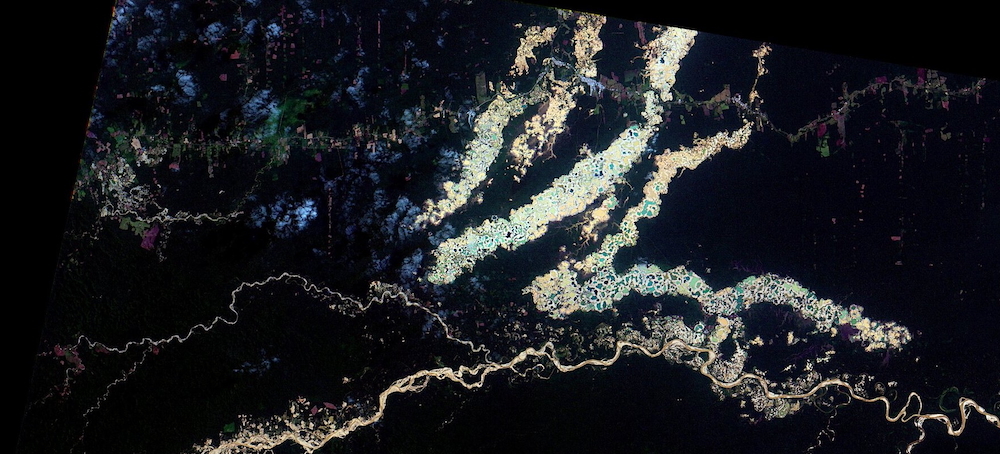 Illegal gold mining in the Amazon in Madre de Dios, Peru / Large-scale illegal gold mining in the southern Peruvian Amazon, in Madre de Dios. (photo: Coordenação-Geral de Observação da Terra/INPE)
As environmental crimes threaten Indigenous communities in the Amazon, their struggles are ignored by a humanitarian system that has rendered such emergencies invisible.
Drug trafficking in the Amazon does not operate in isolation. It coexists with environmental crimes, which act as complementary criminal economies. In Oxapampa, Paloma’s community has not yet seen environmental mafias exploiting natural resources on their land, but they can clearly see the effects of their presence in the neighboring communities of Puerto Inca and the Oxapampa-Asháninka-Yanesha Biosphere Reserve. These areas are already being affected by illegal logging and land use change by groups presumably linked to drug trafficking.
Land use change is one of the most important drivers of deforestation in the Peruvian Amazon, explained Rosa Barrios, an environmental lawyer from the Global Initiative Against Transnational Organized Crime (GI-TOC). Such deforestation is caused by various factors, which range from land leasing and subsequent invasion to illicit coca crops and illegal gold mining.
The convergence between conventional organized crime and transnational environmental crimes (TECs) is one of the main threats to environmental and human security in South America. Many criminal networks use environmental crimes to cover up other illegal activities. For example, they often use them to launder money obtained from drug trafficking. In this sense, the environmental damage caused by organized crime is proportional to the massive sums of money that environmental exploitation promotes. This situation also has a high humanitarian cost that currently lacks legal recognition at both national and international levels: forced displacement caused by TECs.
Transnational Environmental Crimes: A Threat to Human Life
TECs in the Amazon represent a direct threat to the life, health, security, and survival of the indigenous and riverside communities that inhabit the region. In Amazonian municipalities, illicit economies linked to illegal gold mining, illegal logging, land grabbing, and drug trafficking are the main drivers of criminal violence.
It is estimated that some 17 armed groups and transnational criminal networks—including Brazil’s Comando Vermelho and Primeiro Comando da Capital and Colombia’s Revolutionary Armed Forces of Colombia (FARC) dissidents, and the National Liberation Army (ELN)—keep native and peasant populations subjected to fierce illicit orders based on extortion and death. Additionally, a 2025 Amazon Underworld report suggested that armed groups and criminal networks in at least 67 percent of Amazonian municipalities in Bolivia, Brazil, Colombia, Ecuador, Peru, and Venezuela are dismantling the resources of the Amazon basin.
In Peru, the situation in areas such as Madre de Dios, Pataz, Loreto, and Cajamarca has all the components of a silent ethnic cleansing, characterized by the extermination of indigenous leaders who protect ancestral lands. Between 2019 and 2024, around 44 environmental leaders were murdered in the Amazon region.
However, for many indigenous communities, illicit extractivist economies are also a way to survive. César Ipenza, a Peruvian lawyer and expert in environmental matters, explained the situation: “It has become more common for indigenous and peasant populations to be part of illegal activities, providing security for illicit activities,” he explained. “This happens, for example, in Puerto Inca, where the Asháninka population facilitates illegal mining and charges a percentage to illegal miners. The same has been happening in Madre de Dios… when the authorities come, it is the indigenous people themselves who come out to defend the illegal miners.”
In the Venezuelan Amazon, the scenario is also critical. A report by local NGO FundaRedes stated the region is experiencing an unprecedented humanitarian crisis, characterized by dispossession, displacement, food crisis, and health issues caused by mercury contamination from illegal mining. According to the report, indigenous people are constantly forced to choose between “joining illegal armed groups or being displaced.”
Global North Demands Fuel the Silent Humanitarian Crisis in the Amazon
The Trump administration’s cut to U.S. aid programs—particularly those that funded biodiversity conservation and environmental protection programs—has generated concern among assistance recipients because the lack of aid fuels organized crime groups. “The withdrawal of cooperation from other countries or sectors has led to a level of greater vulnerability that is not being assumed by other countries,” said Ipenza.
In this context, high demand for raw materials and natural resources from the Global North strengthens the proliferation of parallel markets. The cuts to environmental programs are a blank check for the management of the Amazon basin’s natural resources by criminal organizations. In fact, luxury industries that feed the demand of rising middle classes are one of the factors aggravating the environmental and humanitarian crisis. A January 2026 investigation by the Environmental Investigation Agency (EIA) revealed that EU and U.S. companies use wood from protected species for high-profile projects, like hotels, VIP stands, and luxury properties.
It is a vicious cycle: luxury brands must satisfy the aspirational consumption of the “new rich,” and to do so, they rely on the lack of traceability in illicit markets to obtain the raw materials at lower costs. In turn, these opaque supply chains perpetuate massive deforestation, transnational organized crime, and violations of indigenous rights in the Amazon.
A 20th-Century Humanitarian System for 21st-Century Threats
As a result of the demand for natural resources and the expansion of armed groups in the Amazon basin, Indigenous communities have been caught in the crosshairs, and little has been done to help them. In South America, transnational environmental crimes are not recognized as a direct legal cause of forced displacement or humanitarian crisis. Broadly speaking, the region’s environmental regulatory framework is divided into environmental law, which focuses on ecosystems, and refugee law, which does not include environmental causes for displacement. The result of this current system is that people displaced by environmental damage—including that caused by organized environmental crimes—fall into legal limbo.
Under the current humanitarian system, millions of people remain without protection because funding is geopolitically oriented, and only large-scale armed conflicts or natural disasters are recognized as emergencies. In cases of criminal violence, like those occurring in the Amazon, these mechanisms are rarely activated or are too late. Moreover, when criminal violence is the cause of destabilization, local authorities do not apply a humanitarian approach but a securitized one. Thus, the combination of militarization and organized crime-related violence reduces space for humanitarian action and complicates efforts to ensure the protection of vulnerable populations.
Despite the current humanitarian system having multiple limitations, we do not need to dismantle it but to transform it. The humanitarian system requires an honest paradigm shift. To do this, it is necessary to recognize that the current model of state security has changed and threats coming from non-state actors who operate in the gray areas are increasing.
In this scenario, thinking about a new humanitarian paradigm implies expanding the concept of crisis and creating new legal categories that would allow for the recognition of hybrid situations that combine drug trafficking, deforestation, and illegal mining with armed violence. This also means updating regional frameworks, explicitly incorporating organized crime, illegal economies, and environmental destruction as causes of displacement, forcing governments to modify the definition of refugee at the international level.
Some countries, like Colombia, have sought to address this. The 2025 approval of the law on internal forced displacement due to causes associated with climate change and environmental degradation has become a regional milestone. The law not only introduces the term “environmental degradation” as a factor for displacement, but it also opens the door for interpreting it to encompass illegal economies as an international protection factor.
At a regional level, changing the humanitarian system would be possible through the Cartagena Declaration (1984) and the Escazú Agreement (2018). The former expands the definition of a refugee to situations that “seriously disturb public order,” which, for some jurists, applies to illegal economies—when they cause social collapse or widespread violence. In the second case, the Escazú Agreement set a precedent regarding the possibility of considering the vulnerability of Amazonian environmental leaders as a cause for legal protection.
At the international level, the network of agencies that support the Global Humanitarian System also does not include transnational environmental crimes as a cause of humanitarian crises. In this regard, Alpaslan Özerdem, dean of the Jimmy and Rosalynn Carter School for Peace and Conflict Resolution, defined the drivers triggering humanitarian crises as “a complex network of interrelated causes and factors, such as political violence, military aggression, natural hazards, climate change, terrorism, and the spread of infectious diseases.” However, in a global scenario like the current one, where the advance of transnational threats represents an ever-larger challenge for states. Relying exclusively on these parameters to define which threats can put human survival and security at risk is excessively simplistic. Therefore, redefining what a “humanitarian crisis” is from a more holistic perspective becomes mandatory.
Grassroots Initiatives Fill Humanitarian Gaps
In recent years, the limitations of international humanitarian mechanisms in responding to lower-intensity crises have created space for new actors operating outside traditional channels and with far more localized approaches. While these new actors are rarely acknowledged—or do not present themselves—as “humanitarian” entities, they typically possess greater local legitimacy and contextual knowledge than international or external agencies.
In Peru, grassroots initiatives usually focus on preventing displacement through territorial defense and resistance to polluting projects. Some of the most relevant grassroots initiatives and organizations include Indigenous communities in the Amazon, such as Awajún, Wampis, Asháninka, and Shipibo-Konibo, which are organized into social and environmental defense groups. These communities conduct river monitoring against illegal mining in areas like the Cenepa River, Loreto, and Madre de Dios.
In areas like Cajamarca and the Peruvian Andes, peasant communities and rondas (autonomous peasant patrols) have been resisting extractive projects that contaminate water and generate forced displacement due to the loss of agriculture and livestock for decades. Women environmental defenders organized in the Amazon and the Andes are also key actors in this new paradigm of collective assistance. The Federation of Indigenous Women and collectives such as those promoted by FCDS-Peru (Foundation for Conservation and Sustainable Development) strengthen female leadership in territorial defense. They face criminalization from the state and threats from environmental mafias while protecting water resources and forests that, if degraded, force communities to abandon their land.
Other important initiatives include participatory environmental monitoring committees in mining areas such as Juprog, Orcopampa, or Mallay. These committees are grassroots initiatives supported by NGOs but managed by local communities to monitor pollution, document damage, and pressure for environmental compliance, avoiding or mitigating displacements due to irreversible degradation.
As a whole, these grassroots initiatives represent a new way of addressing human security in the Amazon regions, more adapted to the problems of the 21st century, where non-traditional transnational threats constitute the main source of vulnerability for local populations.