Texts, Emails Bolster Whistleblower Account of DOJ Defying Court Order
Perry Stein and Jeremy Roebuck The Washington Post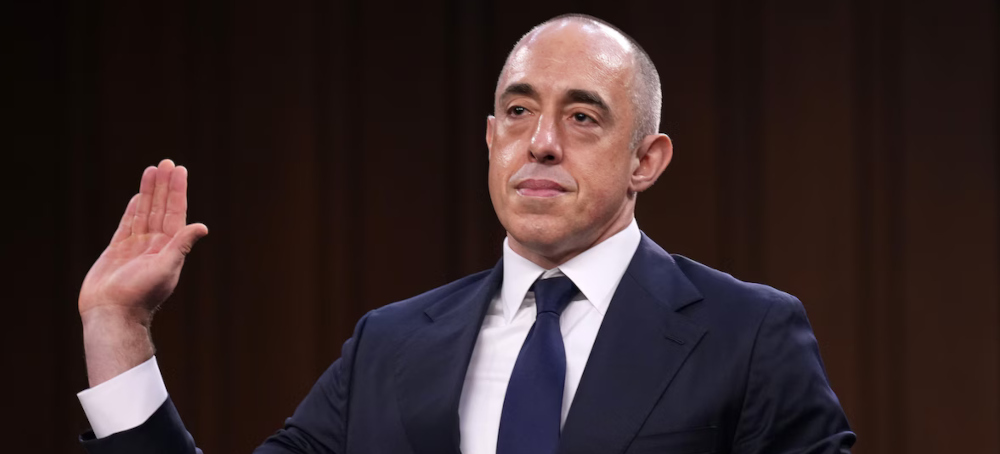 Emil Bove, President Donald Trump's nominee to be a judge on the U.S. Court of Appeals for the 3rd Circuit and Trump's former personal lawyer. (photo: Getty)
A fired Justice Department employee has given Congress a cache of internal communications related to Emil Bove, a top Trump official now nominated as a judge.
The messages provided by attorney Erez Reuveni show him repeatedly seeking assurances from Justice Department and Homeland Security officials that they would abide by a judge’s March 15 order to halt the in-progress deportation of about 130 Venezuelans to El Salvador under an obscure wartime law. According to the documentation, disclosed to the Senate Judiciary Committee after Reuveni filed a whistleblower complaint last month, officials rebuffed his requests with either vague or no responses and eventually concluded they did not need to comply.
The emails and text messages released Thursday reveal concern from some Justice Department officials that they may have violated the court’s order and that some people might be punished for their actions.
“It’s a question if drew gets out without a [court] sanction,” one of Reuveni’s colleagues texted him, referring to Drew Ensign, the Justice Department lawyer who had argued the case in court. “Jesus,” Reuveni replied.
Reuveni is a longtime Justice Department attorney who was suspended — and later fired — after he admitted in court that a man sent to a prison in El Salvador was deported in violation of a court order and said he did not know the legal basis for the expulsion.
In his whistleblower complaint, Reuveni described an incident in which a top Justice Department official, Emil Bove, used an expletive when he implied to a room full of department attorneys in March that they may need to ignore a judge’s order blocking the deportation flights to El Salvador.
Written messages from Bove, a former criminal defense lawyer for Trump whom the president has nominated for a federal judgeship, were not included in any of the files released Thursday. But the newly released texts show Reuveni referencing and discussing with a colleague what Bove allegedly told them at the meeting, stating that they may soon need to ignore a court order.
“Well, Pamela Jo Bondi is,” the colleague wrote back, naming the attorney general as the person who would be responsible for ignoring a judicial directive. “Not you.”
Democrats have amplified Reuveni’s whistleblower account to try to sink Bove’s nomination to the U.S. Court of Appeals for the 3rd Circuit, arguing that the Justice Department official is unethical and unqualified to be a judge with a lifetime appointment.
The Justice Department and Bove, who is the principal deputy assistant attorney general, have denied Reuveni’s account. The judge overseeing many of the relevant proceedings, Chief Judge James E. Boasberg in D.C., has chided Justice Department officials for their handling of the matter and found probable cause to initiate contempt proceedings to investigate whether administration officials willfully defied his orders.
“We support legitimate whistleblowers, but this disgruntled employee is not a whistleblower — he’s a leaker asserting false claims seeking five minutes of fame, conveniently timed just before a confirmation hearing and a committee vote,” Bondi posted on X on Thursday morning.
She insisted: “And no one was ever asked to defy a court order.”
At his nomination hearing last month, Bove frustrated Democratic lawmakers by refusing to answer many of their questions and was buoyed by support from Republicans who said criticism of him was unfounded. An initial committee vote on his nomination is expected next week.
“Senators raised these allegations at Emil Bove’s judicial nomination hearing, and he offered only carefully wordsmithed responses,” Sen. Dick Durbin (D-Illinois), the top Democrat on the Senate Judiciary Committee, said in a statement Thursday. “So, I asked for documentation from Mr. Reuveni to further substantiate his claims. That’s what I’m releasing to the public today.”
The emails and texts, collected by Reuveni over weeks, offered a behind-the-scenes look into the internal communications and frictions among officials at the Justice, Homeland Security and State departments in some of the Trump administration’s most explosive confrontations with the courts over the president’s immigration agenda. They also suggest Bove played a key role in shaping the Justice Department’s controversial legal strategies.
In one of the newly disclosed emails, Yaakov Roth, then the acting head of the Justice Department’s Civil pision, told Reuveni and others that the administration had decided to proceed with the March 15 deportations anyway because Boasberg’s order to turn the planes around was initially issued orally, from the bench.
By the time the judge filed a written order, the planes had already left U.S. airspace. Bove, Roth said, had concluded that because of that timing, it “was permissible under the law and the court’s order” to continue with the deportations.
As the legal fight continued over the next several days, Reuveni again texted his supervisor, August Flentje.
“At this point why don’t we just submit an emoji of a middle finger as our filing,” he wrote on March 19.
Flentje responded: “So stupid.”
Other documents included in the release Thursday reveal friction between Reuveni and counterparts at the Department of Homeland Security on how to handle the legal fallout over the government’s mistaken deportation of Kilmar Abrego García, the Maryland man sent to a megaprison in El Salvador on one of those March 15 flights. Reuveni initially told a federal judge in Maryland that Abrego’s deportation had been an “administrative error” — an in-court assertion that ultimately led his superiors to suspend and fire him.
But emails before that hearing showed at least some administration officials had acknowledged the mistake. In fact, State Department staffers had expressed openness in their communications to begin negotiations to return Abrego to the United States. A top official at the Department of Homeland Security resisted, pushing instead for the government to tell the judge that Abrego was a dangerous gang member who should not be returned.
“Can we say the following?” James Percival, a senior counselor to DHS Secretary Kristi L. Noem, wrote in a March 31 email to several officials, including Reuveni, listing reasons a court order requiring Abrego’s return to the U.S. would be improper. Among them was the claim: “This guy is a leader of MS-13.”
Administration officials have repeatedly trumpeted that assertion in public statements in the months since Abrego’s removal — and the eventual decision last month to bring him back to the United States to face newly filed human smuggling charges. But Reuveni responded at the time that they could only say in court that Abrego held a leadership position if U.S. Immigration and Customs Enforcement officials were able to provide a sworn statement based on evidence to that effect.
One ICE staffer, whose name was redacted in the email exchange released Wednesday, ultimately concluded that the best evidence they were able to uncover — a 2019 Prince George’s County police report they obtained weeks after Abrego’s removal — suggested that he was not a leader and was at best a “verified member” of MS-13. “But I’ll keep looking,” the staffer added.
In another exchange, concerning an order from a federal judge in Boston limiting the administration’s effort to deport immigrants to places other than their native countries, Justice Department officials pressed Percival to clarify DHS’s view of that decision to ensure both departments could present a united argument in court on whether the administration had deported people in violation of the ruling.
Percival rebuffed those requests. “My take on these emails is that DOJ leadership and DOJ litigators don’t agree on the strategy. Please keep DHS out of it,” he wrote in a March 29 email. He added in a separate message later that day: “Figure out what DOJ’s position is and get back to us. DHS has one position from the top of the agency to the bottom. DOJ needs to do the same.”
As Reuveni pushed for further clarity, Percival responded: “Ask your leadership. Holy crap, guys.”
In an April 1 email to a colleague, Reuveni lamented: “Neither DHS nor DOJ leadership is willing to answer any of these questions right now. I am getting nowhere with anyone. Leadership appears committed on not answering anything until ordered to do so.”
Later that evening, Reuveni told his supervisor via text that he had received word that Bove was unhappy with his continued efforts to press for more information on the apparent violation of the court’s order in writing.
“Got a nastygram from Emil Bove,” Reuveni wrote in the text. Flentje, his boss, responded: “Uh oh.”
Within four days, both men had been suspended by the Justice Department leaders.