Texas Moves to Allow Anyone to Sue Abortion Pill Prescribers, Distributors
Praveena Somasundaram The Washington Post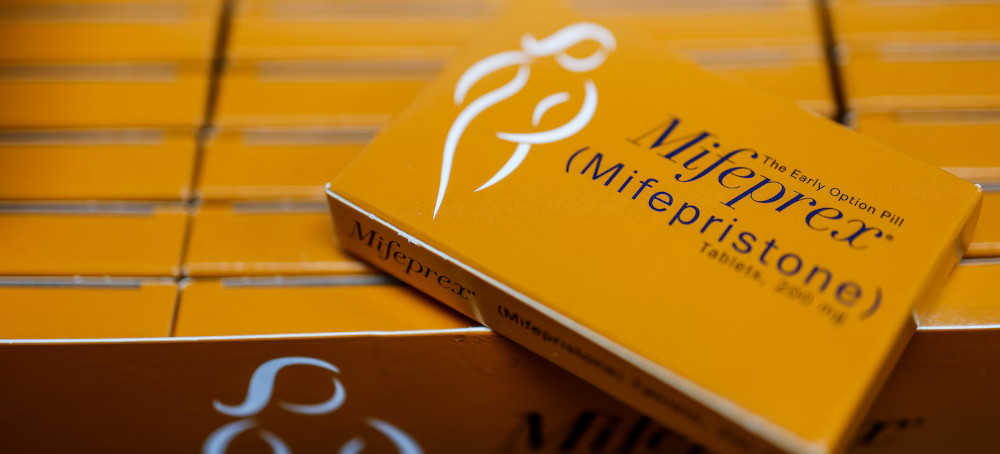 Packages of mifepristone tablets at a family planning clinic in Rockville, Maryland, in 2023. (photo: Anna Moneymaker/Getty)
The measure aims to stop the flow of pills into Texas from blue states. It could open package-delivery services up to fines, along with doctors and drug-distribution firms.
The bill, backed by antiabortion activists and passed in the state Senate on Wednesday, allows private citizens to sue companies and individuals who manufacture or distribute abortion pills to patients in Texas. Winning plaintiffs would get a minimum of $100,000 in damages.
Gov. Greg Abbott (R) is expected to sign the legislation into law. Abbott included the bill on the agenda for the state’s two special sessions this summer, which have been largely dedicated to redistricting and the July floods.
It’s Texas’s latest attempt to curb the increasing popularity and availability of medication abortion, even in states that ban or severely restrict the procedure. In eight Democratic-led states, abortion providers can prescribe and mail the pills — typically a two-step drug regimen — to patients across the country under “shield” laws designed to give them legal cover from out-of-state prosecution.
John Seago, president of Texas Right to Life, an antiabortion group that spearheaded the legislation, said it was written “aggressively” to stop what he called the “trafficking” of the abortion drugs into Texas under shield laws.
“That’s really what we’re trying to get at — to create better tools to respond to this open defiance and very dangerous practice of mailing abortion pills,” Seago said.
Since the Supreme Court overturned Roe v. Wade and the constitutional right to an abortion three years ago, women seeking to end pregnancies have increasingly used pills to do so. Texas has emerged as a testbed of new legislation and legal strategies seeking to thwart abortion pill access.
With the new measure, conservatives hope to build a legal framework to bulwark Texas against out-of-state abortion providers — an effort that has been slow-moving so far. It stipulates that shield laws cannot be used as a defense in the lawsuits filed under it. But winning plaintiffs may still be unable to collect damages from defendants in states with shield laws, if officials there refuse to file judgments. Those clashes, if they arise, would test whether and how far Texas will be able to influence the interstate abortion pill mailing network.
Conservative lawyers in Texas and the state’s Attorney General Ken Paxton have already sued abortion providers in states with shield laws — but to no avail thus far. That legal fight is expected to land before the Supreme Court.
Texas already allows private citizens to sue anyone who helps facilitate an abortion after cardiac activity is detected in a fetus, but the newly passed measure would broaden who can be sued, regardless of whether a woman actually took or attempted to take abortion pills. Companies that are involved in mailing or delivering abortion pills could be sued. So could parents in the state who obtain or ask about obtaining the medication for their child.
It includes exceptions that mirror existing Texas law, including when abortion pills are used for medical emergencies and ectopic pregnancies, in which the embryo implants outside the uterus.
Abortion advocates have sounded the alarm about the bill, saying it deputizes private citizens as “bounty hunters” to snitch on anyone who helps women wanting to end their pregnancies via abortion pills. The measure does not allow for lawsuits against women for obtaining or using abortion pills.
Texas Sen. Carol Alvarado, a Democrat who spoke against the bill Wednesday, described it as a mode of “surveillance.”
“This bill only works if we turn Texans against each other,” Alvarado said. “Imagine living in fear of the man behind you at the pharmacy, of the delivery driver, even of your own relatives. Every word, every prescription, every private conversation could be twisted into evidence.”
Blair Wallace, policy and advocacy strategist on reproductive freedom at the ACLU of Texas, said the bill incentivizes “neighbors to police one another’s reproductive lives, further isolating pregnant Texans, and punishing the people who care for them.”
It took months for the legislation, which failed in regular session, to overcome opposition — some of which came from within the antiabortion movement.
Some members of the movement worried that it did not do enough to protect the privacy of pregnant women during potential legal cases. They also wanted to draw boundaries that excluded certain people, such as abusers and those with family violence convictions, from being allowed to bring lawsuits.
Antiabortion groups negotiated significantly to close those loopholes ahead of the bill’s passage.
In its wording now, only a woman who is pregnant when she receives abortion pills or certain close family members can receive full damages. Other people who sue can only receive $10,000, and the measure stipulates that the remainder be given to charity. The policy also says a woman cannot be compelled to give testimony in a case, unless she consents.
Those changes won over some groups, including the Texas Alliance for Life, that initially opposed.
The latest version is a “strong tool against illegal abortion by mail that also safeguards women and reflects Texas’s commitment to both protecting unborn children and providing compassionate care for their mothers,” said Amy O’Donnell, a Texas Alliance for Life spokesperson.
If enacted, the legislation would mark the latest victory in a manifold approach to stifle access that Texas abortion opponents hope other states will adopt.
The state has been at the center of multiple lawsuits against providers accused of prescribing abortion pills from other states. They include a civil case against a New York doctor, the same one who was criminally indicted in Louisiana. But so far, New York officials have not extradited or otherwise punished the doctor, Margaret Carpenter, citing the state’s shield law and vexing abortion opponents.
In late July, Paxton joined 15 other Republican attorneys general who wrote to Congress, asking the body to figure out the “problem” of shield laws, which they said were preventing them from properly enforcing their abortion bans. Weeks later, Paxton also mailed cease-and-desist letters to one California doctor and two out-of-state abortion pill providers, threatening to sue them if they do not stop sending the drugs to Texas.
The most significant attack on the national level came in July, when Trump signed his massive tax bill, which included a measure that cut off Medicaid funding for health care providers who received more than $800,000 in federal funding and also offered abortions. That provision would kneecap Planned Parenthood, the nation’s largest abortion provider. Thus far, a judge has blocked it during an ongoing legal battle.