Texas Food Banks Are Rationing Meals for Flood Survivors Because of Trump’s Cuts
Ayurella Horn-Muller Grist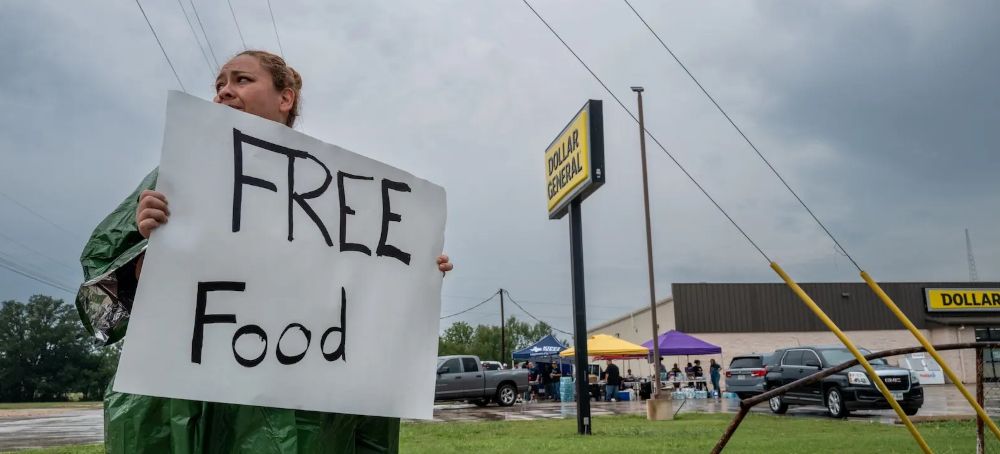 The July 4th flooding has become the first major disaster to expose the grave effects of Trump’s new food and hunger policies. (photo: Getty)
The July 4th flooding has become the first major disaster to expose the grave effects of Trump’s new food and hunger policies.
Later that day, President Donald Trump signed the One Big Beautiful Bill Act into law. The law gutted public food and healthcare safety nets, including the Supplemental Nutrition Assistance Program and Medicaid, while also codifying massive tax breaks for wealthier individuals and major corporations. The devastation in Texas, then, became the first major disaster to expose the grave effects of Trump’s extensive disinvestment from disaster resilience programs — and his administration’s newest food and hunger policies.
Charitable groups such as food banks and pantries typically serve as frontline distributors of food and water in a time of a crisis, working in tandem with other responding national and global relief organizations and government agencies. Now, though, because of the policy and funding decisions enacted by the Trump administration over the last six months, the primary food banks that are responding to the needs of residents throughout central Texas have less food to distribute.
Near the beginning of Trump’s second term, the Department of Agriculture stopped the flow of some of the money that pays for deliveries of products like meats, eggs, and vegetables known as “bonus commodities” through The Emergency Food Assistance Program, or TEFAP, to charitable organizations like food banks. TEFAP is one of the primary ways that state and federal governments have ensured food reaches communities in need in the aftermath of climate-fueled disasters like a hurricane or heatwave.
In March, the USDA also moved to end future rounds of funding for the Local Food Purchase Assistance Cooperative Agreement Program and the Local Food for Schools Cooperative Agreement Program. These two programs, which are also designed to support emergency food providers such as food banks, were slated to distribute more than a billion dollars this fiscal year to states, tribes, and territories.
In April, the funding cuts drove the Central Texas Food Bank to cancel 39 loads of food — the equivalent of 716,000 meals — scheduled to be delivered through September, said Beth Corbett, the organization’s vice president of government affairs and advocacy. The state of Texas lost more than $107 million for programs that allowed food banks and schools to buy food locally because of the administration’s funding cuts, the Austin Monitor and KUT reported. The San Antonio Food Bank also endured similar losses to its inventory.
San Antonio Food Bank’s president and CEO Eric Cooper told Grist he is consumed by concern that they may not be able to meet the emergency food demand prompted by the flooding tragedy in central Texas.
“Prior to this disaster, we just don’t have the volume of food in our warehouse that we need to have,” said Cooper, noting that they are “struggling to keep up” with the demand intensified by the deluge. “We have had to try to pivot a little bit to ration some of what we do have across the population we serve so that we can stretch [our supply],” he added. “USDA cuts have made it harder to keep up. The flood will make it even more difficult. Pending SNAP cuts feel like it will be impossible.”