Susan Monarez, CDC Director Being Ousted Refuses to Resign, Says RFK Jr. Is ‘Weaponizing Public Health’
Lena H. Sun, Dan Diamond and Lauren Weber The Washington Post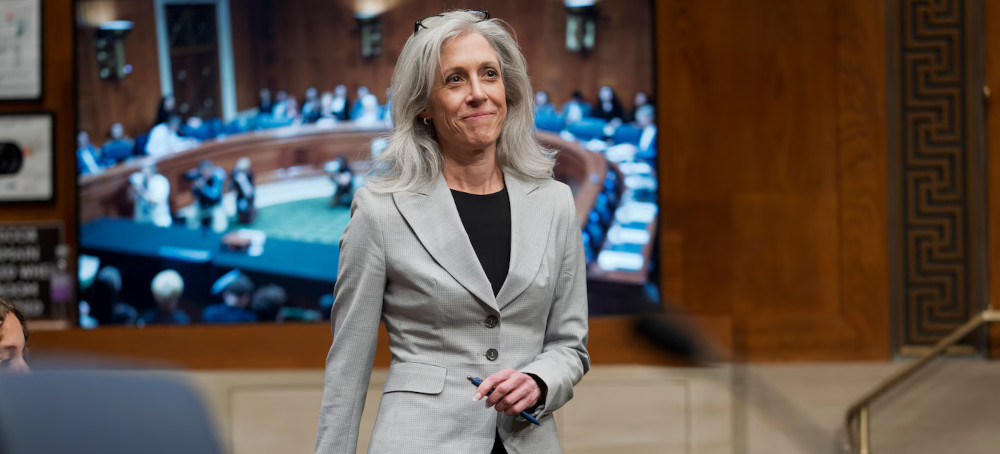 Susan Monarez attends a Senate hearing on her nomination to lead the Centers for Disease Control and Prevention in June. (photo: J. Scott Applewhite)
ALSO SEE: White House Says CDC Director Fired After She Refuses to Resign
Susan Monarez was confirmed as the CDC’s director in July. Three top agency officials announced resignations as the Trump administration moved to oust her.
Hours after the Department of Health and Human Services announced early Wednesday evening that Monarez was no longer the director, her lawyers responded with a fiery statement saying she had not resigned or been fired. They accused HHS Secretary Robert F. Kennedy Jr. of “weaponizing public health for political gain” and “putting millions of American lives at risk” by purging health officials from government.
“When CDC Director Susan Monarez refused to rubber-stamp unscientific, reckless directives and fire dedicated health experts, she chose protecting the public over serving a political agenda,” the lawyers, Mark S. Zaid and Abbe Lowell, wrote in a statement. “For that reason, she has been targeted.”
Soon after their statement, the White House formally fired Monarez.
“As her attorney’s statement makes abundantly clear, Susan Monarez is not aligned with the President’s agenda of Making America Healthy Again,” White House spokesman Kush Desai said in an email. “Since Susan Monarez refused to resign despite informing HHS leadership of her intent to do so, the White House has terminated Monarez from her position with the CDC.”
Zaid said Monarez never intended to resign, never told anyone that she intended to do so and legally remains in the position because President Donald Trump did not personally fire her.
Wednesday’s shake-ups — which include the resignation of the agency’s chief medical officer, the director of its infectious-disease center and other key officials — add to the tumult at the nation’s premier public health agency. Kennedy and his allies have long criticized the CDC as too deferential to the pharmaceutical industry and vaccine makers. As the nation’s top health official, Kennedy has upended vaccine policies, including on Wednesday narrowing approval of coronavirus vaccines to high-risk groups, and he has taken steps that medical experts worry are undermining the nation’s public health response.
Monarez, who was confirmed in late July, was pressed for days by Kennedy, administration lawyers and other officials over whether she would support rescinding certain approvals for coronavirus vaccines, according to two people with knowledge of those conversations. Kennedy, who has a long history of anti-vaccine advocacy, and other officials questioned Monarez on Monday on whether she was aligned with the administration’s efforts to change vaccine policy, the people said.
Kennedy and one of his top advisers, Stefanie Spear, also pushed Monarez to fire her senior staff by the end of this week, according to an administration official and another person with direct knowledge of that conversation. Spear did not immediately respond to a request for comment.
Monarez, who was a longtime federal government scientist before Trump nominated her to lead the CDC, declined to commit to support changing coronavirus vaccine policy without consulting her advisers, two people said. That prompted Kennedy to urge her to resign for “not supporting President Trump’s agenda,” one of the people said.
Monarez declined to immediately resign and enlisted Sen. Bill Cassidy (R-Louisiana), chairman of the Senate’s health committee, who cast a pivotal vote for Kennedy’s confirmation after securing commitments to protect vaccines, said three people with knowledge of those conversations. Cassidy privately pushed back on Kennedy’s demands, the people said, further angering Kennedy, who lambasted Monarez for involving the senator.
Administration officials told Monarez she could either resign or be fired, the people said. The officials and other people familiar with efforts to oust Monarez spoke on the condition of anonymity to discuss a sensitive personnel matter.
HHS said she is no longer the CDC director in a post on X on Wednesday evening.
“We thank her for her dedicated service to the American people. @SecKennedy has full confidence in his team at @CDCgov who will continue to be vigilant in protecting Americans against infectious diseases at home and abroad,” the agency wrote.
In social media posts late Wednesday, Zaid said Monarez was notified by White House staff in the personnel office that she had been fired, but as “a presidential appointee, senate confirmed officer, only the president himself can fire her.”
For this reason, Zaid wrote, “we reject notification Dr. Monarez has received as legally deficient and she remains as CDC Director. We have notified the White House Counsel of our position.”
Cassidy posted on X that the departure will require oversight by his committee.
Since taking office, Kennedy has upended the government’s approach to vaccination, including firing every member of an advisory committee that recommends vaccines, terminating research funding for mRNA vaccines and reviving a task force to scrutinize the childhood immunization schedule.
The leadership disruption at the CDC follows months of chaos, including budget cuts, the termination of hundreds of employees and an attack on its Atlanta headquarters by a gunman who fired hundreds of rounds at the campus buildings.
After news of efforts to oust Monarez, at least three top CDC officials announced their resignations Wednesday, citing lost funding, the political climate and a broader attack on public health, according to their emails to staff obtained by The Washington Post.
Demetre Daskalakis, the CDC’s top respiratory illness and immunization official, posted his scathing resignation letter on X where he blasted Kennedy and his appointees for unraveling coronavirus vaccine recommendations, which he said “threaten the lives of the youngest Americans and pregnant people.”
“I am not sure who the Secretary is listening to, but it is quite certainly not to us. Unvetted and conflicted outside organizations seem to be the sources HHS use over the gold standard science of CDC and other reputable sources,” Daskalakis wrote. “At a hearing, Secretary Kennedy said that Americans should not take medical advice from him. To the contrary, an appropriately briefed and inquisitive Secretary should be a source of health information for the people he serves. As it stands now, I must agree with him, that he should not be considered a source of accurate information.”
The CDC’s chief medical officer, Debra Houry, told staff that “ongoing changes” prevent her from continuing in her job.
“Vaccines save lives — this is an indisputable, well-established, scientific fact,” Houry wrote. “Recently, the overstating of risks and the rise of misinformation have cost lives, as demonstrated by the highest number of U.S. measles cases in 30 years and the violent attack on our agency.”
Dan Jernigan, a longtime official who helped oversee the CDC’s infectious-disease response, also announced his resignation.
Public health advocates had hoped Monarez would be a check on Kennedy and block him from limiting access to vaccines. Kennedy on Wednesday announced that the health agency signed off on new coronavirus vaccines but that the agency limited approval to people 65 and older or who have risk factors for severe coronavirus disease, instead of everyone 6 months and older.
“While public health has become political, science has not been and should not be,” said Chrissie Juliano, executive director of the nonprofit Big Cities Health Coalition, which represents public health officials from major cities. “When a career civil servant that leads an agency and this number of senior career officials resign in the same day, it raises serious questions about how the CDC can and will continue to do its work to protect and promote the public’s health. It’s a real loss for the nation’s health.”
Trump nominated Monarez after withdrawing his first pick, former Republican congressman Dave Weldon, who was criticized for his views on vaccines and autism. Monarez was confirmed in July after telling senators she values vaccines and rigorous scientific evidence.
Monarez’s firing comes as the Trump administration has questioned federal vaccine data and moved to roll back prior recommendations.
The CDC is expected to soon issue new recommendations on who should receive coronavirus vaccines.
Before becoming HHS secretary, Kennedy had falsely called the coronavirus vaccines the “deadliest vaccine ever made” and said they contained a “poison.” In his Senate confirmation hearings this year, Kennedy denied being anti-vaccine and said he was only seeking additional evidence on the shots’ effectiveness.
Monarez had scheduled an agencywide call Monday, but that was canceled Friday, according to several CDC employees who spoke on the condition of anonymity to discuss internal matters.
The agency had been reeling from the gunman’s Aug. 8 attack on its Atlanta headquarters, which forced hundreds of workers into lockdown and left a police officer dead. The shooter was frustrated by the coronavirus vaccine and blamed it for his health problems, according to law enforcement officials, neighbors and his father. Trump has not publicly addressed the shooting.
Monarez joins several Trump administration officials with brief tenures.
The White House sparred with IRS Commissioner Billy Long over access to immigrant data before Trump reassigned him to serve as ambassador to Iceland. Trump also ousted Michael Waltz as national security adviser to instead serve as ambassador to the United Nations after Waltz inadvertently added a journalist to a group chat about military operations in Yemen.