Supreme Court for Now Allows Trump to Deport Migrants to ‘Third Countries’
Ann E. Marimow The Washington Post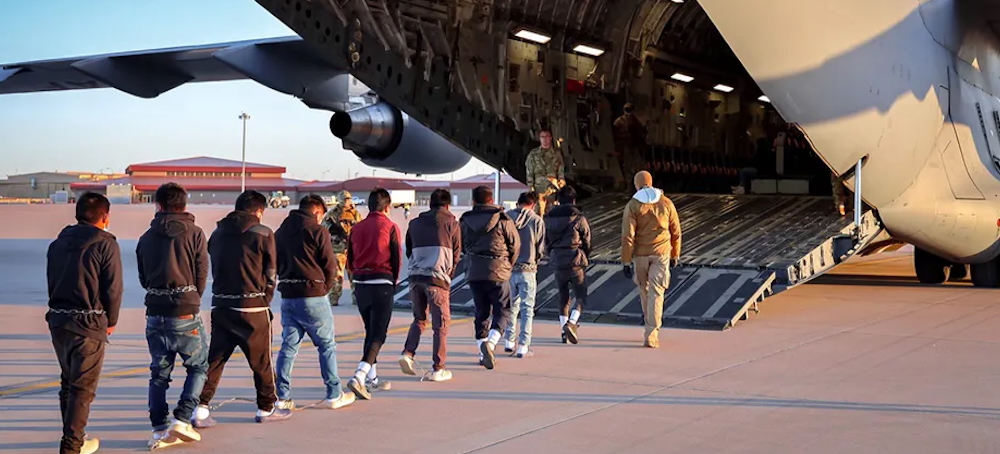 People are seen boarding a deportation flight. (photo: White House)
ALSO SEE: Supreme Court Lifts Limits on Trump Deporting Migrants to Countries Not Their Own
The case centers on President Donald Trump’s attempt to deport migrants to countries where they are not citizens, including conflict-ridden South Sudan.
The court’s order, which drew a sharp dissent from the three liberal justices, was the latest of several allowing President Donald Trump to move forward with a major change in policy while litigation on the issue continues in lower courts. Each has been made as part of the court’s “emergency docket,” which means they are decided based on truncated court filings, not oral argument, and the justices do not always explain their reasoning.
As part of Trump’s mass deportation efforts, the administration has attempted to send groups of migrants, some convicted of crimes in the United States, to countries other than their own, including to conflict-ridden South Sudan. Four individuals initially filed a lawsuit in Boston on behalf of all migrants potentially subject to third-country removals, saying they are entitled to notice and an opportunity to raise fear-based claims before deportation.
U.S. District Judge Brian E. Murphy in Massachusetts ruled against the administration, temporarily barring such deportations. He later said a planned deportation flight to South Sudan had violated his order. Those migrants have since been held in a makeshift detention facility at a U.S. naval base in Djibouti, enduring health hazards and the threat of rocket attacks.
Justice Sonia Sotomayor, joined by Justices Elena Kagan and Ketanji Brown Jackson, wrote a nearly 20-page dissent, criticizing the administration for violating the lower-court order and trying to send migrants to “a nation the State Department considers too unsafe for all but its most critical personnel.”
“Rather than allowing our lower court colleagues to manage this high-stakes litigation with the care and attention it plainly requires,” the liberals wrote, the majority was “rewarding lawlessness” by halting an order the administration has repeatedly defied.
“Apparently, the Court finds the idea that thousands will suffer violence in farflung locales more palatable than the remote possibility that a District Court exceeded its remedial powers when it ordered the Government to provide notice” to the targeted migrants, the dissent said. The conservative majority’s one-paragraph, unsigned statement did not explain its reasons for pausing Murphy’s decision.
The White House and the Department of Homeland Security claimed victory, posting on social media the message “Fire up the deportation planes,” and a meme of the president doing a celebratory dance.
In a brief order late Monday, Murphy said the men in Djibouti were protected from immediate removal based on a separate ruling he previously issued.
The third-country removals case is one of several that have reached the Supreme Court involving the Trump administration’s aggressive efforts to ramp up deportations and restrict legal and illegal immigration. The justices restrained the administration in other deportation cases, joining lower courts in chastising Trump officials for failing to provide immigrants with sufficient time or due process to challenge their removals. But the justices also allowed Trump to lift protected status for hundreds of thousands of migrants while litigation on the cancellation of their programs continues.
The court, for example, ordered the administration to facilitate the return of Kilmar Abrego García, who was wrongly deported to El Salvador despite a court order prohibiting it. The government brought him back to the United States this month after securing an indictment against him for allegedly transporting undocumented migrants.
In her dissent Monday, Sotomayor suggested that the majority’s position contradicted its earlier orders that had emphasized that migrants cannot be removed without a fair process.
Georgetown Law professor Steve Vladeck, who closely tracks the emergency docket, called the order “disastrous” and scolded the majority for failing to address the Trump administration’s violations of Murphy’s order. That silence, he wrote in his One First newsletter Monday night, could encourage the administration to violate other lower-court orders.
Like Sotomayor, Vladeck noted the court’s earlier rulings that migrants are entitled to notice and an opportunity to challenge their deportations. He said Monday’s order “effectively allows for countless other migrants to be removed to third countries where they have credible arguments that they’ll be mistreated — for no other reason than because they’ve already been held to be removable to some other country. Due process apparently matters to these justices on the initial removability question, but not beyond that.”
Attorneys for the migrants said the court action leaves thousands of people vulnerable to deportation and mistreatment.
“It strips away critical due process protections that have been protecting our class members from torture and death,” Trina Realmuto, executive director of the National Immigration Litigation Alliance, said in a statement. She emphasized that the broader challenge to the administration’s policy is still underway in the lower courts, adding, “We now need to move as swiftly as possible to conclude the case and restore these protections.”
Tricia McLaughlin, an assistant secretary in the Department of Homeland Security, said in a statement that the agency “can now execute its lawful authority and remove illegal aliens to a country willing to accept them.”
Murphy had ordered the government to give those targeted for third-country deportations up to 25 days to legally challenge their removals. He said the deportees also must be interviewed by the government, with their attorney and interpreter present, to determine whether they qualify for humanitarian protection.
In asking the Supreme Court to overturn that ruling, Solicitor General D. John Sauer told the justices that the U.S. is “facing a crisis of illegal immigration, in no small part because many aliens most deserving of removal are often the hardest to remove.”
He argued that the lower-court judge infringed on the executive’s authority over deportations and imposed an “onerous set of procedures” for the government to assess any claims under the Convention Against Torture, which was ratified by Congress in 1994 to bar the U.S. government from sending people to countries where they might face torture.
Attorneys for the immigrants told the justices that Murphy “went to great lengths to avoid micro-managing” the administration’s compliance with federal law prohibiting such deportations — even of criminals — to third countries where they would face persecution or torture.
They also disputed the administration’s characterization of the migrants as “the worst of the worst,” saying many of those targeted have not been convicted of crimes and initially entered the United States legally as refugees or on student or work-based visas.
Murphy has grown increasingly frustrated with the administration’s responses to his orders, accusing Justice Department lawyers of “manufacturing the very chaos they decry” as a way to evade his instructions. In May, Murphy found that the administration had violated his court order by attempting to remove one group of migrants, who are from Cuba, Vietnam, Myanmar, Laos and Mexico, after federal authorities determined they had committed serious crimes and their homelands would not take them.
A lawyer for the immigrants had urged Murphy to order the government to return the men, bound for South Sudan, to the United States. But the judge declined to order their return, saying the Department of Homeland Security could bring them back for the interviews or conduct them where the migrants were being held.
In his filing, Sauer assured the court that under the Convention Against Torture, the administration “will not remove an alien to any country where he is likely to be tortured — i.e., the extreme scenario where the alien is likely to face severe pain or suffering intentionally inflicted by the hand or with the consent of a public official.”