Supreme Court Allows Trump to Launch Mass Layoff and Restructuring Plans
Ann E. Marimow Washington Post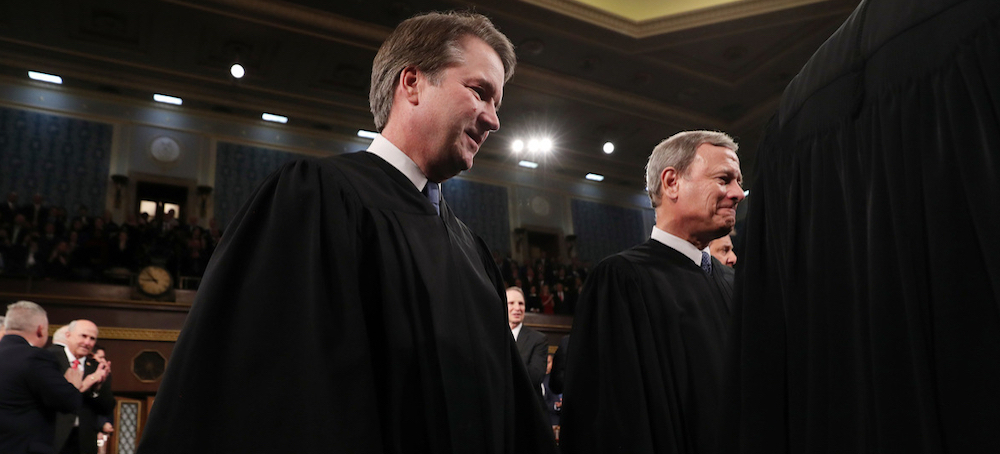 Justice Brett Kavanaugh and Chief Justice John Roberts. (photo: Getty Images)
ALSO SEE: Supreme Court Clears Way for Mass Firings at Federal Agencies
The justices said they were not ruling on the legality of specific firing plans but simply allowing the administration to launch such efforts while litigation continues.
The justices lifted a lower-court order that temporarily blocked plans to lay off thousands of federal workers, including at the State Department and the Social Security Administration, because the administration did not first consult with Congress.
In response to other emergency requests from the Trump administration, the Supreme Court has repeatedly sided with President Donald Trump’s efforts to upend the federal bureaucracy. The court’s conservative majority has permitted the administration to fire independent regulators and thousands of probationary workers while legal challenges play out in the lower courts.
But in this case, two of the liberal justices — Elena Kagan and Sonia Sotomayor — appear to have joined the conservatives in allowing the administration to plan reorganizations and reductions in the workforce. Sotomayor said it was because the administration had directed agencies to operate “consistent with applicable law.”
“The plans themselves are not before this Court, at this stage, and we thus have no occasion to consider whether they can and will be carried out consistent with the constraints of law,” wrote Sotomayor, who contended that the lower-court judge is still free to assess the legality of the administration’s plans.
In their brief unsigned order, the majority said that “we express no view on the legality of any” agency plans for restructuring or shrinking of the workforce, and left open the possibility that the issue could return to the Supreme Court.
Only Justice Ketanji Brown Jackson, who has distinguished herself this term with a series of biting dissents, noted her sharp disagreement. She warned of serious harm that could come from allowing the administration to dramatically remake the federal government before determining whether its actions are legal.
“For some reason, this Court sees fit to step in now and release the President’s wrecking ball at the outset of this litigation,” Jackson wrote in her 15-page dissent. “In my view, this decision is not only truly unfortunate but also hubristic and senseless.”
The full impact of the Supreme Court’s order was not immediately clear. In January, Elon Musk and his U.S. DOGE Service moved to aggressively shrink staff and spending across the government. But Musk has left Washington, and there are some signs of retreat from that effort.
The Department of Veterans Affairs said Monday that it was on pace to reduce its total staff by nearly 30,000 employees through retirements, attrition and deferred resignations, and that it will no longer be forced to conduct a much larger workforce reduction.
A spokesperson for the New York attorney general’s office said the decision would not affect a preliminary injunction in a separate lawsuit that paused mass terminations and restructuring at some subagencies within the Department of Health and Human Services, including the Centers for Disease Control and Prevention, a center within the Food and Drug Administration, and Head Start.
The State Department, however, said it would move ahead with its plans to cut 15 percent of staff. Secretary of State Marco Rubio had planned to pursue mass dismissals on July 1 but backed off to await the court’s decision.
Agency employees reacted to the Supreme Court’s order with grief, despair and anger, according to interviews with a half-dozen staffers and chat records obtained by The Washington Post. In private group messages, they wrote of their fears for U.S. national security and about how they would provide for their families. Some recalled their decades of service, often in dangerous postings. Others simply wrote that they felt sick.
In February, Trump ordered federal agencies to plan for and carry out mass layoffs and reorganizations as part of his effort to shrink the federal workforce and to eliminate what he called “waste, bloat, and insularity.”
The nation’s largest union of federal workers, the American Federation of Government Employees (AFGE) — joined by 11 nonprofit organizations and six local governments in California, Texas and Illinois, among other places — filed suit.
In a joint statement Tuesday, the groups said the court’s decision “puts services that the American people rely on in grave jeopardy” and “does not change the simple and clear fact that reorganizing government functions and laying off federal workers en masse haphazardly without any congressional approval is not allowed by our Constitution.”
Attorney General Pam Bondi praised the court’s order in a post on X, saying that it had stopped “lawless lower courts from restricting President Trump’s authority over federal personnel.”
“Now, federal agencies can become more efficient than ever before,” Bondi said.
A federal judge in California had temporarily halted Trump’s plans in May, saying the administration must partner on any mass reorganization with Congress, which created, funds and provides direction to the agencies.
Nine presidents in both parties over the past 100 years have sought and obtained authority from Congress to reorganize the executive branch, U.S. District Judge Susan Illston wrote in her ruling. She noted that Presidents George W. Bush, Barack Obama and Trump in his first term asked Congress for agency reorganization authority but did not receive it.
Trump officials “want the Court to either declare that nine Presidents and twenty-one Congresses did not properly understand the separation of powers, or ignore how the executive branch is implementing large-scale reductions in force and reorganizations,” Illston wrote. “The Court can do neither.”
Her opinion emphasized the potential impacts of the cuts on government services. At the Social Security Administration, where 7,000 workers are targeted for layoffs, retirees have already reported long phone wait times, problems with the agency’s website and difficulty making in-person appointments. In the National Institute for Occupational Safety and Health office, which researches health hazards faced by mineworkers, all but one of the 222 employees were targeted for layoffs.
Attorneys for the labor union and other challengers told the justices that the Supreme Court should not allow the “breakneck reorganization of the federal government” on a truncated emergency timeline before the matter is thoroughly considered by the lower courts. Hundreds of thousands of federal employees will lose their jobs under the reorganization, the challengers said in court filings, adding that programs and offices across the government will be abolished, agencies will be dramatically downsized from what Congress intended, and critical government services will be lost.
“If the courts ultimately deem the President to have overstepped his authority and intruded upon that of Congress, as a practical matter there will be no way to go back in time to restore those agencies, functions, and services,” the challengers wrote. “Whatever one’s view on the proper size and scale of government, that vision may not be imposed by unilateral executive order, without engaging in the dialogue and cooperation with Congress that the Constitution requires and that Presidents have historically pursued.”
Solicitor General D. John Sauer, the administration’s advocate at the Supreme Court, told the justices that Trump does not need special permission from Congress to exercise a core presidential power of overseeing federal agencies.
Sauer said the challenge to the planned layoffs is premature and in any case must be handled first by an administrative process for civil servants through the Merit Systems Protection Board. In a different case, the Supreme Court in April allowed Trump to remove the head of that independent agency while litigation continues.
The solicitor general argued that Trump’s restructuring order is lawful because it directs agencies to ensure they do not eliminate any of the functions that are required by statutes passed by Congress.
Illston’s decision to block the layoffs, which was upheld by the U.S. Court of Appeals for the 9th Circuit, has created confusion at agencies, Sauer wrote, and compelled the government to “retain — at taxpayer expense — thousands of employees whose continuance in federal service the agencies deem not to be in the government and public interest.”