Sunday Song: Leonard Cohen | The Partisan
Leonard Cohen YouTube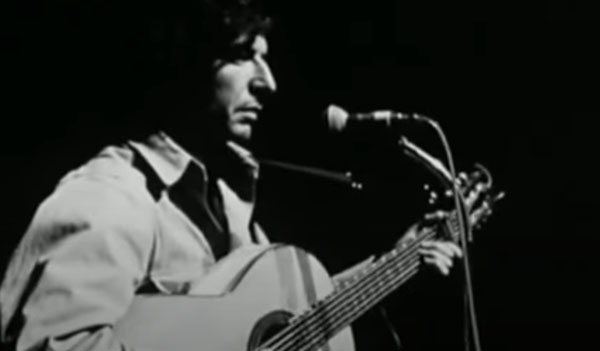 Leonard Cohen's masterpiece rendition of the War II resistance anthem The Lament of the Partisan. (photo: Image outtake The Partisan live in France, 1970/YouTube.)
27 February 22
Leonard Cohen's masterpiece rendition of the War II resistance anthem The Lament of the Partisan. (photo: Image outtake The Partisan live in France, 1970/YouTube.)
27 February 22
"The Partisan" is an anti-fascist anthem about the French Resistance in World War II. The song was composed in 1943 by Russian-born Anna Marly (1917–2006), with lyrics by French Resistance leader Emmanuel d'Astier de la Vigerie (1900–1969), and originally titled "La Complainte du partisan" (English: "The lament of the partisan"). Marly performed it and other songs on the BBC's French service, through which she and her songs were an inspiration to the Resistance. A number of French artists have recorded and released versions of the song since, but it is better recognised globally in its significantly, both musically and in the meaning of its lyrics, different English adaptation by Hy Zaret (1907–2007), best known as the lyricist of "Unchained Melody".
Canadian singer-songwriter Leonard Cohen (1934–2016) recorded his version, using Zaret's adaptation, and released it on his 1969 album Songs from a Room, and as a 7-inch single in Europe. Cohen's version re-popularised the song and is responsible for the common misconception that the song was written by Cohen. It has inspired many other artists to perform, record and release versions of the song, including American Joan Baez (born 1941), on her 1972 album Come from the Shadows, and with the title "Song of the French Partisan", Canadian Buffy Sainte-Marie (born c. 1941) and Israeli Esther Ofarim (born 1941)."
Lyrics Leonard Cohen, The Partisan.
When they poured across the border
I was cautioned to surrender,
this I could not do;
I took my gun and vanished.
I have changed my name so often,
I've lost my wife and children
but I have many friends,
and some of them are with me.
An old woman gave us shelter,
kept us hidden in the garret,
then the soldiers came;
she died without a whisper.
There were three of us this morning
I'm the only one this evening
but I must go on;
the frontiers are my prison.
Oh, the wind, the wind is blowing,
through the graves the wind is blowing,
freedom soon will come;
then we'll come from the shadows.
Les Allemands étaient chez moi (The Germans were at my home)
ils m'ont dit "Résigne-toi" (They said, "Surrender,")
mais je n'ai pas pu (this I could not do)
j'ai repris mon arme (I took my weapon again)
J'ai changé cent fois de nom (I have changed names a hundred times)
j'ai perdu femme et enfants (I have lost wife and children)
mais j'ai tant d'amis (But I have so many friends)
j'ai la France entière (I have all of France)
Un vieil homme dans un grenier (An old man, in an attic)
pour la nuit nous a cachés (Hid us for the night)
les Allemands l'ont pris (The Germans captured him)
il est mort sans surprise (He died without surprise)
Oh, the wind, the wind is blowing,
through the graves the wind is blowing,
freedom soon will come;
then we'll come from the shadows.