Sudan’s Refugees Endure Brutal Sanctuary in the Desert
Laura Kelly The Hill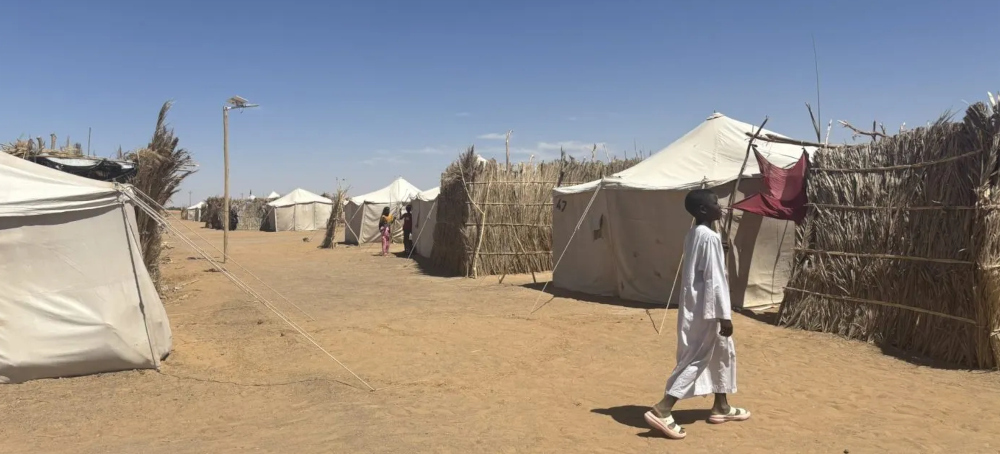 An internally displaced person walks among the tents and makeshift structures at the Al-Affad camp in Sudan. (photo: The Hill)
Many of the camp’s 25,000 residents traveled about 745 miles — a month’s journey by foot — to reach relative safety from their homes in the southwest of the country, in North Darfur.
The government-run camp, situated on a patch of Sahara Desert next to the life-giving Nile River, is composed of a mix of tarped tents and shelters made of dried reeds for walls and roofs.
Fadiya, 20, was studying nutrition in her home city of El Fasher, North Darfur State, when Sudan’s civil war broke out on April 15, 2023, between the Sudanese Armed Forces (SAF) — the recognized government’s military — and the rebel Rapid Support Forces (RSF).
“They forced us to leave El Fasher, not from ourselves,” Fadiya said, referring to the RSF. She evacuated her home with her family, her father, mother, three brothers and three sisters.
It took 18 months for the RSF to gain control of North Darfur’s capital from the SAF.
Fadiya is one of the rare English speakers in the camp, one of the few who could talk with a small group of journalists who visited the camp on April 10. She declined to have her photo taken.
Fadiya said she and her family have been at the camp for six months. She was open and smiling, but her words were forceful and harsh.
“This place, it is not a condition to live. The weather is so hot, and we live in a tent,” she said bluntly.
Fadiya wants to leave the camp and eventually return to El Fasher, a dream that is difficult to imagine as the SAF and RSF show no commitment to negotiating a ceasefire.
Both sides have powerful Persian Gulf and Middle East backers, who are exacerbating the war. Saudi Arabia, Turkey and Qatar support the SAF; the United Arab Emirates heads a regional African coalition backing the RSF.
Both sides are recognized as carrying out war crimes, but it’s the RSF that was designated as committing genocide by the U.S. in 2025. At the war’s three-year anniversary, the SAF controls about three-quarters of the country.
For Fadiya, the nation’s split is as traumatic as the deaths of her family, friends and neighbors.
“We lost our family, our neighbors and also most of our country,” she said.
“That is why I hope in my gut to return, and everybody returns to his house.”
Fadiya recounts her experience through the war, looking back to the outbreak of fighting three years ago, the same moment the war began in the capital, Khartoum.
“We have a shelter; we make a hole in the ground,” Fadiya said, describing her family trying to survive the bombs and bullets.
“We stayed in the hole until the shooting stopped, and come out of the hole like rabbits, can you believe it? So bad.”
The camp, which is a year old, provides relative safety, but it is extremely underresourced.
Older women begging for money approached the group of journalists. Others sat in the small bit of shade from the tents. The temperature was 88 degrees with a clear blue sky and little escape from the punishing sun. Any breeze is dangerous, whipping up sand and dust and making it hard to breathe and difficult to see.
There’s a mosque at the camp; women and men separate to participate in the Friday prayer service. There’s a water tank for cleaning hands and feet.
But sanitation and hygiene are a major problem. The camp needs 1,200 toilet facilities; it only has 200.
There’s only room in the school for 450 primary students, although the camp hosts 1,500 in this age group. The total number of children is 9,200, the government’s representative to the camp said.
All manner of professions are represented among the residents, including farmers and engineers, like electrical engineering student Tariq Faize Omar, 20.
He managed to purchase a couple of solar panels and rig them up to provide a cellphone charging station. He charges 500 Sudanese pounds, less than $1, to charge the other internally displaced persons’ (IDP) devices.
Of what he earns, he sends about 50,000 Sudanese pounds (around $90) per month to his family, who remain in Darfur.
Also among the IDPs are a doctor, nurse and midwife. They work at what operates as a clinic — a building made of corrugated-metal panels. There are a few rooms with cots and sparse medical supplies.
On the flat ground and under the blinding sun, it’s difficult to see the full size of the camp. There are avenue-like main pathways, with tents on either side that are generally evenly spaced in multiple rows. There’s a crude market stand, with soap, onions, dried ramen packages and eggs, presumably for sale.
A group of women — appearing to be between the ages of 30 and 40 — wave from their tent to invite in the journalists.
The outside of the tent is covered in a white tarp, but inside, it’s draped with cloth in colorful patterns — green swirls, and black and white polka dots. The women are wearing traditional Sudanese toubs, large cloths designed with multicolored animal prints that wrap around their head and body.
Two cots — with little to no support — provide a place to sit. A large blue plastic drum holds drinking water. One of the women offers glasses of water. A fire burns in a small cooking stove while a broken cinder block serves as a makeshift coffee table.
A male translator says that the women tell him they’ve been at the camp for six months and that they all came from El Fasher. They speak all at once, mentioning journeys of days of walking before finding some semblance of safety. When asked if they want to go back to El Fasher they respond, “La, La, La” — Arabic for “no.”
The women say the water is contaminated, and they would like to go to Khartoum for better services and more opportunities.
Another IDP is Azeri, 24. He arrived at the camp with about 10 members of his family. He was an English teacher in El Fasher.
“Right now I am in between. I want to study, I want to work hard, I want to be someone,” he said. “At the same time, circumstances are standing in front of me like a wall, telling me, ‘Go if you can.’ That’s the deal. I don’t know where I can go, sadly. Go back to the land of great-great-grandparents?”
El Fasher before the war was like “a heaven,” he said, adding that people were peaceful and there was a sense of community. But when the war started, they were living under bombing, saying they were shot from outside the city.
“The good thing is we live in peace right now, we are safe,” he says of Al-Affad.
Azeri is generally lucky to be at the camp because it hasn’t accepted new refugees for three months.
Rami Abd El-Rahim is a representative of the SAF-controlled central government helping administer the camp. There are a few signs around the camp identifying their international donors, to include the United Nations Refugee Agency, Qatar and the Sudanese American Physician Association.
El-Rahim briefs our group on the yawning gap between the resources needed and what’s available, but he quickly transitions into what the SAF, its supporters and civilians living under SAF control often mention: The RSF is the ultimate evil, and its surrender is nonnegotiable.
“There is a question we have to ask ourselves, why this camp initiated?” he asks through a translator.
“There is militia, RSF military, they force people to get away from their homes. These military and RSF do these trouble things, and these people run for their lives, to save their children, mothers and lovers. That’s why this camp is initiated,” he says.
El-Rahim is asked if there are any plans or preparations being made for the residents to find more permanent housing and employment. The SAF-controlled government is carrying out a campaign to encourage Sudan’s internally displaced to come to Khartoum after retaking the city from the RSF one year earlier.
But El-Rahim said the plan is to get the people at the camp back to their villages and to El Fasher.
“You need to put pressure on the militias [RSF] so these people can go back to their homes,” he tells our group of journalists.