Stone Age Mentality
Ishaan Tharoor The New Yorker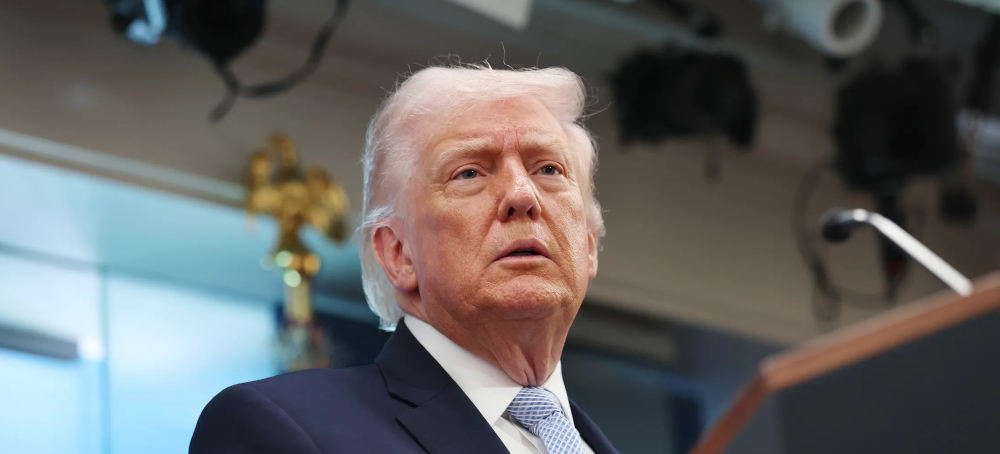 A temporary truce can’t erase the chaos of a war that the White House started and never fully understood. (photo: Anna Moneymaker/Getty)
A temporary truce can’t erase the chaos of a war that the White House started and never fully understood.
This was astonishing language, even for Trump, whose aggressive rhetoric has become background noise. Some Democrats cited the post as evidence of the President’s deteriorating mental fitness and his inability to remain in office. Iran’s envoy to the United Nations said that Trump was broadcasting “his intent to commit war crimes and crimes against humanity.” António Costa, the president of the European Council, said that targeting civilian infrastructure, particularly energy facilities, is “illegal and unacceptable,” and added, “This applies to Russia’s war in Ukraine, and it applies everywhere.” Pope Leo XIV told reporters, “There are certainly issues of international law here, but even more, it is a moral question concerning the good of the people as a whole, in its entirety.”
But the United States and Israel have shown little regard for international law, or other such obligations. The Trump Administration believes it can secure perceived U.S. interests however it sees fit; earlier this year, Trump told the Times that he was constrained only by his “own morality.” If that statement didn’t offer much clarity, Trump’s close adviser, Stephen Miller, delivered his own explanation of the Administration’s guiding principles. “We live in a world in which you can talk all you want about international niceties and everything else, but we live in a world . . . that is governed by strength, that is governed by force, that is governed by power,” Miller told CNN, in January. “These are the iron laws of the world since the beginning of time.”
This embrace of atavistic thinking in Washington—call it Stone Age mentality—may play well with Trump’s nationalist base at home, but it has done little to advance his aims in the Middle East. By Tuesday night, his bluster had given way to what sounded like relief at finding an off-ramp. After a group of regional intermediaries, led by Pakistan, brokered a temporary truce, Trump announced on social media that he would “suspend the bombing and attack of Iran for a period of two weeks,” contingent upon the regime allowing the strait to reopen. Trump claimed that the United States had “already met and exceeded all Military objectives” and was close to clinching “Longterm PEACE with Iran.” The Pakistani Prime Minister, Shehbaz Sharif, said that U.S. and Iranian delegations were invited to Islamabad for potential talks later this week. As of Wednesday morning, Iran’s civilization still stood.
There are plenty of reasons to be skeptical about the negotiations that follow. Previous rounds of talks between U.S. and Iranian interlocutors were cut short by American and Israeli bombardments on Iranian targets, and defined by vast deficits in trust and understanding between the parties. Those gaps remain. The statements issued from Washington and Tehran on Tuesday evening already showed a clear divergence: Trump claimed that the Strait of Hormuz would be immediately opened to the free flow of ships, whereas the wording from the Iranian foreign minister, Abbas Araghchi, suggested that “safe passage” would be possible only in “coordination” with the Iranian military—an indication that Tehran sees the strait not as a bargaining chip but as permanent leverage. According to initial reports, the ten-point Iranian plan that Trump said formed a “workable basis” for future dialogue included maximalist demands that Iran be able to enrich uranium for a nuclear program, that years of sanctions on Tehran be dropped, that Iran get compensated for war damages, that the U.S. withdraw its forces deployed in the Middle East, and that Israel cease its fighting with Hezbollah, an Iranian proxy, in Lebanon. (Israel says that Lebanon is not included in the ceasefire, and multiple strikes have continued today in Beirut and across the country.) Trump, who has repeatedly claimed that his campaigns have “decimated” Iran’s military and wiped out its nuclear facilities, said Wednesday morning on Truth Social that there would “be no enrichment of Uranium” but indicated a willingness to discuss sanctions relief.
The President will be hard pressed to convince anyone aside from his most ardent supporters that what has happened in the past six weeks constitutes an American success. Iran’s military may be degraded—its stores of ballistic missiles and attack drones depleted, and the regime’s top ranks eliminated—but the Islamic Republic is intact and not, as Trump once asserted, on its last legs. Some analysts argue that the regime is emerging from the confrontation in a position of even greater strength. If the current terms of the ceasefire hold, “Iran will be able to rebuild capabilities within a year,” Andreas Krieg, a senior lecturer at King’s College London, wrote on X. “Iran will have more disposable income that will be put into building a more powerful military dictatorship,” he added, gesturing to the sanctioned Iranian oil that the Trump Administration has allowed into the market, and the internal regime realignments after the U.S. and Israel killed Iran’s Supreme Leader, Ayatollah Ali Khamenei. “The people in place might be less theocratic but also less pragmatic and more belligerent,” Krieg continued. “The race to build a bomb might be on again (with outside help) as the previous fatwas will be void after this experience.”
Meanwhile, in just a matter of a month or so, the United States and Israel have already spent billions of dollars on the war, burned through stockpiles of critical munitions, antagonized international and domestic public opinion, jeopardized U.S. military personnel and bases in the Middle East, and committed possible war crimes. The U.S.-Israeli strikes have killed thousands of people and triggered retaliatory attacks from Iran on targets across the Middle East. Iran’s “civilization” has been in the crosshairs for a while: officials say that some thirty Iranian universities have been hit, in addition to the Pasteur Institute in Tehran, a celebrated century-old institution that specializes in the study of infectious diseases. UNESCO World Heritage sites in Isfahan, a former Safavid imperial capital and a jewel of Perso-Islamic architecture, have also been damaged by strikes.
Trump may claim the opening of the strait as a victory, but it simply marks a return to a prewar status quo—with Iran more aware of its ability to control the passage. It is one of the more predictable outcomes of a war that Trump decided to initiate—a war that quickly spiralled beyond anything that the White House had anticipated, and left Trump resorting to desperate threats to obliterate Iran. Some in Trump’s camp now doubt there’s enough lipstick to put on this pig. “This war is actively weakening American power, increasing the danger to American citizens, and frustrating the president’s important efforts at addressing our many domestic challenges,” Oren Cass, the chief economist at American Compass, a right-wing think tank, lamented on social media. “It has closed a strait that was previously open, strengthened the incentive for other nations to pursue nuclear weapons, and in this most recent rhetoric made more plausible their use.”
A Pew poll from the last week of March found that about two-thirds of Americans don’t have confidence in Trump’s ability to make good policy decisions regarding Iran. Outside the U.S., the view is all the more dismal. Trump’s war has provoked a series of crises across the rest of Asia, which relies on energy imports from the Gulf. Throughout South Asia, cooking-gas shortages in cities forced hotels and restaurants to shutter. Inflation soared and currencies tanked. Airlines scaled back operations in Vietnam. As the flow of oil from the Gulf stopped, the Philippines declared a national energy emergency in late March. “Hormuz has exposed both the fragility of the fossil fuel system and the limits of American power,” Mona Ali, a professor of economics at the State University of New York, wrote. “Washington no longer seems able to win the wars it starts or manage the economic fallout of its recklessness.” As countries across the region scramble for a future where they are less vulnerable to this sort of oil shock, they will seek to expand investment in renewable energy. In doing so, they’ll be tapping into supply chains already dominated by Beijing, whose clout and influence has quietly grown during the war. Trump said that China played a role behind the scenes to bring Iran to the table. According to a 2025 survey, China was already viewed more favorably than the United States in several Arab countries, and it may find new opportunities to present itself as a reliable partner for the region in an age of Trumpist disruption. “China will have waited out its rival’s self-inflicted exhaustion and emerged, without firing a single shot, as the principal strategic beneficiary of a war it did nothing to start,” Mohammed Soliman, a senior fellow at the Middle East Institute, wrote.
If Trump or his allies are at all aware of this emerging geopolitical reality, they’ve shown no signs of it. Instead, the President can only muster his chest-thumping, Stone Age triumphalism, his gloating about U.S. military preëminence and success, no matter the contradicting facts on the ground or the murkier strategic picture. Stephen Walt, an international-relations scholar at Harvard’s Kennedy School, described Trump’s foreign-policy strategy as that of a “predatory hegemony”—that is, he explained in a Foreign Affairs essay, “its central aim is to use Washington’s privileged position to extract concessions, tribute, and displays of deference from both allies and adversaries, pursuing short-term gains in what it sees as a purely zero-sum world.” The latest war in the Middle East ought to make clear the hollowness of this approach, which, as Walt put it, will “generate growing global resentment” and “create tempting opportunities for Washington’s main rivals.”
“People admire the Wild West cowboy approach to geopolitics only when it is successful,” Malcolm Turnbull, the former Prime Minister of Australia, said in an interview with the Wall Street Journal. “America’s friends are not just hoping for an early end to this war of choice. They also hope that America’s fever breaks, that wild impulsive strategic moves are replaced by a more orderly approach to geopolitics.” They shouldn’t hold their breath.