Speaker Mike Johnson Caught Between Lawmakers and Trump in GOP Map Fight
Kadia Goba and Marianna Sotomayor The Washington Post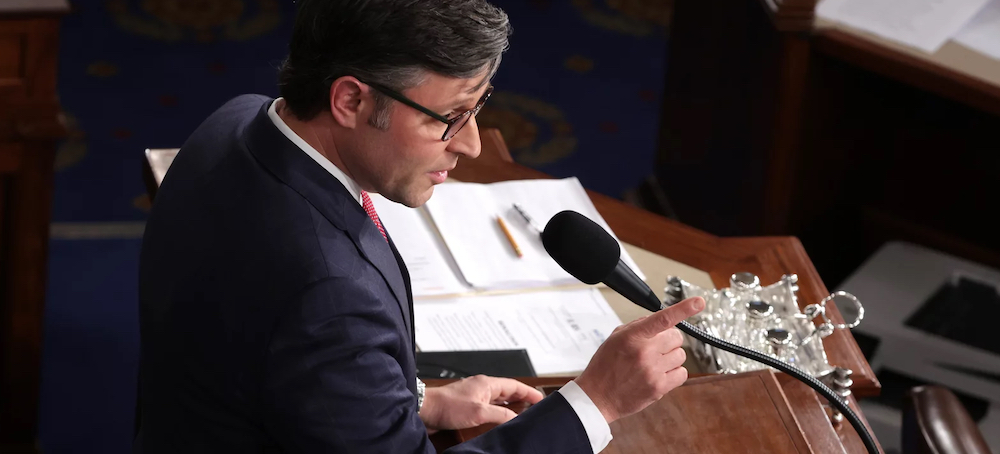 House Speaker Mike Johnson, R-La., delivers remarks at the U.S. Capitol. (photo: Alex Wong/Getty Images)
It’s a tough spot for the speaker, who is trying to placate GOP members worried about being targeted in a redistricting war while also backing Trump’s push to expand the GOP House majority.
It’s a tough spot for the speaker, who is trying to mollify Republican House members who worry they may be targeted in a redistricting war, while also backing Trump’s push to expand the GOP’s razor-thin House majority — and solidify the president’s agenda for the second half of his administration.
“In recent days, the speaker has of course had discussions with several members who have expressed their questions or concerns about the various developments in their inpidual states,” Greg Steele, a spokesman for Johnson’s political team, confirmed in a statement.
Johnson has “relayed pertinent information between the White House and those Members in what remains a thoughtful, productive dialogue,” Steele added.Johnson has kept in regular touch with Trump’s team about its redistricting push, a White House official confirmed. Trump aides have told the speaker to reassure anxious House Republicans that “no one is getting sacrificed,” according to a person familiar with the conversation, who spoke on the condition of anonymity to be candid about private deliberations.
The message has assuaged some, but it has not convinced other Republican lawmakers whose futures in Congress could be jeopardized if Texas Republicans go ahead with their plan to create five additional GOP seats in a rare round of mid-cycle redistricting. The Texas gambit has sparked a cascade of threats from blue-state governors, from California to Maryland, to retaliate in ways that would imperil Republican members in those states.
“I really don’t like the idea that this is going to be some sort of redistricting war, or there’s going to be this domino effect where one state after another upends their district lines. That’s not the way things are supposed to work,” said Rep. Kevin Kiley, whose GOP district is one of five that California Democrats could erase if Texas proceeds with its plan.
Republican state lawmakers in Indiana are set to meet with Trump at the end of the month to discuss redistricting as some lawmakers remain concerned over how their district lines could be redrawn.
Other Republicans consider redistricting a potential gain, arguing that Democrats started the fight by changing the New York map ahead of the 2024 elections. Meanwhile, in ruby-red Florida, lawmakers are less skeptical, hoping that adding as many as five seats could increase their delegation’s influence on the House GOP conference.
Redistricting is only the latest headache for Johnson, who oversees a historically narrow House majority with boisterous personalities who have often stymied passage of key legislation. A larger majority could ensure a continuation of Johnson’s speakership for another two years and give him a wider margin for success. But the redistricting debate could make it harder for him to pass legislation in the meantime.
The House Republican campaign arm and Johnson have been at pains to say they are not the driving force behind the effort to redraw the national map.
Johnson has had “no involvement” in the “development of national redistricting strategy,” Steele said.
A presentation given to House GOP lawmakers and donors at Johnson’s political retreat in Jackson Hole, Wyoming, this week showed the map in Texas with its current lines, not those the legislature has proposed that have yet to be adopted. At a different briefing led by the White House and the Congressional Leadership Fund, the House GOP’s fundraising arm, redistricting was briefly discussed and described as a response to Democrats having drawn maps to their political advantage for years.
The White House played a crucial role in persuading Texas Republicans to redraw their congressional map. And Trump’s ambitions to further cushion the House GOP majority — solidifying his agenda and insulating him from any Democratic-driven investigations — have led the White House to press Missouri, Indiana and Florida to also redraw their maps mid-decade. Ohio is set to adopt a new map based on state rules ordering a redraw before 2026, one that Republicans hope eliminates more Democratic seats.
Democrats are hoping to offset any GOP gains by changing district lines in California, Illinois, Oregon, Washington, Maryland and later, in 2028, in New York. But their pathway to success is less reliable. Still, Republicans in those states are fretting over their districts being fully eliminated or turning into toss-ups.
There’s debate over whether the White House push is worth it in an election cycle in which the president’s party historically gets punished, given that the consequences are unpredictable, said multiple GOP strategists familiar with House campaigns. There is no guarantee that the maps would result in GOP gains because it’s unclear which voters will turn out, especially without the president at the top of the ticket, they said.
Some red-state Republicans are concerned, too. Texas Republican House members are frustrated that their seats in the new map, which is on the path to approval, would become more competitive and that they might have to fend off primary challengers in slightly less conservative districts. Some fear their districts could include more Democratic voters and become swingier.
Lawmakers privately noted that Johnson is bearing the brunt of the worries because his colleagues are loath to defy Trump.
Kiley has been the most outspoken critic. He has not ruled out “using any and all means” to secure a House vote on his bill to prevent states from engaging in redistricting before a new census, unless a court says otherwise. The California Republican may go around Johnson via a procedural maneuver known as a “discharge petition” that would force a vote if 218 lawmakers support the legislation.
“I have made it very clear to [Johnson], both publicly and privately, that I think he and the minority leader, Hakeem Jeffries, need to show leadership here and get this situation under control and stop this chaos from cascading across the country,” Kiley said.
The GOP redistricting gambit began in late December as Republicans eyed a Wisconsin Supreme Court race, according to multiple people familiar with House GOP and White House thinking. Elon Musk, the tech billionaire and sometimes Trump ally, invested $20 million in the race and often echoed concerns that a win by the liberal side in the officially nonpartisan election could pave the path for Democrats to add more congressional seats.
The White House political operation moved quickly after the liberal candidate won in early April, contacting Texas Gov. Greg Abbott (R) and state lawmakers about redrawing the map in their state to possibly counter a Wisconsin map. House Republicans from Texas were briefed by White House liaisons in June.
Jeffries and other national Democrats have reversed course on partisan gerrymandering and are supportive of California Gov. Gavin Newsom’s effort to retaliate by having the state legislature propose a congressional map that adds five new Democratic seats that could displace Kiley and four other Republicans: David G. Valadao, Ken Calvert, Doug LaMalfa and Darrell Issa.
Unlike in Texas, California voters must cast ballots to adopt the map, which Newsom said last week will serve only as a “temporary” and “emergency response” to Texas Republicans if they proceed with their plan.
Some California and national Republicans do not share Kiley’s concern, noting that Democrats are taking a risk in betting that voters will support their effort to overturn the congressional map in November. Republicans are planning to discredit the move by pouring money into an ad campaign and using other means to inform voters about Democrats’ mid-decade changes.
“We’re confident that there is donor appetite to defeat Gavin at the ballot box, if that’s what it takes,” a person familiar with the White House’s thinking said.Republicans have an edge over Democrats in the number of states where they have control over redistricting. Maryland’s lone GOP representative, Andy Harris, who chairs the House Freedom Caucus, believes that Democratic attempts to draw him out of his seat will probably elicit a lawsuit akin to one in 2022 that ended with the state’s map being ruled overly partisan and illegal.
“If the Democrats want to roll the dice, let them roll the dice. I look forward to having more Republican colleagues from the state in Congress, and I think that’s what the result is going to be,” Harris said in a statement.