South Carolina Republicans Block Plan to Eliminate Clyburn’s House Seat
Patrick Marley Washington Post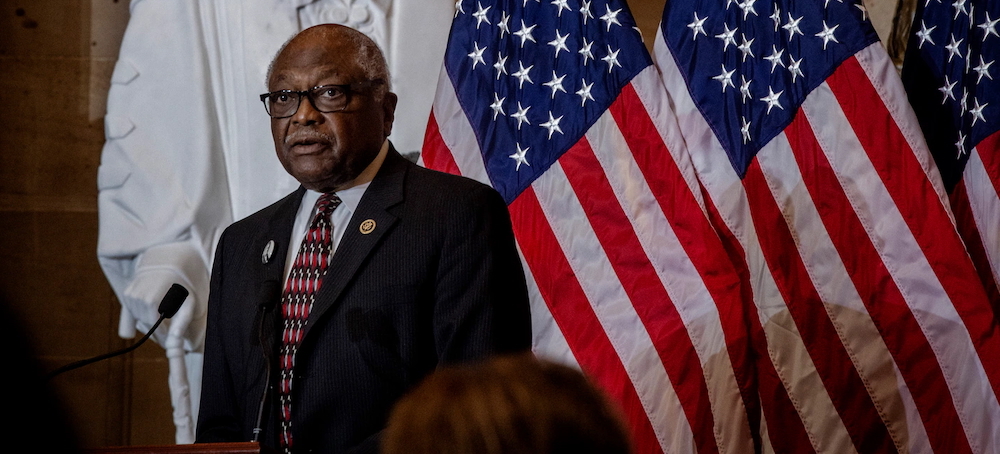 Rep. James E. Clyburn. (photo: Bill O’Leary/WP)
Rep. James E. Clyburn has long been a power broker in the Democratic Party. A state Senate leader had warned that a new map could backfire for the GOP.
The rejection was a victory — at least for now — for Rep. James E. Clyburn, the Democrat whose seat was at risk, and a setback for President Donald Trump. The president has persuaded Republicans in other states to redraw their congressional maps to boost the party’s chances of hanging on to its slim House majority.
South Carolina Republicans decided not to redraw their map after a GOP leader warned it could backfire. Republicans now hold six of the state’s seven congressional seats, but state Senate Majority Leader A. Shane Massey argued that a new map would spread out Republicans’ core voters so much that they would wind up with five.
In a lengthy floor speech, Massey told his colleagues they shouldn’t get too greedy.
“To most people in the country, I think this is a perfect example of just how much elected officials have lost their way,” he said. “Too many people in power just want to do whatever it takes to stay in power.”
Massey said he spoke with Trump on Monday in what he described as a gracious conversation. Ahead of the vote, the president in a social media post said he was “watching closely” and urged Republicans in South Carolina to “BE BOLD AND COURAGEOUS.”
To pass a new map, the South Carolina Senate needed to agree to extend its legislative session, a move that required a two-thirds majority. The senators voted, 29-17, leaving supporters two votes short.
James Blair, who heads Trump’s political operation, wrote in a social media post after the vote that “South Carolina isn’t done.” South Carolina Gov. Henry McMaster (R) did not immediately say whether he would call a special session to try to push a new map through the legislature.
Trump last year pressured Republican-led states to draw more districts in the GOP’s favor, and the Supreme Court two weeks ago gave them more opportunities to do that with a decision that weakened the Voting Rights Act.
Since last summer, Republicans have boosted their chances in 15 districts across seven states and could add another one or two in Louisiana.
Democrats have probably gained six seats since last summer — five through a ballot measure in California and one through a lawsuit in Utah. Voters in Virginia approved giving them another four last month, but the state Supreme Court last week invalidated the ballot measure.
In another blow to Democrats, the Missouri Supreme Court on Tuesday upheld a Republican gerrymander in that state.
Also Tuesday, Alabama Gov. Kay Ivey (R) postponed four House primaries slated for next week in response to a Supreme Court decision clearing the way for a map that’s more favorable for Republicans. The primaries will now be held in August.
The Republicans’ advantage in the national redistricting fight has improved their chances of keeping their majority in the House, which they now control 217-212. Democrats are bullish about winning this fall because of Trump’s sagging approval ratings.
“Donald Trump and House Republicans have failed on the economy and have made life more expensive,” House Minority Leader Hakeem Jeffries (D-New York) said in a statement. “That is why the extremists are trying to rig the midterm elections through an unprecedented gerrymandering scheme. They will not succeed.”
The latest rush to gerrymander districts is expected to reduce the number of Black members of Congress. The number of Black lawmakers has grown for decades largely because of the Voting Rights Act of 1965 and later amendments to it.
A new map in South Carolina would probably end the career of Clyburn, who was first elected in 1992 and is the first Black member of Congress from South Carolina since Reconstruction. He has established himself as a power broker during his 34 years in Congress, and he played an essential role in securing the Democratic presidential nomination for Joe Biden in 2020.