Some Republicans Fear Medicaid Cuts Could Cost Them Their Jobs
Hannah Knowles and Marianna Sotomayor The Washington Post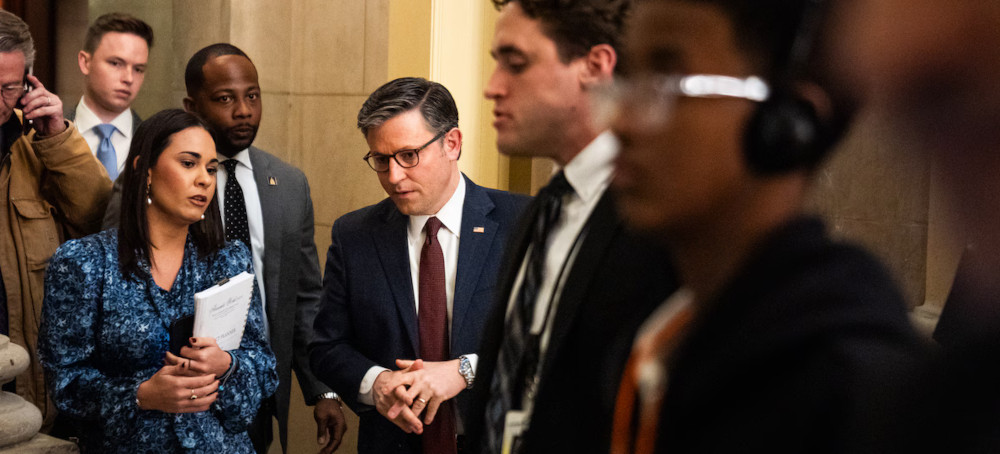 Speaker Mike Johnson (R-Louisiana) makes his way to the floor on Tuesday. (photo: Demetrius Freeman/The Washington Post)
Possible changes have become a headache for the most vulnerable Republicans in Congress and have handed Democrats a potent issue.
“They’re going to go after you for this,” Van Drew recalled telling the president. “You know, we could very easily lose the majority for it. I think it’s a mistake.”
On Tuesday, however, Van Drew and almost every other House Republican voted to move forward with that framework for their “big, beautiful bill,” as Trump called it, setting up a potential clash over health insurance for millions of lower-income Americans that could cost the GOP at the ballot box. Trump and House GOP leaders insist they won’t touch Medicaid benefits and will simply target “fraud” — but it’s not clear how they can meet their targets for spending cuts without big changes, experts say.
The possibility of Medicaid cuts has become a headache for the most vulnerable Republicans in Congress — some of whom are vowing to reject any final bill that slashes the program — and it has handed Democrats a potent issue ahead of the 2026 midterms. Republicans are struggling to pay for Trump’s legislative agenda without cutting into programs that their voters rely on, especially as they seek to position themselves as the party of the working class.
“Last night’s vote was important, but that was just the beginning,” said Rep. Tony Gonzales (R-Texas), who has urged leadership to stay away from Medicaid. “And myself, other members of the Congressional Hispanic Conference, [are] going to be very involved in the sausage-making process to ensure that some of these … proposals that I think are detrimental to hardworking Americans don’t become reality.”
Republican leaders have suggested they can reduce waste and fraud in Medicaid spending without cutting Americans’ benefits. Van Drew said Wednesday that he voted for the budget resolution because Trump appears “100 percent committed to keeping Medicaid other than waste, fraud and abuse.” He said he also expects the GOP’s plan to change as the Senate gets involved in negotiations.
“We’re not going to touch it. Now, we are going to look for fraud,” Trump said Wednesday when asked about Medicaid. House Speaker Mike Johnson (R-Louisiana) echoed that goal.
Democrats are already using the threat of Medicaid cuts against Republicans. The Democratic Congressional Campaign Committee issued a flurry of news releases Wednesday hitting the most politically vulnerable GOP lawmakers on the issue. Medicaid has also been a focus of recent protests at lawmakers’ offices around the country.
Rep. Suzan DelBene (Washington), chair of the Democratic Congressional Campaign Committee, said Republicans are “favoring the wealthy and well-connected and making working families pay for it” as they look to extend the tax cuts from Trump’s first term. She dismissed some lawmakers’ claims they can avoid cuts to Medicaid.
“The math doesn’t work,” she said.
Medicaid provides health coverage for roughly 1 in 5 Americans, and significant cuts to social safety net programs could hurt swing-district House Republicans, particularly those who represent lower-income communities. Republicans note that the budget resolution passed Tuesday sets only the parameters for a long negotiation ahead. But it calls for $880 billion in cuts to spending overseen by the House Energy and Commerce Committee, and Medicaid and Medicare make up the vast majority of what that committee could slash.
Republican and Democratic leaders alike have sworn off cuts to Medicare, which provides health coverage for the elderly. That leaves Medicaid. Even if the Energy and Commerce Committee slashed all the other spending under its purview, that would not get it to $880 billion, said Edwin Park, a research professor at Georgetown University’s McCourt School of Public Policy who has examined the GOP’s proposals closely.
Republicans have floated many possible changes to Medicaid, including various ways to shift more of the program’s financial burden to states. Some want to add work requirements to receive benefits and say that option is the most politically palatable.
“Work requirements, I think, is something that we can get every Republican to agree on,” said Sen. Josh Hawley (R-Missouri), who has warned against major cuts to Medicaid.
Past Congressional Budget Office estimates, as well as more recent projections, suggest that work requirements could save about $100 billion, Park said. That would fall far short of Republicans’ $880 billion target.
In interviews, some Republican senators expressed skepticism about potential Medicaid cuts. Hawley said he is open to restructuring Medicaid but has concerns about “anything that results in cuts to actual work beneficiaries.”
“Medicaid is monstrously important in West Virginia, that’s for sure,” said Sen. Jim Justice (R-West Virginia). “[But] I think it’s premature for us to run through the village with our hair on fire.”
In the House, some GOP lawmakers voted yes on the budget resolution but rejected Medicaid reductions.
“I’ve heard from countless constituents who tell me the only way they can afford health care is through programs like Medicaid, and I will not support a final reconciliation bill that risks leaving them behind,” Rep. David G. Valadao (R-California), a top target for Democrats, said on the House floor. Well over half of his constituents use Medicaid.
“Millions of Americans depend on Social Security, Medicare and Medicaid, and I will have no part in cutting these programs for the folks that are legally entitled to them,” Rep. Derrick Van Orden (R-Wisconsin), another congressman from a battleground district, said in a statement.
It took time for undecided lawmakers to support the budget resolution, which passed the House on Tuesday after every Republican but one voted to approve it. Leadership and relevant committee chairs told skeptical lawmakers this week that they will be part of a process that protects Medicaid and other programs.
“There are still plans to have reforms to Medicaid so that it’s not being defrauded,” said Rep. Jodey Arrington (R-Texas), who chairs the Budget Committee.
GOP lawmakers say they are just beginning the legislative process that will become Trump’s “big, beautiful bill” meant to extend tax cuts and enact his priorities on energy and border security. Johnson and Senate Majority Leader John Thune (R-South Dakota) must iron out differences in their budget proposals, since both chambers must agree on a set of spending parameters.
Rep. Nicole Malliotakis (R-New York), another lawmaker who has warned against Medicaid cuts, said she received assurances that leadership is “focusing on the Medicaid fraudster.”
If the eventual bill does cut into benefits — as Democrats predict — “then maybe I’m not going to vote for the final budget,” Malliotakis said. Right now Republicans in the House can lose only one vote.