Snow Days Set to Disappear Across Much of the US Due to Climate Change
James Dinneen New Scientist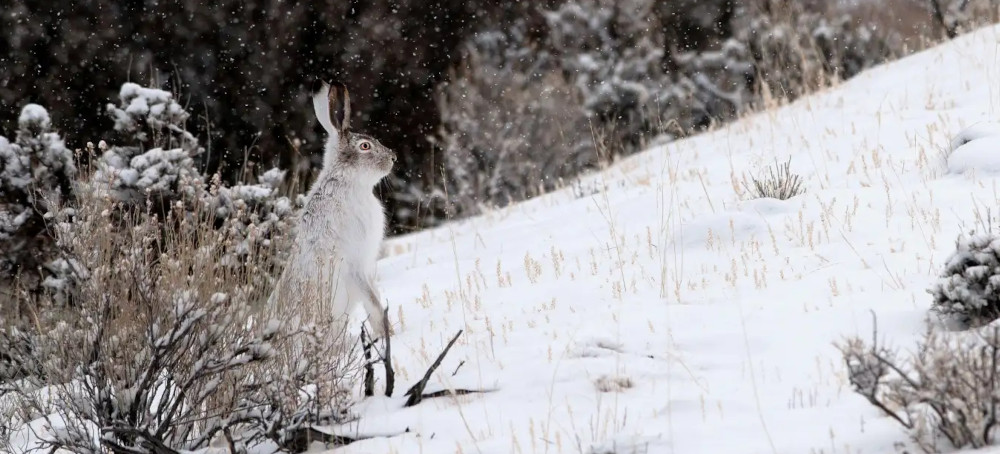 A white-tailed jackrabbit (Lepus townsendii) in the snow. (photo: Alamy)
By the end of the century, most of the US outside the high mountains may never see deep snow cover the ground, with consequences for water storage as well as for the life on and beneath the snow
Once-snowy areas have already started transforming. “We see places like New Hampshire turning into places like New Jersey, which is a bit hard to swallow,” says Elizabeth Burakowsi at the University of New Hampshire.
We have long known that warming temperatures can reduce snow cover, but the relationship isn’t always straightforward. Higher temperatures can cause more snow to fall as rain, speeding up melting. But this heat can also boost overall precipitation by enabling the atmosphere to hold more water vapour, increasing snowfall in some places.
Burakowski and her colleagues used a climate model to project how snow cover would change across the continental US under a worst-case emissions scenario leading to global warming of around 3.6°C by 2100.
They found that the number of days each year with at least some snow on the ground will decline across much of the country. Areas like New England will still get snow, but “it becomes a much more ephemeral, come-and-go snow”, says Burakowski.
There will be a more dramatic decline in days with deep snow – a snowpack around 76 centimetres thick or more, enough to melt into the snow water equivalent (SWE) of at least 75 millimetres of precipitation. By the end of the century, most of the country will have no deep snow days, save for mountainous areas like the northern Rockies and parts of Maine.
These changes are visible in maps showing the number of deep snow days per year. In New England and the Midwest, there were plenty of deep snow days in 2019 (upper left), although not as many as these regions saw, on average, from 1984 to 2013 (upper right). But that changes drastically in the maps showing the model’s forecast for snow days in the future: coverage drops significantly from 2020 to 2050 with 2.4ºC of global warming (lower left) and disappears from 2070 to 2100 with 3.6ºC of warming (lower right).
The loss of this deep snow can especially affect animals and plants that live beneath the snow, such as frogs and small mammals. The change in snowfall will also have consequences for water storage and flooding, such as increased runoff from rain falling on snow, says Burakowski.
“You’re going to see more intermittent melt events that can obliterate the snowpack and make it completely disappear,” she says.
Burakowski presented the findings at the American Geophysical Union meeting in Washington DC on 11 December.