She Was Put in Jail in Texas for an Abortion. Blame the Supreme Court for What Happened Next.
Mary Ziegler Slate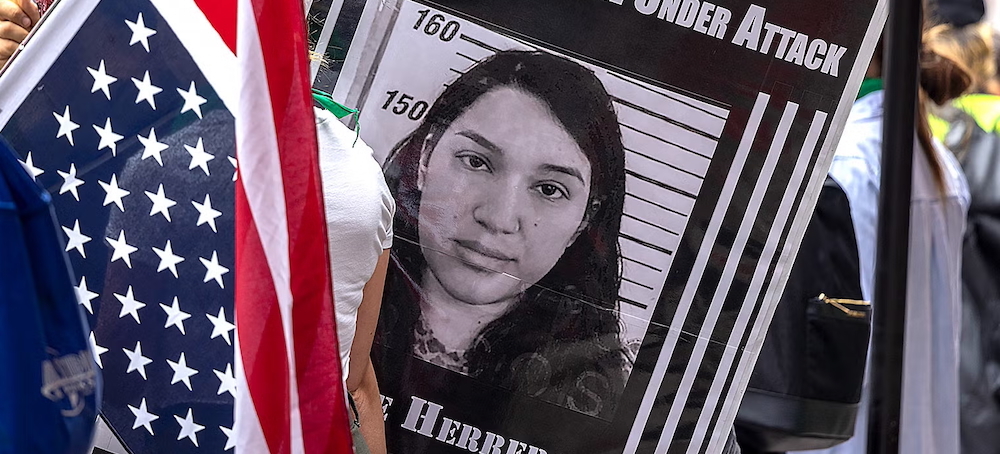 The stakes of Lizelle Gonzalez’s suit are high. (photo: David McNew/Getty Images)
In 2022 Herrera, who now goes by Lizelle Gonzalez, took the abortion pill misoprostol when she was 19 weeks pregnant. After she suffered complications, she went to a county hospital, and following her discharge, a health care provider tipped off local law enforcement. Then, Gonzalez was arrested.
The arrest never should have happened. Though Texas’ S.B. 8 made it a civil offense to provide or aid an abortion after six weeks of pregnancy, the law protected abortion seekers from suit. State law prohibits the prosecution of women for abortions too. Eventually, that reality caught up to county prosecutors, who released Gonzalez after she spent two days in jail. The Texas bar subsequently disciplined Gocha Allen Ramirez, the Starr County district attorney, and Gonzalez filed a civil-rights suit against him and other officials involved in her arrest.
The stakes of Gonzalez’s suit are high because there has been a significant uptick in prosecutions related to conduct during pregnancy, especially in the years since the SCOTUS reversal of Roe. If officials don’t even have to have a legal basis for charges, the number of prosecutions will only increase.
And the spike we’ve seen so far isn’t an accident. The anti-abortion movement has long fought for fetal personhood, the idea that constitutional rights begin at fertilization, and that enforcement of those rights requires the criminalization of abortion (and potentially in vitro fertilization or some contraceptives). Prosecutions amplify this strategy by treating an embryo the same as a born person. Someone unsure of how to react to a miscarriage might be prosecuted for abuse of a corpse. Someone who takes drugs during pregnancy might be charged with chemical child endangerment.
Demand for this kind of charge only seems to be growing. In recent years, self-proclaimed anti-abortion abolitionists have argued that personhood requires the punishment of women. If an embryo or fetus is a person like any other, the abolitionist argument goes, abortion seekers must be prosecuted, since they would face homicide charges for any other unlawful killing. The abolitionists also assert that women should be punished not for abortion but for homicide. This stance may have a practical appeal to abortion foes, who recognize how much easier it will be to punish women who live in ban states than to extradite and penalize doctors who mail abortion medication from places that protect reproductive rights.
Abolitionist bills have become increasingly common in the states, and prominent figures in the anti-abortion movement have embraced them. Abby Johnson, one of the movement’s most visible figures, supports this kind of criminal law. Clint Pressley, the president of the nation’s largest conservative Protestant denomination, the Southern Baptist Convention, recently endorsed a Tennessee bill that would treat abortion seekers as murderers and subject them to sentences including life in prison or even the death penalty.
Some prosecutors aren’t waiting for the passage of abolitionist laws. In Georgia, 31-year-old Alexia Moore went to the hospital with severe abdominal pain. She reported having taken misoprostol and oxycodone. She then gave birth to a severely premature child who died about two hours later. Prosecutors charged Moore with malice murder because she had taken misoprostol. There are signs that the charges won’t stick: A Georgia judge released Moore on a $1 bond on the murder charge because he was so unconvinced that a jury would convict her. (Because of her oxycodone use, Moore also faces charges for possession of a controlled substance and possession of a dangerous drug.) But without a deterrent, anti-abortion prosecutors may have little to lose by proceeding in cases like Moore’s.
Deterrence is what Lizelle Gonzalez was trying to create with her lawsuit. She brought a civil-rights suit for false arrest, malicious prosecution, and conspiracy. Her basic claim was that prosecutors and police should have known that she had committed no crime but persecuted her anyway. The defendants responded with a claim that has become familiar in cases of police violence: They simply enjoy immunity from suit, whether or not they violated Gonzalez’s rights.
Qualified immunity doctrine is supposed to give law enforcement and other government actors fair notice of when they have crossed a constitutional line before they face debilitating lawsuits. Recently, the doctrine has come in for scathing criticism from commentators across the ideological spectrum. Critics argue that qualified immunity is a lawless recent invention, with no roots in our history or tradition, one that eliminates accountability for government wrongdoing and undermines trust for the people who are supposed to protect us. None of this has moved the Supreme Court, which has shown no interest in revisiting the validity of the doctrine.
And the rules governing qualified immunity paint plaintiffs like Gonzalez into a corner. She had to prove that her rights were “clearly established” at the time of her arrest. In practice, for many people whose rights have been violated, that’s an impossible task.
That has been the case for Gonzalez so far. Judge Drew Tipton, whom President Donald Trump nominated in 2020, granted the prosecutor and police’s motion to kick out the case based largely on the idea of qualified immunity. His reasoning was striking. While noting that the right to protection against false arrest was clear, for example, Tipton ruled that it wasn’t clear the sheriff’s office had violated Gonzalez’s rights by following prosecutors’ orders, even though they knew they had no probable cause to arrest her. And the sheriff had qualified immunity from the malicious prosecution claim because at the time Gonzalez was arrested, the 5th U.S. Circuit Court of Appeals hadn’t yet recognized such a claim. Gonzalez’s claims against Ramirez, the DA, didn’t fare any better.
The outcome in Gonzalez’s case isn’t entirely a surprise. False-arrest claims are notoriously hard to win. A plaintiff like Gonzalez needs to show that law enforcement lacked even probable cause for an arrest. That’s more than just innocence: A plaintiff must demonstrate that an arrest was inherently unreasonable and that police lacked even a reasonable suspicion of wrongdoing. Malicious prosecution cases are similarly hard to bring because they require proof that a prosecutor had malicious intentions, not just a bad case.
But Gonzalez had an excellent case. Texas law is clear: Women can’t be criminally prosecuted for ending their own pregnancies. And Tipton seemed to acknowledge that everyone involved in her arrest had no probable cause to move forward, and they knew it. That still wasn’t enough. Gonzalez lost this round of her case. That speaks to just how hard it will be for future plaintiffs to hold officials accountable. Not every state’s law is as clear as Texas’. If Gonzalez loses, it’s hard to see who can prevail.
Gonzalez’s case isn’t over, but it has already sent a chilling message. Prosecutions of abortion seekers are only going to increase, and prosecutors will see rulings like this one as a green light to ignore the laws that claim to protect them.