Senate Approves Slashing $9 Billion From Foreign Aid and Public Broadcasting
Theodoric Meyer and Marianna Sotomayor Washington Post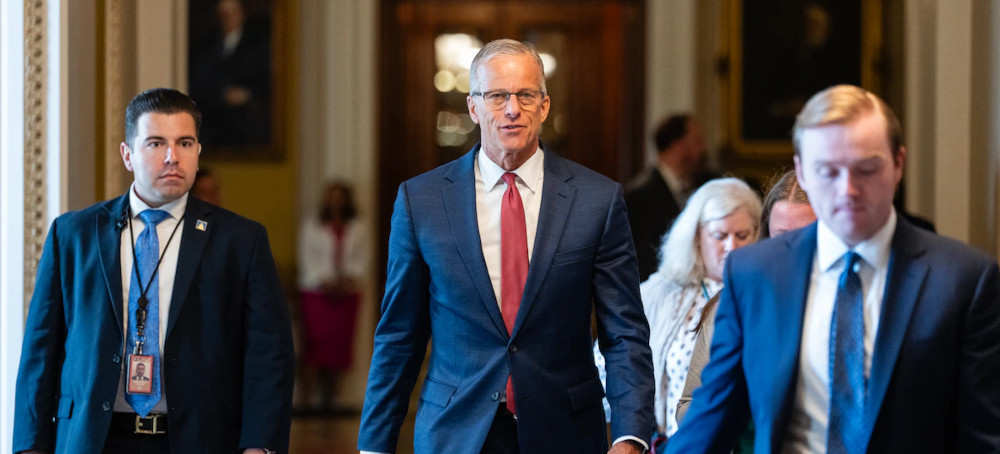 Senate Majority Leader John Thune (R-South Dakota) spearheaded a successful vote on a bill to slash $9 billion from already allocated funds for foreign aid and public broadcasting. (photo: Eric Lee/For The Washington Pos)
ALSO SEE: The Senate Approves Cuts to NPR, PBS and Foreign Aid Programs
The legislation hands the Trump administration a victory in its ongoing power struggle with Congress over federal spending.
The vote was 51-48. Two Republicans — Sens. Susan Collins (Maine) and Lisa Murkowski (Alaska) — voted with Democrats against the bill. One Democrat, Sen. Tina Smith (Minnesota), was admitted to George Washington University Hospital on Wednesday after feeling unwell and did not vote.
The bill now returns to the House, which must pass it by Friday under the law that Republicans are using to undo spending that Congress previously approved. The rescissions — as such cuts are called — would be the first passed at a president’s request in decades.
Senate Republicans concerned about the cuts won an important concession, restoring $400 million for the President’s Emergency Plan for AIDS Relief that the administration sought to slash. PEPFAR is estimated to have saved 26 million lives since it was started in 2003 by President George W. Bush.
But there was no reprieve for public broadcasting. The bill would slash $1.1 billion from the Corporation for Public Broadcasting, which funds PBS and NPR. Democrats have warned that the cuts will devastate local stations — especially in rural areas — that depend much more on federal funding than NPR or PBS themselves. A last-ditch amendment from Murkowski and Collins to undo most of the public broadcasting cuts failed Thursday morning.
Other Republicans argued that taxpayers should not be forced to subsidize stations that have other funding streams, including donations, corporate sponsorships and grants from private foundations.
“Many states already invest in public broadcasting,” Sen. Eric Schmitt (R-Missouri), the bill’s lead sponsor, said on the Senate floor. “It’s entirely reasonable and frankly long overdue to expect them to shoulder more of the burden.”
The package also includes billions of dollars in cuts to foreign aid, including funding for refugees, democracy promotion and the United Nations. Russell Vought, the White House budget director, has described some of the spending as “almost comically wasteful,” such as funding for electric buses in Rwanda and wind farms in Ukraine.
The bill would mark a second legislative victory for Trump in recent weeks if it passes the House. Trump signed a law earlier this month extending his 2017 tax cuts and pouring hundreds of billions of dollars into immigration enforcement and defense.
Republicans have described the bill as a first step toward cutting spending, even though it achieves only a small fraction of the $1 trillion in annual saving that Elon Musk promised to find in the federal budget during his time as a top White House adviser.
“What we are talking about here is one-tenth of 1 percent of all federal spending,” Senate Majority Leader John Thune (R-South Dakota) said Thursday morning on the Senate floor. “But it’s a step in the right direction.”
Democrats have countered that the cuts pale in comparison to the more than $3 trillion that the tax and spending bill Trump signed this month would add to the deficit, according to the Congressional Budget Office. Sen. Patty Murray (Washington), the top Democrat on the Appropriations Committee, warned Republicans with reservations about the bill that passing it would embolden the administration to seek more cuts.
“Everything is going to be on the chopping block, and all of our time here in the Senate is going to be spent on those requests,” Murray said Wednesday on the Senate floor.
The bill is the latest salvo in an ongoing struggle between Congress and the administration over federal spending. The administration has made deep cuts to federal agencies without congressional approval, firing thousands of workers and effectively shuttering the U.S. Agency for International Development. The agency administered many of the foreign aid programs that the bill would cut.
Democrats and Republicans alike have pushed back.
Collins and Murray chided Vought in March for failing to spend $2.9 billion approved by Congress, writing that “it is incumbent on all of us to follow the law as written — not as we would like it to be.” And Collins and nine other Republican senators wrote to Vought on Wednesday to urge him to stop withholding education funding approved by Congress from the states.
In addition to scrapping the PEPFAR cuts in the bill, the White House agreed to transfer millions of dollars to the Interior Department to spare Native tribal radio stations from the cuts to public broadcasting to secure the vote of Sen. Mike Rounds (R-South Dakota).
Those changes were not enough for Collins and Murkowski, who criticized the administration for failing to provide enough detail about which programs would be affected by the bill’s cuts.
Some Republicans who backed the bill echoed their concerns. Sens. Thom Tillis (R-North Carolina), Mitch McConnell (R-Kentucky) and Roger Wicker (R-Mississippi), all of whom voted for the bill, lamented that the White House had not shared more details about which programs would be cut if it passed.
“I suspect we’re going to find out there are some things we’re going to regret, some second- and third-order effects, and I suspect that when we do, we’ll have to come back and fix it,” Tillis said.
McConnell voted against starting debate on the bill Tuesday but flipped and supported it Thursday morning.
“I don’t have any problem with reducing spending,” he told reporters Tuesday evening. “We’re talking about not knowing — they would like a blank check, is what they would like. I don’t think that’s appropriate.”
Senate Majority Leader John Thune (R-South Dakota) told reporters he sympathized with those concerns but that most Senate Republicans “believe that there was enough detail there to make a good decision about whether or not we wanted to move forward on the package.”
Democrats accused Republicans who supported the bill of making it harder to strike bipartisan funding deals moving forward. Senate Republicans will need Democrats’ votes to avoid a government shutdown starting Oct. 1. But Republicans could later on scrap Democratic priorities enacted in such a deal without their input through rescissions bills, which need only a simple majority to pass.
“This is just an old-fashioned double cross,” Sen. Chris Murphy (D-Connecticut), an Appropriations Committee member, said on the Senate floor. “It’s a con job.”
The House expected to take up the bill Thursday to approve the Senate’s changes.
House Republican leadership is confident it can pass, even though four House Republicans — Reps. Mark Amodei (Nevada), Brian Fitzpatrick (Pennsylvania), Michael R. Turner (Ohio) and Nicole Malliotakis (New York) — voted against it last month. The bill passed only because of several Democratic absences, and House Speaker Mike Johnson (R-Louisiana) will need to flip at least one of the Republicans who voted no if every lawmaker is present.