Searching for Iran’s Disappeared
Cora Engelbrecht The New Yorker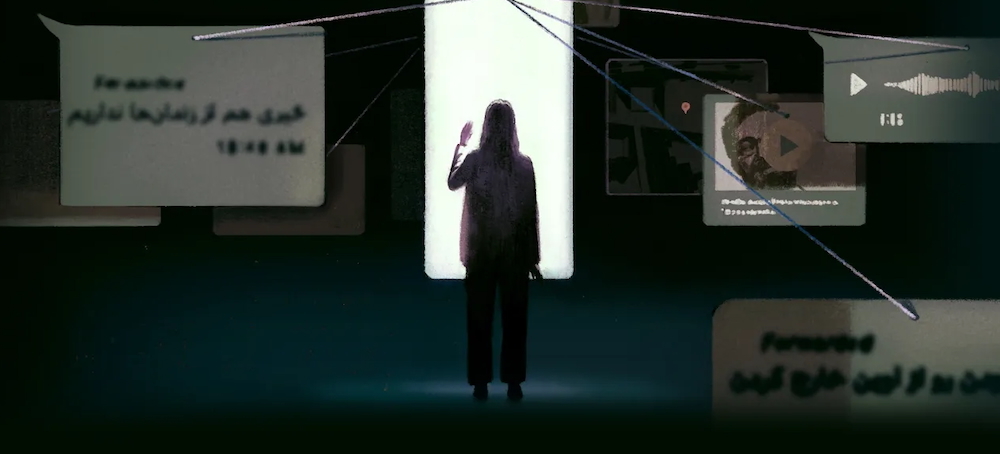 "Families are doing ad-hoc forensics to confirm the whereabouts of their detained loved ones, who have been transferred to undisclosed locations, and are at risk of abuse or execution." (photo: Hokyoung Kim/New Yorker)
Families are doing ad-hoc forensics to confirm the whereabouts of their detained loved ones, who have been transferred to undisclosed locations, and are at risk of abuse or execution.
The Asadollahis set out to Evin Prison, in the foothills of the Alborz Mountains north of the city, where they believed Ali was detained. State-controlled television had announced that Supreme Leader Ayatollah Ali Khamenei had been “martyred,” and the highways out of Tehran were clogged with bumper-to-bumper traffic as people tried to escape the capital. When the Asadollahis finally arrived at Evin, a crowd had formed outside, made up of hundreds of other Iranians who had similarly braved the ongoing bombardment to reach their loved ones. The Asadollahis headed toward Ward 209, a repository for political prisoners that’s run by Iran’s intelligence ministry. But they were turned away by the guards, who told them that the ward’s detainees had been transferred elsewhere.
The Asadollahis went to the Islamic Revolutionary Court, in eastern Tehran, hoping to find someone there who could provide more information. An officer confirmed that Ali had been taken to a new location, but he wouldn’t provide more details. One of his relatives updated the family’s group chat, which included relatives outside Iran:
“Guys, I’ve been told that those who were in Ward 209 have been taken out of Evin.”
“They’ve been transferred somewhere else—we don’t know where.”
“I’m really worried—what if they take them to a safe house and then bomb that place?”
Soon after the Asadollahis went home, the Revolutionary Court was hit by an air strike—part of President Donald Trump’s widening liberation campaign, which he has said is meant to help Iranians “take over” their country. Trump’s call to action was astounding for many people, like the Asadollahis, whose relatives had already served prison sentences for protesting the Islamic Republic. “My family has faced repression and psychological torture from this regime for my entire life,” Shailin, one of Ali’s sisters, told me. She spoke to me from Germany, where she had fled after participating in Iran’s Women, Life, Freedom movement, which flared up in September of 2022 and led to the arrest of around twenty thousand protesters, including Ali and another sister, Anisha.
Shailin and her siblings come from a family of dissidents who have long hoped to see the government fall. But she was enraged by the U.S. and Israel’s military campaign, which had wedged her relatives in Iran between autocracy and possible death. If her family left their houses to search for her brother, they risked encountering air strikes that were now “destroying our oil, our water, and our neighborhoods,” Shailin told me. She called Trump and the Israeli Prime Minister Benjamin Netanyahu “manipulators” who have “no interest in changing the regime” in Iran. (In a speech on Wednesday night, Trump said as much, claiming, “regime change was not our goal. We never said regime change,” though he added that regime change was a by-product of his operation in Iran.) “This is not the war we wanted,” Shailin said. “This is just some new hell.”
As Trump threatens to bomb Iran “back to the Stone Age,” many Iranians are still grappling with the human consequences of the protests that occurred before the war, which pushed the Islamic Republic toward a political precipice. The regime ruthlessly cracked down on hundreds of thousands of demonstrators who emerged in the streets in late December and early January. No one knows exactly how many protesters were killed, but estimates range from seven thousand to thirty thousand. Even more were arrested: as many as fifty thousand people are thought to be held in facilities across the country, many after receiving harsh sentences in court proceedings that were closed to the public. Some of those prisoners have since been transferred to new locations, making it harder for their families to find them, let alone advocate for them.
Prisoners have been moved because of staffing, food, and capacity shortages at the facilities where they were being held. There’s also the potential of the jails themselves becoming military targets: last June, during the Twelve-Day War, Israeli air strikes hit Evin Prison, killing roughly eighty people, including detainees, visiting family members, and prison staff. Security officers forced the remaining prisoners to walk, shackled and at gunpoint, through a “tunnel of horror” to an undisclosed location, according to Mehdi Mahmoudian, a screenwriter and activist who was previously imprisoned at Evin, with whom I spoke last month. He later wrote that he felt “caught between the claws of foreign beasts and domestic torturers being passed from one to another.”
Since the bombardment in March, prisoners have been moved to military zones, police facilities, safe houses, and other jails that have been damaged by air strikes, too, according to human-rights groups and relatives of prisoners. Families like the Asadollahis were also fearful that the regime would use the U.S.-Israeli assault as a pretext to abuse or kill their loved ones under the cover of war. “Prisoners are in real danger of being routinely executed in this darkness,” Hadi Ghaemi, the director of the Center for Human Rights in Iran, told me. In March, a group of detainees were shot and killed by guards at a prison in Sistan-Baluchestan, an impoverished province in southeast Iran, after they protested the living conditions in their wards. That same month, in the city of Qom, Iranian authorities hanged three men who were accused of killing police officers during the nationwide protests. These executions “crossed a critical threshold,” according to a statement from the United Nations, which noted that these were the first Iranians to be hanged in connection with the demonstrations. “We are afraid they will not be the last,” the statement read.
The Islamic Republic has also been doubling down on propaganda, and enlisting its supporters—including soldiers, their families, and children as young as twelve years old—to come out and “occupy the enemy within, so that it doesn’t have a chance to mobilize,” Ghaemi said. “They’re telling their base that they are fighting two wars—one is against foreign aggression, and the other at home, against protesters in the streets.” In a recent television interview, Iran’s police chief, Ahmadreza Radan, warned that, “from now on, if someone acts at the enemy’s behest, we will no longer consider them protesters or anything of the sort. We will regard them as the enemy.” Shortly after, the Islamic Revolutionary Guards Corps (I.R.G.C.) said that any future protests would be met with an even “harsher blow” than before. Ghaemi said that this language was reminiscent of the propaganda that helped fuel and justify other historic atrocities, such as the massacres in Myanmar or Rwanda. “The regime is making it clear that any dissident, protester, or anyone else who is not with them will soon get their wrath,” he said. “It is deeply worrying.”
Since early March, when the war began, Iranian authorities have arrested at least fifteen hundred people, including activists and civilians accused of speaking to foreign media outlets. The regime has also broadcast hundreds of forced confessions on state television. One woman sent me a video of her eighteen-year-old nephew, his face blurred as he sits for a staged interrogation in which he admits that he “made a mistake” by joining a January demonstration in the city of Isfahan, where four security officers were said to have been killed.
The public displays of control are happening amid an internal bureaucratic collapse. Several dozen Iranian leaders and their deputies have been killed since the war began. Military experts from the Institute for the Study of War have verified strikes on at least seventeen of the sixty-nine known police stations in Tehran, in addition to fourteen of the twenty-three military bases overseen by the Basij, a paramilitary organization that operates under the authority of the I.R.G.C. While the I.R.G.C. is still in place, many local police and paramilitary officers have abandoned their posts, making it almost impossible for residents to report missing people. Recurring internet blackouts have also compromised communications, and caused even more confusion for families, who have been racing to confirm the fates of those who have disappeared.
Shailin Asadollahi told me that her family’s group chat had turned into a live feed of ad-hoc forensics, chronicling their efforts to find her brother. She sent me some of her exchanges with her relatives, including texts, voice notes, and satellite images—any evidence that could help them confirm his whereabouts. In one message, a relative wrote that she had heard that authorities were transferring prisoners to a military complex in northern Tehran. Shailin started searching for others who could help her confirm the tip. A woman told her that several of her relatives had been escorted by security agents to a checkpoint on Artesh Highway to collect a prisoner there. The highway is near a military zone, called Lavizan, which has been targeted five times during the war, according to military experts. Shailin sent satellite images of the road and its surroundings to her family members inside Iran. “I never knew if I was helping them or just stoking their fear,” Shailin told me.
Shailin’s relatives in Iran—largely deprived of a voice themselves—told her to publicize their plight. Shailin appeared on Persian-language television programs and spoke to international media outlets; she also asked PEN International, a group that advocates for free expression, to publish a letter, which was signed by more than a hundred writers and scholars, calling for Ali’s release. And she posted selfie videos on her personal Instagram account, which collectively received more than one million views. “I’m calling on anyone who can hear me . . . to help us,” she said in a post on March 5th, nearly one week after the war started. She explained that her family was under the impression that her brother had been moved to a military zone that was getting bombed. “If this is true, Ali Asadollahi and other prisoners are being used as human shields,” she said.
In a post from March 13th, Shailin addressed her brother’s captors directly. “Why won’t you release him?” she asked. “My family has risked everything under this barrage of threats, going to every office to find out where Ali is. You give no answers.”
The publicity campaign paid off. On March 17th, Shailin received a phone call from Ali, who told her he had been released. He was finally coming home. “I did not recognize his voice,” Shailin told me, breaking into tears. Ali sounded despondent. He spoke in a hushed tone, and he slurred his words. But he managed to thank her for bringing attention to his case. “There is a big Hell,” he added, before handing the phone to his wife, who told Shailin that she suspected Ali had been tortured while he was detained.
The Asadollahis are part of a fortunate fraction of Iranian families who have reunited with their imprisoned relatives. After she publicized Ali’s story, Shailin’s phone turned into a makeshift hotline for other families whose relatives were still languishing in Iran’s prisons. She had received hundreds of messages from people inside and outside the country who requested her help bringing international attention to their cases. Many who reached out to her were ordinary Iranians—the “people least likely” to report disappearances, she noted, who messaged her using pseudonyms or fake accounts on social media. “They have been terrorized by this regime for decades,” she explained. “They don’t have the experience or courage to speak out. How could they?” They had believed that soliciting media attention would only provoke their relatives’ captors.
Shailin managed to refer some families to human-rights groups that advocate for prisoners in Iran. She also assisted several of them with writing scripts for their own selfie videos on Instagram, such as Leila Moradi, a woman whose brother had been transferred from Evin Prison to Fashafouyeh Prison, south of Tehran.
“Some days I just stay in bed,” Shailin told me, during a recent phone call. “These are not my family members. But I think about them incessantly, even when I try to rest, as if they are my own brother.”
Hamidreza Mohammadi, the brother of Narges Mohammadi, the imprisoned Nobel Peace Prize laureate, said that families like his have long endured “psychological torture.” Narges, who is one of many prominent activists and journalists who have been detained since December, was beaten by security agents in Mashhad before she was taken to a detention center run by the intelligence ministry, according to her relatives and Chirinne Ardakani, a human-rights lawyer based in Paris, who represents her. Over the next two months, her family received just two phone calls from her and few details about her circumstances. Others released from the same prison reported that Narges, who has a heart stent, had been taken to the hospital twice for cardiovascular problems and for injuries she had sustained during her arrest.
In February, a judge sentenced Narges to seven and a half years in prison for “assembly and collusion against national security” and “propaganda against the Islamic Republic Regime.” She was transferred to a more remote prison in Zanjan, a city that has since been targeted multiple times by air strikes. Last week, Narges was finally allowed a brief visit with her sister and two lawyers, who were alarmed at how rapidly her health had deteriorated. “She had lost weight, she was very pale,” and she was accompanied by a nurse, “because she was not in good shape,” Ardakani, who was briefed on the visit, told me. Narges said she had recently passed out in her cell for more than an hour before her cellmates managed to get the attention of the prison guards. She regained consciousness in the prison infirmary, where a doctor told her she had likely suffered a heart attack. Authorities had since dismissed her lawyers’ requests to send her to a hospital for urgent treatment. Her case was not an exception, according to a researcher at Human Rights Watch, who told me that they had confirmed similar reports from prisons across Iran, where detainees were routinely denied access to adequate medical care, including specialized treatment at hospitals.
One prisoner in his thirties, whom I will call Amin, was arrested in Tehran on January 8th. After his mother learned that he had been taken by security agents, she drove from her home in northern Iran to Fashafouyeh Prison, where she believed he was being held. She slept outside the prison in her car for three nights until officials confirmed that her son was inside. Afterward, she was allowed to visit with him every Tuesday. The first day they met, he could not stand to greet her because his left leg had been badly beaten during an interrogation. His mother put money in his jail commissary account, so he could buy snacks and meals. She showed him how to clean his clothing, which had become infested with bedbugs. And she recruited someone who worked in the prison to smuggle Amin antibiotics for an ear infection.
On March 2nd, an explosion damaged part of Fashafouyeh Prison. “He was terrified,” Amin’s sister, whom I will refer to as Deli, told me in a phone interview from Germany. She said her brother had called their mother, hours after he felt the blast, crying—he was worried that more attacks on the facility would prompt the guards to start shooting prisoners. “He wanted my mother to be there, to be his witness in case he was killed or relocated,” his sister told me.
“The day Khamenei was killed was honestly one of the best days of my life,” she continued. “But, at the same time, I was scared to death. Every time I thought about my brother in the hands of the regime—I knew they were angrier and more unpredictable than ever.”
Days after the explosion, Amin called his mother in Iran again, with better news. He had been told that he’d soon be released on bail. He seemed confident that he had a good chance of going home: the authorities were scrambling to make room in their wards to accommodate an influx of detainees from other facilities across the capital, he said. The judge assigned to Amin’s case was Iman Afshari, known in Tehran for his tough sentences—a reputation that led the European Union to place him on a blacklist, in January, for human-rights abuses. Deli explained to me that Israel and the U.S. had been targeting courthouses and the homes of influential Iranian officials. “I would never have guessed in my lifetime that I would pray for such a murderous man to stay alive—long enough to free my brother,” she said.
Later that month, there was an explosion near the Sadr city courthouse, in northern Tehran, where Amin’s mother was waiting to post bail for Amin alongside hundreds of others who had gathered to follow up on their jailed relatives. She survived the attack and returned the next morning, clutching the deed to her family’s house. She got there in time to hear a courthouse official call her son’s name. She pledged their house as security for his release and was able to bring Amin home. When Deli saw him on a video call, later that week, she said “he looked like a diminished version of himself.” He barely spoke and appeared to have lost weight. She didn’t ask him about the details of his imprisonment. “I didn’t want to upset him,” she told me.
The situation in Iran is especially harrowing for relatives who suspect that their loved ones are already dead. These families exist in a unique kind of limbo: caught between hope and grief, and denied any sense of closure. One father in his sixties, whom I will call Rebin, told me he lost contact in early January with his son, who had joined the protests in Tehran. Later that month, his daughter, who lives abroad, received a call from an unknown number informing her that her brother had been shot and killed. “Your family must collect his body,” the caller said, before abruptly cutting the line.
The phone conversation, which lasted less than two minutes, sent the family on an endless chase to find their relative. Rebin shaved and put on a white shirt and a brightly colored tie—a direct rebuke to the clerics whose burial rites demand that mourners appear unshaven and wear dark clothing. “I refuse to wear their uniform of defeat,” he told me. “This tie is the only weapon I have to unsettle their cruelty.” For the next two weeks, Rebin visited morgues, cemeteries, police stations, prisons, and forensic offices in Tehran and its neighboring districts. Trucks and vans, filled with bodies, arrived every few days. He stood among groups of families who were all on a similar hunt. He searched piles of corpses in body bags as if he was “turning the pages of a horror book,” he told me. “It was endless.” The impossibility of his quest began to settle in. He felt so disenfranchised and so thoroughly cut off from information that he began to believe the authorities were purposefully withholding evidence about his son’s fate as punishment for his own history as a political activist. “They want to torture me,” he said. “Was he shot in the heart? In the head? A thousand questions torment me.”
Rebin carries a despairing sense of hope in him, months later. “Every sound I hear, I think it might be him,” he told me. “Sometimes I think perhaps he is still alive. Perhaps there has been some mistake.” He had spent hours scrolling through online images and videos of the January demonstrations, hoping to catch a glimpse of his son among the mass of dark figures. “I searched everywhere,” he said, in a selfie video that he sent to his family and friends. “There’s no sign of him. I don’t know what I should do.” The video was discovered by intelligence agents in his province, one of whom warned that he “would settle things” with Rebin for broadcasting his story. “Our country is currently in a situation where our rulers threaten that anyone who reports news abroad will be accused of espionage and treason,” he told me. “If you mention my name, rest assured, they will kill me without a trial.”
After the war started, Rebin said that bombs would not deter him from driving to the capital once more to search for his son. “The heart wants to believe that its loved one will be found,” he wrote me, in a text message, before setting out for Tehran. “It may not be logical, but hope and longing always deceive a person.” He was determined, at the very least, to arrive in time to witness the fall of the regime. “I have waited my entire life for this moment,” he told me. “If this government ends, I will know my son’s absence will not have been for nothing.”