Samuel Alito's Wetlands-Destroying Opinion Pretends Physics Doesn't Exist
Louis Derry Slate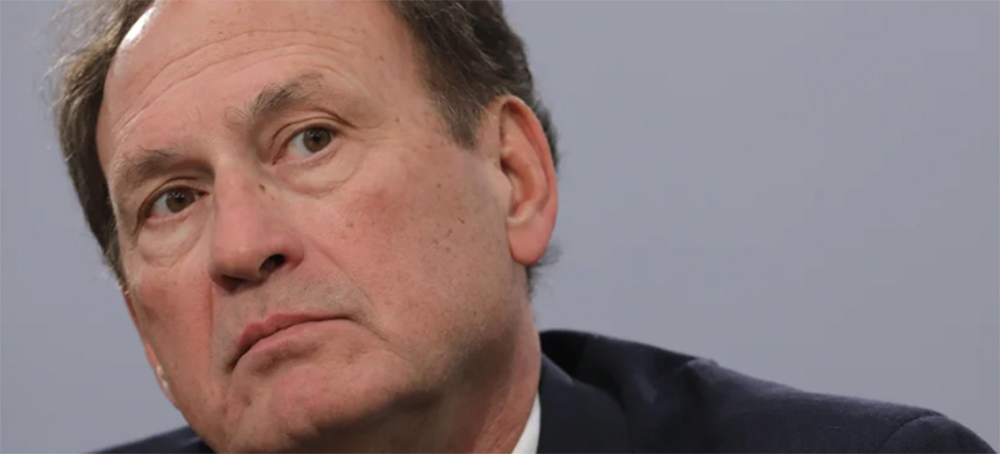 Justice Samuel Alito testifies about the court's budget in 2019. (photo: Chip Somodevilla/Slate)
The court ruled that protection under the CWA only applies when wetlands have “a continuous surface connection to bodies that are ‘waters of the United States’ in their own right, so that there is no clear demarcation between ‘waters’ and wetlands.” Justice Samuel Alito arrived at this distinction by parsing the wording of the Clean Water Act as passed by Congress in 1972 and amended in 2018—specifically the words “waters of the United States”—and the opinion makes much of this means of arriving at the decision. However, at no point does the opinion consider what connections between waters actually look like or how they work.
The notion that a wetland can only be linked to streams or lakes by a continuous surface connection—presumably visible to the justices themselves—is fundamentally at odds with hydrology, the science of water. The movement of water beneath the surface (groundwater) connects water bodies in ways that are just as or more important than surface connections, something that has been understood by hydrologists for well over a century. There is about one hundred times the volume of fresh groundwater beneath the surface as there is in lakes, rivers, and wetlands combined. Water routinely moves from wetlands into rivers and streams, and back, and much of that exchange is beneath the surface. Groundwater movement freely allows wetlands to connect to rivers even when there is no visible surface connection. Consequently, there is quite commonly no clear demarcation between “waters” and wetlands whether there is a surface connection or not. The distinction drawn by the court is hydrologically meaningless. The water itself can flow back and forth, whether the justices see it with their eyes or not. Hydrologists use the concept of “watershed” to include all the waters in a basin because they are almost always all connected, often by flow beneath the surface. This should come as no surprise even to someone with no background in hydrology. We are all at least passingly aware of the many of cases of groundwater contamination that impact water bodies of all kinds, with substantial human, ecological, and economic costs.
However, there is no need to criticize the quality of scientific understanding in the opinion—because there is nothing to criticize. Remarkably, the opinion seeks “to decide the proper test for determining whether wetlands are ‘waters of the United States’ ” while explicitly excluding scientific understanding from this test. The scope of the new opinion goes far beyond what was necessary to resolve the case before it. The court used this opportunity to deliberately undermine the CWA by establishing an expansive “proper test” that has no scientific basis. Instead of giving even minimal consideration to the science of water in making this sweeping ruling, the court cites as authorities various English-language and law dictionaries. The court apparently considers the physical principles of water movement irrelevant to a ruling that has the potential for enormous impacts on water quality and the environment.
Indeed, the court says so: It derides the EPA’s interpretation of “adjacent” and overturns the use of the concept of a “significant nexus” between a wetland and another water body, a standard that had been in place since a previous court decision in 2006. However, the EPA’s usage has a considerably firmer hydrological basis for understanding the connections between wetlands and waterways than the court’s new continuous surface connection standard.
Justices Elena Kagan and Brett Kavanaugh correctly note that it is well understood that wetlands can be linked to other water bodies without an obvious surface connection. If the court were truly interested in establishing whether wetlands are connected to other water bodies, instead of abstruse arguments about the meaning of adjacent vs. adjoining, the hydrologic sciences have an extensive tool kit that can address those questions. But the court opinion dismisses that approach as “fact-intensive,” as if facts bearing on a question were somehow a hindrance to a logical and just decision.
Further, the court takes a distinctly negative view of the possibility that the classification of a wetland could “evolve as scientific understandings change.” There could hardly be a clearer indication of the disconnect between law and science in this opinion. According to the court, the law demands a fixed definition of a wetland and its connectivity that depends weakly if at all on the facts of a specific case. That science would seek to marshal facts and to evolve understanding as new information becomes available is clearly a bug, not a feature, in the eyes of Alito.
A case about our natural world is not contract law—there is actual physical reality involved that can only be ignored at the peril of making a poor or even dangerous decision. If you jump off a bridge, gravity will surely decide the outcome, regardless of the wording of a statute on bridge-jumping. The result of the court’s linguistic analysis is an exiguous textual opinion based on parsing dictionaries instead of a functional understanding even minimally consistent with basic science.
As much as they might like to believe otherwise, even the Supreme Court does not have the power to decide if water will flow from a wetland to a stream. It will do so based on well-understood physical principles that are unaffected by legal hair-splitting. The court should not hide behind dictionary definitions in addressing questions that are inextricably both legal and scientific and that have enormous consequences for our environment and quality of life. That the court chose to deliberately ignore any scientific knowledge of the question before it and directly reject any consideration of the environmental consequences of its decision does not make this a narrow textual decision—it makes it narrow-minded.
In handing down this decision, the court has seriously undermined the explicitly stated intent of Congress “to restore and maintain the chemical, physical, and biological integrity of the Nation’s waters.” In many cases, the goals of the CWA simply cannot be achieved if a large fraction of wetlands is excluded from its purview. The opinion supporting this outcome is plainly physics-free. But physics applies whether the court wants it to or not. Wetlands are almost always connected to streams and lakes, and damaging or polluting wetlands will negatively impact the integrity of the nation’s waters, whether the court can see the connection or not. They are demonstrably part of the waters of the United States and no rational water quality policy—or legal opinion—can pretend otherwise.