Rioters? Agitators? Immigration Agents’ Claims Against US Citizens Protesters Mostly Fall Apart in Court.
Madeline Buckley, Christy Gutowski and Joe Mahr Chicago Tribune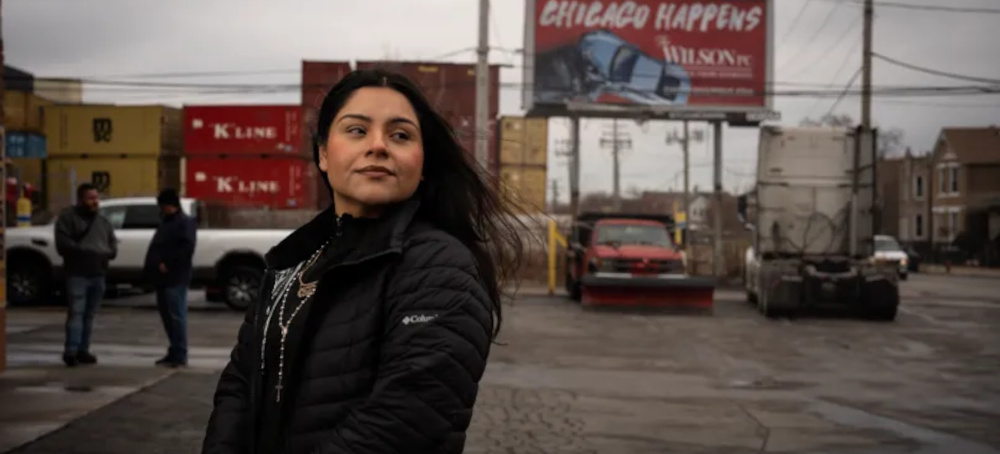 Marimar Martinez outside a truck service shop on Dec. 26, 2025, where she called 911 after she was shot five times in October by a Border Patrol agent in Brighton Park. (photo: E. Jason Wambsgans/Chicago Tribune)
The administration said U.S. citizens “stalked law enforcement, rammed vehicles, fled scenes, injured agents, and caused multiple accidents.” It called them “agitators” and “rioters.”
Agents arrested six citizens, accusing them of impeding law enforcement and — in one case — alleging that a woman vowed to put out a hit on U.S. Customs and Border Protection Cmdr. Gregory Bovino.
“And if you lay a hand on a law enforcement officer,” a news release warned, “you will be prosecuted to the fullest extent of the law.”
But, two months later, the allegations in that 24 hours have not withstood the harsh light of the federal court system. Just one of the six people has faced any federal charge. And that’s a misdemeanor ticket that agents themselves issued. It has yet to go in front of a judge.
The day is emblematic of what the Tribune found to be a broader pattern of disconnect between the U.S. Department of Homeland Security’s rhetoric of the dangers to agents during Operation Midway Blitz versus the reality borne out in the federal courts.
As federal agents swarmed the area in the aggressive immigration enforcement program, they also swept up more than 100 people, most of whom were detained during public protests, traffic altercations or on residential streets.
A Tribune analysis found that, time and again, Trump’s DHS claimed horrific abuses at the hands of protesters. Yet time and again, their allegations of abuse did not withstand the scrutiny of judicial review.
Of the 106 who could be identified as having been caught in the federal dragnet, just nine resulted in pending felony charges. The vast majority either haven’t been charged by prosecutors or, if they were, had their charges dropped — including one man jailed four days and later absolved of any wrongdoing by prosecutors.
The arrests have spurred congressional hearings and the recent filing of federal tort claims, the precursor to a lawsuit alleging negligent or wrongful acts of federal employees.
Of the others arrested, roughly two dozen were directly ordered into court on misdemeanor charges by federal agents writing tickets at the scene, instead of prosecutors choosing to file formal charges. Nearly half of the tickets have already been dismissed, while most others have yet to go before a judge.
The Tribune has interviewed more than two dozen detainees, reviewed court documents and spoken to attorneys involved in the cases, which altogether describe a federal government operating amid dysfunction and chaos.
Cases have fallen apart, sometimes in a highly public and spectacular fashion.
For example, federal grand jurors refused to indict three defendants facing felony allegations — rejections that are extremely rare in Chicago’s federal courthouse. And prosecutors opted to dismiss felony charges for several other citizens, including a 70-year-old Air Force veteran, a man with an intellectual disability and a teaching assistant at a Montessori school who survived multiple gunshots by a Border Patrol agent and later told Congress about her final moments before losing consciousness.
“I remember putting my head on the wall and thinking I was dying,” she said.
Her attorney, Christopher Parente, said the Tribune’s findings are typical of investigations during the fast-moving, aggressive Operation Midway Blitz.
“The system isn’t designed to move at a speed like a blitz,” said Parente, a former longtime federal prosecutor. “The whole point of federal prosecutions, and why they win so many cases, is because they do all the work before they charge and then once they charge a case, it’s rock solid. Here, they sort of flipped that on its head and they charge first, and investigate later. And I think that’s why you’ve seen all the problems you’re seeing.”
DHS has scoffed at the criticism of its agents and denied peddling a false narrative about citizen protesters in myriad social media posts, including the agency’s news release about that October day, entitled “Cicero or Sicario: A Day of Crashes,” which compares a Chicago suburb to the 2015 crime thriller.
In a statement issued to the Tribune, the agency doubled down on its characterization of “out-of-control violence in Chicago perpetrated by violent rioters against our agents.”
“The rhetoric and smears from sanctuary politicians and the media only contributed to this violence,” according to the statement, which concluded that agents “should be commended for the restraint they have shown.”
DHS did not directly respond to questions about how the vast majority of its arrests did not result in formal charges or survive courthouse review. Instead it referred questions about specific cases to the local U.S. attorney’s office, which said it worked long hours to “ensure justice in every case” in what was the largest enforcement operation in the district’s history.
In a statement to the Tribune, U.S. Attorney Andrew Boutros said his office “applies exacting standards before we bring federal criminal charges.”
“We carefully evaluate all facts and applicable law before making charging decisions, and in this climate, even when a crime has been committed, we must consider the concept of nullification, meaning whether a jury will convict or a grand jury will even indict,” he said.
The Trump administration’s claims of widespread Chicago chaos have underpinned the Republican president’s bid to deploy troops in the area against the wishes of Illinois’ Democratic governor. The Supreme Court this month blocked that effort, for now, while the case works its way through the appellate court in what is shaping up to be a legal showdown over whether protesters’ actions have been so rebellious that Trump could decide on his own to send troops into the streets.
While constantly complaining about the chaos its agents encounter, DHS has so far refused to release a comprehensive list of protesters it arrested during the operation. In response, a team of Tribune reporters compiled the most detailed detainment data available and conducted the first in-depth analysis of the outcomes.
The reporters’ review included a list of 92 non-immigration arrests that DHS was required, as part of a lawsuit, to submit to a federal judge. The Tribune and other media outlets successfully petitioned the court to release that record, which purportedly logs every non-immigration arrest by border agents in the operation’s first 7 ½ weeks.
The Tribune analysis added eight additional cases identified by federal prosecutors or reporters, as well as six people not arrested at a protest scene but later indicted by a federal grand jury over alleged actions at a demonstration. The list of 106 does not include anyone arrested by state or local officers called to police protests — with those cases outside the purview of DHS or federal courts.
Although federal judges have questioned the credibility of agents’ reports of danger on the streets, the Tribune did find examples of protesters screaming into the faces of agents at scenes, blocking agents’ vehicles as they tried to drive away and even trying to free people that agents had detained.
Still, many of the citizen detainees described a widespread pattern of constitutional violations, including excessive force, fabricated charges and arrests, and the denial of medical care. They detailed what they viewed as unprofessional, disorganized and downright strange treatment. Multiple arrestees said they were released without charges and then dropped off at a random gas station.
Some described being driven around for hours in unmarked SUVs, unaware of where they were being taken. None spoke of real fear that they would not make it home eventually, noting the reality that they are citizens with rights, and likely experienced far better treatment than immigrant detainees in the country without legal permission. Still, a federal judge ruled the agents’ use of force against citizens “shocks the conscience.”
‘Staged photo shoot’
Early Sept. 27, Bovino pulled into the parking lot of the Broadview Police Department and, according to court filings, issued a warning to Broadview police: Prepare for “a s–––show.”
By evening, under a dark sky, protests outside of the ICE processing facility had plunged into tumultuous scenes of violence. An agent tackled protester Aaron Hollatz to the ground, a video shows. Someone screamed: ”Get off of him!”
Demonstrators there that night — and on other days during which conflagrations broke out — told the Tribune they witnessed poor crowd control tactics and attacks by agents who seemed to be trying to provoke a confrontation.
“I’ve seen, quote, unquote, by-the-books, sort of, crowd control tactics — what cops normally do when they are not trying to cause an unsafe situation,” said Hollatz, who was detained by federal agents that day. “This was in every way the opposite of that.”
Another detainee, Ian Sampson, a 27-year-old accountant, told the Tribune he was documenting events with his camera the same day when agents emerged to move the perimeter farther away from the west suburban facility. Their commands to the crowd to move back were unintelligible, several protesters allege.
“All of a sudden they were there, in your face,” Sampson said. “So I stepped back on the grass. … I tried to move out of the way and then they just grabbed me by my backpack, pulled me down and … I had four or five guys on top of me, putting a knee in my back, smashing my head into the ground.”
Agents deployed tear gas, and arrestees who were hit described the discomfort of sitting for hours in a holding cell in the aftermath of the chemical spray. Robert Held, a 68-year-old attorney detained that day as well, said it was a pain “I do not wish on my worst enemy.”
“It blinded me,” he told the Tribune.
Less than a week later, on Oct. 3, Bovino was back at the facility — this time joined by DHS Secretary Kristi Noem in what appeared to be designed as spectacle, replete with masked agents waving from an armored truck and a far right influencer recording scenes.
When a gate opened at the facility, Elise Knaub recalled a tank rolling down the street as agents marched into the crowd in what looked like a “staged photo shoot.” The protest was otherwise fairly calm until that moment, she said.
Knaub was arrested and held for about eight hours before she was released without charges.
While detained, Knaub said agents asked her bizarre questions, including: “Who paid you to come here today?” Her husband, Michael Boyte, who said he was tackled to the ground but never detained or charged, meanwhile, waited anxiously outside as the hours ticked by, trying in vain to get his wife legal assistance.
Several detained citizens told the Tribune their request to speak to a lawyer was either delayed for hours or outright denied.
Brad Thomson, an attorney who volunteers for the National Lawyers Guild, confirmed that often happened when he and scores of other attorneys were on scene in Broadview and other neighborhoods to render legal help.
Some citizens reported that agents took DNA samples or used photo recognition software to identify them, without explaining the basis — or probable cause — for their arrest.
“It was such a farce,” said Knaub, a 36-year-old science teacher in Little Village who as a member of an anti-imperialist group also protested at the Democratic National Convention. “To me, all of this is clearly not real and made up as a way to justify their violence and wanting to make a bigger show.”
Prosecutors have not filed charges against Hollatz, Sampson, Held and Knaub. As a judge later noted, footage from a photojournalist’s livestream showed Sampson had been cooperative and compliant outside the Broadview facility prior to agents detaining him for about five hours.
Bizarre behavior
Much of the list of detainees swept up in the immigration enforcement push was made public in response to a federal lawsuit — filed by a consortium of media outlets and other plaintiffs — that became an official record of the havoc that Operation Midway Blitz caused in Chicago.
U.S. District Judge Sara Ellis, who presided over the case, highlighted what happened to Sampson and several other citizens in a scathing ruling limiting the use of tear gas or other munitions against journalists and protesters, among other restrictions.
Ellis wrote in the opinion that, over and over, the agents’ body camera footage undermined what they wrote in their use-of-force reports, rendering their statements unreliable. Of the government’s assertion that the area is “a vise hold of violence, ransacked by rioters, and attacked by agitators,” thus justifying the agents’ use of force, Ellis wrote: “That narrative simply is untrue.”
Besides the chaotic scenes outside the Broadview facility, Ellis noted detentions in several neighborhoods where citizens allege masked agents sparked car crashes, used excessive force and even forced some into unmarked cars, driving them around for hours.
The judge’s injunction ultimately was stayed by an appeals court for being “overbroad.” The plaintiffs later voluntarily dismissed the suit, citing the fact many federal agents appeared to have left Chicago, perhaps temporarily.
On a sunny and crisp Halloween afternoon, Evanston became another flashpoint setting after Border Patrol agents took three citizens into custody following a car crash involving one of them. Their detainments riled an angry crowd, which demanded the trio’s release.
Much of the disturbance was documented on witness cellphone and police bodycam videos reviewed by the Tribune. One of the detained citizens, a young Chicago man, was captured on video being wrestled to the pavement and punched in the head, while handcuffed. Another agent, also caught on cellphone footage, pointed his handgun at protesters.
Some in the crowd later complained agents deployed pepper spray without provocation — a point DHS later disputed on its X account, saying its agents were tailgated before the crash, then physically assaulted by the man, and verbally abused by the “hostile crowd.”
Jennifer Moriarty, who lives nearby, told the Tribune an agent threw her down on the ground without warning after she approached with her cellphone to try to record as the female motorist was “literally ripped” out of her car following the crash.
Moriarty said she was stuffed with the others in the back seat of an unmarked SUV without a seatbelt, while handcuffed, as another agent drove recklessly, slamming on the brakes to jostle them and nearly causing other crashes. She said agents drove her around for hours through Evanston and Rogers Park before she finally was allowed to leave — more than five hours later — after they left her at an FBI field office.
All three detainees were released without charges, according to Ellis’ ruling.
“I truly believe they were simply here to terrorize our community,” Moriarty said. “The only people who were violent were them.”
Moriarty, an attorney, said the agents “had no idea what they were doing” and failed to pat down the trio, read their rights, take fingerprints or render medical aid. “It was complete incompetence,” she said, a charge echoed by people arrested in other contexts across Chicago, amid broader criticism by policing experts that agents’ poor tactics needlessly risked everyone’s safety.
One U.S. citizen who was detained told the Tribune that agents expressed conspiracy theories and right-wing propaganda, telling her that they believed drug cartels were sending people across the border and that someone was paying protesters to oppose the government. The agents drove her from Broadview toward an FBI facility in Lombard — before they received a phone call instructing them to turn around and take her back to Broadview.
Others told the Tribune agents asked questions about where they were born, if they were in a gang, or if they were paid to protest. Many told the Tribune that after they were released from the Broadview facility, agents dropped them off at a gas station.
“Is it normal for people to be arrested without explaining what they did and then dropped off at a gas station at the end of the day? No, absolutely not,” said Josh Herman, an attorney representing a protester who was arrested but has not been charged.
Federal agents drove around with Scott Sakiyama, a 46-year-old Oak Park attorney, in their back seat Oct. 20 after alleging he had cut off their van in traffic. Sakiyama said he had trailed behind while following from Broadview to Oak Park, later honking his horn and blowing a whistle to warn neighbors of their presence.
Agents eventually detained Sakiyama near his daughter’s elementary school, prompting administrators to put the building in a more secured status. Sakiyama said he was with the agents for about an hour, most of the time sitting in the parked van outside the Broadview processing facility, before they dropped him back off at his car with a ticket for allegedly impeding their efforts. While he was with them, Sakiyama said, he saw the agents receiving texts in a group chat labeled “Chiraq Team 2.”
“They drove me back, opened the door and said have a good rest of your day,” he said. “They wrote up a citation that I cut them off, but I was behind them the entire time.”
Ticketed
The Tribune’s analysis suggests that, in the vast majority of cases, prosecutors didn’t believe they had enough evidence to support a criminal charge in cases where federal agents accused protesters of impeding their enforcement efforts.
While there is some ambiguity in the process, typically the agents consult with prosecutors, who can then decide whether to levy charges in federal court. Of the 100 known arrests that federal agents made on the streets, just 17 resulted in federal prosecutors making the choice to pursue a charge — roughly 1 in 6 arrests.
Regarding those remaining arrests — 83 of the 100 — about a third have been rejected by prosecutors. Another fourth technically have the potential to be filed, although it’d be rare for prosecutors to wait this long, with the last Operation Midway Blitz charge filed seven weeks ago.
And in the rest of the arrests — 29 — agents used their power to write violation notices, in essence paper tickets, that compel the arrested person to show up to so-called petty offense hearings at the federal courthouse.
Already, tickets against 13 arrestees have been dismissed, with the rest pending. The next bulk petty offense hearing is set for mid-January.
At a Dec. 8 initial court hearing, several of the citizen protesters who were ticketed appeared at Chicago’s Dirksen U.S. Courthouse to fight the allegations.
Among those was Rosemarie Dominguez, a Little Village community activist and elected 10th District police council member. Dominguez said agents shot pepper spray projectiles at her car and tried to push her into oncoming traffic as she trailed them Nov. 6 and alerted community members of their presence.
Dominguez said she was in custody for about four hours, released with the violation notice, then led out the front of the Broadview facility. She refused to sign the ticket.
“Absolutely not,” said Dominguez, 33. “Even as someone who knows my rights, the experience was frightening and disorienting. It showed me how easily people can be reduced to something less than human.”
Cases falling apart
Of the 100 arrests that agents made at scenes, 17 resulted in federal prosecutors filing charges, the Tribune analysis found. Only 10 were felony cases, alleging an act that could potentially match the high-octane accusations of melee in DHS news releases.
And, even then, seven of those 10 cases have since been dismissed — offering a rare rebuke of a U.S. attorney’s office that historically doesn’t file charges in cases it isn’t highly confident it would win at trial.
Perhaps the highest profile reproach came in that of Marimar Martinez, who was shot in Brighton Park Oct. 4 by a Border Patrol agent and then accused of creating the circumstances that led to the shooting.
Martinez had been accused of ramming the agents’ vehicle as part of a convoy of civilians following a convoy of federal vehicles. But prosecutors dismissed the charges against her and co-defendant, Anthony Santos Ruiz, last month after it was revealed the agent, Charles Exum, bragged about his marksmanship in text messages to his colleagues, including one that said, “I fired 5 shots and she had 7 holes. Put that in your book boys.”
Martinez’s attorney, Parente, and Thomson said they aren’t surprised the cases are falling apart, which they said mirror the deficiencies they are discovering as they review official reports and other evidence.
“The arrests and prosecutions have been outrageous, unjustified and unconstitutional,” said Thomson, of the People’s Law Office, “and we’ve seen that bear out in court.”
Other serious allegations didn’t even make it past a federal grand jury. Typically, the process is a slam dunk for prosecutors. But a grand jury refused to indict Laugh Factory comedy club manager Nathan Griffin for allegedly slamming a door on an agent’s leg, as well as Ray Collins and Jocelyne Robledo, a husband and wife charged with assault after scuffling with agents.
In one opinion mentioning the latter case, U.S. Magistrate Judge Gabriel Fuentes put that into context: “A ‘no bill’ vote by a grand jury was virtually unheard of in this district until Operation Midway Blitz.”
Even in less serious cases that federal prosecutors chose to charge — the seven misdemeanor cases they filed against arrestees — three already have been dismissed. (In a fourth case — a rare arrest of a noncitizen protester — the man has been deported instead of facing the charge.)
Fuentes’ opinion centered on one of those dismissed cases of a citizen, a U.S. veteran charged with assaulting an agent. That veteran, Dana Briggs, initially was charged with a felony, had it reduced to a misdemeanor, and then prosecutors dismissed the charge after Briggs put Bovino on the witness list for a December trial.
Bovino’s credibility has repeatedly been questioned, including by Ellis, who had earlier ruled the tough-talking field general of Midway Blitz was “evasive” during sworn testimony — “either providing ‘cute’ responses” or “outright lying.” Fuentes’ opinion referenced “the extraordinary judicial determinations that DHS sworn declarations are unreliable” and he noted how unusual it is for prosecutors “to charge so hastily,” particularly with the harm it may cause to the accused.
That’s something Cole Sheridan said he knows well. Sheridan, 27, was detained for four days after Bovino accused him of shoving him, only to be cleared a month later when more complete video surfaced, prompting a federal prosecutor to say it “demonstrated to us the kid was innocent.”
Sheridan told the Tribune he was protesting with friends in Broadview on Oct. 3, the same day Bovino and Noem were at the facility. After a few hours, Sheridan said he planned to head home to prepare for work when the government’s “publicity stunt” began.
According to Judge Ellis, Bovino led a group of armed agents who walked directly to the protesters gathered in the designated protest zone. “And then they just started attacking people, grabbing people and kind of throwing them around,” said Sheridan of federal agents. “People started yelling at us to get back or we’re going to get arrested. And they started pushing us back. I said, ‘There’s people behind me, you (expletive) idiot!’”
Sheridan was held through the weekend at the Metropolitan Correctional Center in downtown. Prosecutors dropped felony charges one month later, on Nov. 3, after the fuller video surfaced.
Though relieved, Sheridan said he went through hell. From lost wages to deplorable holding conditions to his fear of the unknown. Still, he told the Tribune what happened “just proves the necessity” of why he showed up that morning to protest.
“I can’t accept that I have no voice in the horrifying things that are going on,” he said.
The fallout
The most high-profile pending case involves six people who were not arrested at a protest scene, but rather later indicted in late October by a grand jury for allegedly surrounding and damaging a federal vehicle outside the Broadview facility Sept. 26.
Called the “Broadview Six,” the defendants include four Democratic politicians, a political staffer and a garden store worker. They and their supporters have denounced the charges.
As for the 100 directly arrested by agents, one case involves that of a Lyons man accused of ramming his Ford 350 pickup into a Border Patrol vehicle Oct. 3. Prosecutors allege he then tailed the vehicle until agents fired pepper-ball rounds at it, and — and after police caught up to the vehicle an hour later — beginning a high-speed chase in which he drove through a fence.
He has pleaded not guilty.
In the other pending felony cases, prosecutors alleged a woman tried to run over a border agent and a man pushed a border agent after refusing to move off a roadway. Court records indicate prosecutors may agree to drop the woman’s charge if she completes a special probation program, while they may reduce the man’s charge to a misdemeanor.
As for the others, the list of detainees include teachers, lawyers, students, politicians, and even a Harvard data scientist. It also includes children. At least four minors were nabbed, but released without charges, in the federal dragnet, according to the list. Among them was Fidel Rico’s 15-year-old son.
The father told the Tribune he and his son were driving a box truck to get tacos Oct. 23 during a neighborhood melee in Little Village. Rico said agents pulled out him and his son with rifles in their faces.
“They couldn’t control my son so they pepper-sprayed him,” said Rico, who alleges no one offered the boy water for his eyes until the pair left Broadview detention for an FBI building, where they were released.
Earlier this month, U.S. Sen. Dick Durbin, a Democrat, in a letter to Noem demanded answers about the department’s detention of U.S. citizens and cited Tribune reporting. Durbin wrote: “In response to criticism, (DHS) representatives often have deflected, or issued defensive, misleading, or demonstrably false statements.”
And many detained citizens have begun laying the groundwork for legal action. To sue, would-be plaintiffs first must file a federal tort claim with the Justice Department, which has six months to act and then a federal lawsuit may be pursued.
Attorneys interviewed by the Tribune said a handful already have been filed. And Antonio Romanucci, a prominent Chicago civil rights attorney, said his firm represents more than one dozen detained citizens and “we are working on all the claims as we speak.”
If the detentions were meant to curb protests, many citizens who spoke to the Tribune said it actually had the opposite effect. After all, they got a glimpse inside the detention process they were protesting and said they saw, firsthand, that their fears were true.
Dominguez wept while describing a woman she briefly met who was detained for immigration reasons in Broadview. The woman was speaking on the phone, trying to tell the person on the other end of the line how to feed her child. The mother appeared to have urinated on herself, Dominguez said.
“I just see her face,” she said. “They took her to a little room after that.”