Reporters Leave Pentagon en Masse After Refusing to Sign on to New Rules
Scott Nover The Washington Post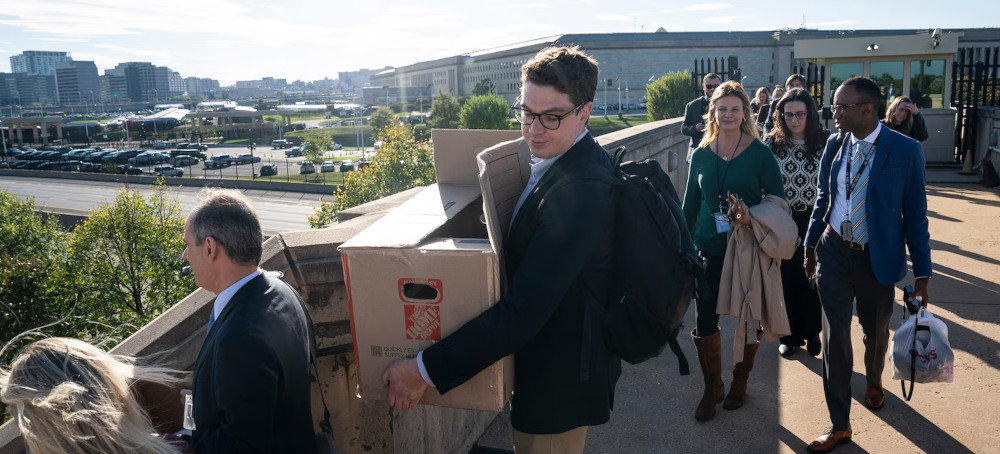 Reporters walk out of the Pentagon together Wednesday after turning in their credentials. (photo: Jabin Botsford/The Washington Post)
After turning in their press credentials, journalists covering the Defense Department walked out rather than comply with its restrictive new policies.
The new rules, which among other things bar reporters from soliciting information that the government hasn’t authorized for them, prompted journalists from The Washington Post and dozens of other outlets to turn in their press credentials and decamp for possibly the last time during Defense Secretary Pete Hegseth’s tenure.
More than 30 members of the Pentagon press corps walked out of the building together before the 5 p.m. deadline, crossing a foot bridge and descending a long staircase that empties out on the northeast end of the five-sided building.
“This is a sad day for those who support a free press,” said Nancy A. Youssef, a staff writer for the Atlantic and a longtime Pentagon correspondent. “But I’m incredibly honored to be part of a press corps that stuck together and was committed to protecting our First Amendment rights.”
The Defense Department cited security concerns in putting forward the new regulations, which include provisions to curtail the media’s access to large parts of the department’s vast headquarters where they were previously allowed to circulate.
In a statement, chief Pentagon spokesman Sean Parnell said: “The guidelines in the memo provided to credentialed resident media at the Pentagon reaffirms the standards that are already in line with every other military base in the country. These are basic, common-sense guidelines to protect sensitive information as well as the protection of national security and the safety of all who work at the Pentagon.”
Negotiations with the Pentagon Press Association over the new policy led to some changes but didn’t fully allay media members’ concerns. The PPA said Wednesday that most of its members had not signed on to the new policy “over its implicit threat of criminalizing national security reporting and exposing those who sign it to potential prosecution.”
The press corps spent the day clearing their desks, in some cases carting out remnants of years in the building — a yellowed Rolodex; a red-, white- and blue-corded Ameritech phone from the 1996 Democratic convention in Chicago. A pale sticky note clinging to a pile of folders that read: “Rumsfeld trip to Pakistan, Afghanistan, Iraq, Jordan. Dec. 20-25, 2005.”
Television networks tore down their broadcast booths, full of technical gear and soundproofing equipment, that had been used for live shots from the Pentagon. Journalists lugged out boxes and rolled suitcases full of gear. Hand trucks and black roller bins carried the bulk of personal belongings and even trash.
The mood was heavy — reporters hugged and some shed tears. “It kind of reminds me of a college dorm move-out without the happiness of summer,” said one reporter, who, like others, spoke on the condition of anonymity because they were not authorized to speak.
Another said they were thanked throughout the day by civilian staffers and military personnel within the Pentagon. “I’m shocked by the number of people stopping me in the hallway today to say ‘Goodbye’ and ‘Thank you,’” the reporter said. “Generals and admirals and people telling me that they appreciate us. People I don’t even know.”