Relatives and Records Cast Doubt on Guantánamo Migrants Being ‘Worst of the Worst’
Silvia Foster-Frau The Washington Post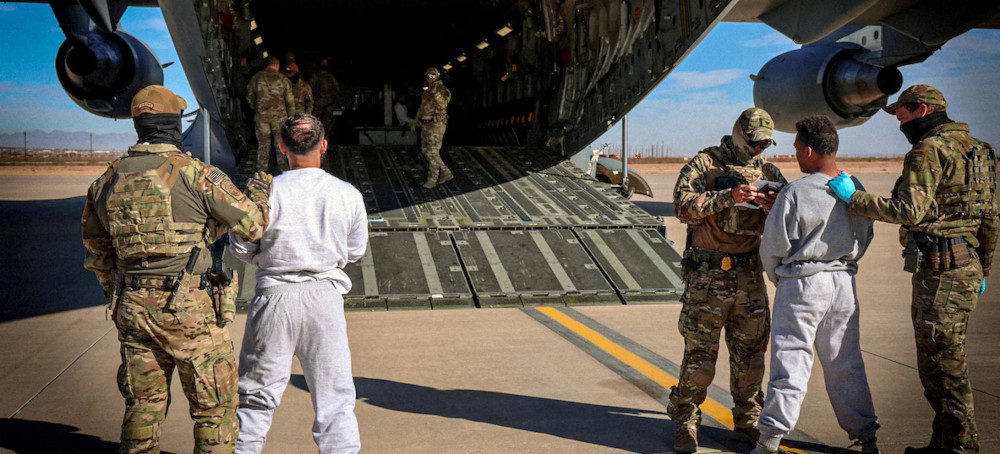 The first U.S. military aircraft to carry detained migrants to Guantánamo Bay in Cuba is boarded from an unspecified location on Feb. 4. (photo: U.S. Department of Homeland Security)
Details on some of the migrants sent to Guantánamo Bay have begun to emerge. They are young Venezuelan men, and relatives say they have been falsely branded Tren de Aragua gang members.
All were members of a Venezuelan gang called Tren de Aragua, the Trump administration said, invoking the name of a group the president mentions frequently to explain why a mass deportation is needed. Officials put them in a prison on the U.S. naval station in Cuba created for suspected terrorists after Sept. 11, 2001.
Little was known about the men when they were initially sent to Cuba. Human rights lawyers called Guantánamo a “legal black hole” and lambasted the U.S. government for not allowing them access to the migrants. But through photos released by DHS and accounts from family members, their names have begun to emerge.
In one of the images is a man with his head bent as a U.S. Immigration and Customs Enforcement officer holds the back of his collar. Relatives have identified him as Luis Alberto Castillo.
In another photo, a bearded man stands in front of a plane and its unfurled ramp. Tilso Gómez’s family says that is him. Nearby is a man with a head full of curly auburn hair. His father insists that is Mayfreed Durán.
Despite the impression given by Homeland Security officials and others, these three men were taken into custody after crossing the southern border, according to court records and family members — not during a targeted immigration operation in a U.S. city or at a jail or prison while serving a sentence.
The Washington Post could not find any violent federal criminal record for Castillo and Gómez, while Durán was charged with assaulting, resisting or impeding an officer during a riot at a detention center. An ICE official said that the agency stands by its assertion that all the migrants aboard the initial flight to Guantánamo are Tren de Aragua members. Their relatives firmly deny the accusation.
ICE has now sent at least nine planes carrying migrants to Guantánamo. As of Friday, 126 migrants were detained at the naval station, according to a Defense Department official. Trump wants troops to prepare to house as many as 30,000 more.
The Post spoke with family members of six migrants whose relatives said they have confirmed through photos and lawyers that their loved ones are being held in Guantánamo. The stories of Castillo, Gómez and Durán, as well as Franyer Montes, Diuvar Uzcátegui and José Daniel Simancas, share several similarities. All involve men who fled Venezuela’s economic and political crisis and were detained immediately upon entering the United States, though one was later released. Nearly all had tattoos that relatives said aroused the suspicion of U.S. authorities. Families of two of the men said they believed their loved one had been singled out because they were born in the Venezuelan state of Aragua.
Tren de Aragua has aroused fears throughout the Americas. But experts in the criminal organization say the group has not established a strong foothold in the United States, where its members probably number only in the hundreds — a small fraction of the nearly 800,000 Venezuelans who live in the country. Three analysts who have studied the gang said tattoos are not linked with membership.
Three of the six families who spoke with The Post shared documents showing their relatives have no criminal record in Venezuela.
ICE said in a statement that tattoos were “one of many indicators” that an individual belongs to the gang. The agency did not answer a question regarding how many Tren de Aragua members there are among all the Guantánamo detainees. A DHS official did not respond to a request for details on how it identifies who belongs to the gang.
Families in Venezuela described regular calls with loved ones in detention centers before a sudden silence. They checked ICE’s online registry to see an update that their family member was in Florida, with a link to call the detention center — a pattern for those taken to Guantánamo. A WhatsApp group for parents, spouses and siblings of Guantánamo detainees continues to grow.
In one of their last calls together, Mayfreed Durán, 21, told his father that ICE was claiming he had ties to Tren de Aragua. Michel Durán said his son had been detained since crossing the border in 2023. After a year and a half in detention, Mayfreed told his father, he had agreed to sign deportation papers to return to Venezuela. The Trump administration had reached an agreement with the Venezuelan government to resume flights.
Days later, Durán had not heard from his son. Then he saw his signature tuft of curly hair in a Homeland Security photo. Mayfreed was in Guantánamo.
“I can’t live in peace thinking about my little boy living there,” Michel Durán said. “It’s not right. I know my son is a clean man, that he is not a criminal like they said he was.”
A gang from Aragua
Unlike the Latin American crime groups that formed on the streets, Tren de Aragua was born inside one of Venezuela’s most infamous penitentiaries in the state of Aragua. Crime bosses within the prison began running kidnapping, drug trafficking and extortion networks from behind bars, while small street gangs outside consolidated and the two began to merge.
By 2014, Tren de Aragua had grown from a prison-based organization to a national criminal syndicate. In 2017, Venezuela’s economic and political collapse sparked a massive exodus of people — and presented the gang with a new and highly profitable opportunity: infiltrating migration routes.
Today, it is an “ethereal, elusive and loose” network primarily involved in migrant trafficking, said Elizabeth Dickinson, a senior analyst at the International Crisis Group think tank. The gang has a foothold in South America, particularly in Peru, Ecuador and Chile, where it profits from smuggling and extortion. It has built its empire in part by preying on those fleeing Venezuela’s crises.
But Ronna Rísquez, an investigative journalist and expert on organized crime in Latin America, said TDA has faced several obstacles in establishing itself in the United States, including a language barrier, competition from stronger criminal organizations and ongoing arrests by law enforcement.
“The U.S. already has well-established mafia structures, cartels and other groups that have been operating here for decades,” she said. “The Tren de Aragua is not going to just take over.”
Nonetheless, Trump seized on the narrative that Tren de Aragua is wreaking havoc to U.S. cities throughout his campaign following several high-profile crimes involving Venezuelan migrants. Multiple studies show Venezuelan migrants are rarely involved in crimes, but those incidents quickly gained widespread attention.
“The Venezuelan gangs are the worst in the world — they’re vicious, violent people,” Trump said in his first TV network interview after winning the election. “They’re literally taking over apartment complexes and doing it with impunity.”
In recent weeks, ICE has shared images of agents arresting people it describes as TDA members. Noem told Fox News in late January that authorities had arrested a “one of the ringleaders of TDA” who had “just been a part of a gun weapons exchange and was trying to buy grenades.” The secretary also mentioned the gang in explaining why the Trump administration had removed temporary protective status for hundreds of thousands of Venezuelans.
“The people of this country want these dirtbags out,” Noem said.
‘A lie’
In early February, detained migrants began calling family members. They were being transferred, they said. But many didn’t know where, or when, or why.
Durán called his father. Luis Alberto Castillo called his wife.
“He was very nervous and sad and started to cry,” said Leidy Calle, Castillo’s wife. “I cried, I told him that he should trust God and that he should leave everything in God’s hands.”
All six of the migrants whose family members spoke to The Post had taken the dangerous journey from Venezuela to the U.S.-Mexico border. They were driven by a desire for a better life, their relatives said, and had goals of opening their own businesses and providing for their families.
One of them was Diuvar Uzcátegui. He grew up in Santa Rita, Aragua — the birthplace of Hector Rusthenford Guerrero Flores, known as “Niño Guerrero,” the Tren de Aragua boss who built the prison gang into a transnational empire.
By day, the Santa Rita streets filled with the sounds of motorbikes, old men at corner stores sipping malta and children kicking soccer balls. By night, the town changed. Parents told their kids to be home by 9. The wrong kind of people lurked in the shadows — the kind who had turned the city into something else, something dangerous.
Uzcátegui and his best friend, Kevin, hoped to get out of the town to make something bigger of their lives. Kevin spoke to The Post on the condition of partial anonymity because he is also a Venezuelan immigrant and fears he could be targeted for deportation.
Uzcátegui went first. He initially crossed the border and surrendered to U.S. authorities in October 2023, but he was sent back to Mexico. He tried again in December that year. This time, ICE held him in a detention center for six months and then released him with instructions to check in weekly, then monthly. He applied for asylum and began working long hours in El Paso to send money back to his daughter.
“Hermano, estoy viviendo el sueño americano,” Uzcátegui told Kevin in January. I’m living the American Dream.
That was the last time Kevin heard from him.
On Jan. 28, ICE agents showed up at Uzcátegui’s workplace. His girlfriend said the agents told him that he’d missed a check-in. She said he never missed an appointment and thought he’d be quickly released. Instead, a few days later, ICE put out the news that it had arrested three Venezuelan nationals “including two known Tren de Aragua associates.”
One of them was Uzcátegui.
It didn’t make sense, Kevin said. Uzcátegui’s girlfriend didn’t understand it, either. The Post could not locate any records in civil or criminal courts in El Paso with his name. His friends and family wondered if immigration agents had focused on Uzcátegui’s tattoos — one of a panther on his hand, another a red rose on his wrist. Maybe that was enough. Maybe coming from Santa Rita, Aragua, was enough.
“We ran from that life,” Kevin said. “We ran so far. And now they’re saying he’s one of them? That’s a lie.”
A Bible and tattoos
For ICE, tattoos have long been viewed as potential signs of gang affiliation. The practice was applied and criticized during the rise in the United States of MS-13, a gang that more commonly uses tattoos as a form of identification. But the government response also led to arrests in which family members disputed the migrants’ ties to the gang.
Several experts told The Post that the practice is even more concerning when attempting to identify members of Tren de Aragua, which does not even use tattoos to signal membership.
Tattoos are also the norm for many Venezuelan youths. Narcoculture — a style where people wear symbols that are sometimes used by gangs — has also become popularized in recent years, said Pablo Zeballos, a Chile-based expert on organized crime.
“Tattoos are greatly meaningless unless they are combined with other factors, like prison history or known criminal associations,” he said.
In 2017, ICE put out a statement outlining how it confirmed gang membership: if migrants admitted they were in a gang; if they were convicted of a crime or civil offense for gang-related activity; or if they met “certain other criteria such as having tattoos identifying a specific gang or being identified as a gang member by a reliable source.”
Bill Hing, a professor of law and migration studies at the University of San Francisco who has represented migrants accused of gang affiliation, said it “usually doesn’t take much more than a tattoo.”
“If they [ICE] have some suspicion, then they will take that person into custody. That doesn’t mean they will prevail in front of an immigration judge with that allegation,” Hing said. “But if that person is undocumented, that person will get deported anyway.”
All six of the migrants in this story had tattoos, their family members said. Five of them expressed concerns that their tattoos were what led to the government’s suspicion of the migrants’ ties to Tren de Aragua.
On Jan. 19, Castillo, his wife and her 9-year-old son showed up for the appointment they had secured through the Biden administration’s CBP One app to plead their case to be allowed into the United States.
Authorities asked the family for their IDs and stamped their fingerprints. Then, officers began asking Castillo about his tattoos, his wife said. He told them he’d gotten them in his youth. After that, she said, they were separated.
“The police officer no longer let him sit next to us,” Calle, his wife, said. Castillo had brought a Bible, and she said officers “told him to start praying because he was from the Tren de Aragua. They made fun of him.”
He was separated from his wife and child then. They haven’t seen him since.
Two weeks later, an image of him appeared in Homeland Security photos touting their first migrant flight to Guantánamo. His head was bent over as he stood on the tarmac, his tattoo of basketball player Michael Jordan visible on his neck.
‘American nightmare’
Kevin remembers Uzcátegui as a man whom he’d spent endless afternoons with playing soccer. The friend who turned everything into a joke, who didn’t drink and who loved his young daughter “more than anything in the world,” Kevin said.
When he saw that his friend was on a list of Guantánamo detainees published by the New York Times, he was in shock.
“I was like, ‘Diuvar? A criminal?’ I still can’t believe it,” Kevin said.
He thought back to Uzcátegui’s ambitions and his friend’s words about his life in Texas: He was living in the America Dream.
“American Dream?” Kevin said. “More like American nightmare.”
Michel Durán said he similarly can’t square the image of his son with that of a hardened Tren de Aragua gang member. He said his son had often criticized his father for drinking beer and smoking.
“He would say ‘Ay, papi, that’s bad for you,’” he recalled.
Frustrated by Venezuela’s deteriorating economy, Michel Durán said his son decided to go to the United States, where he hoped he would open a business and send money back to his family.
He attempted to enter the United States twice and was sent back to Mexico both times. After that, he decided to wait for his CBP One appointment.
It was set for July 7, 2023 — two days after his birthday.
“He said this was the best present he could have gotten,” Michel Durán said.
His son was detained in El Paso after arriving for his appointment. A few months later, he was part of a hunger strike, his father said. A criminal complaint of the incident states that Durán approached an officer who was trying to restrain another detainee and that a fight ensued.
Michel Durán said his son told him officers had begun to punch a detainee, and that Mayfreed intervened to try to separate them.
“He pushed one of the police so they would stop hitting him,” the father said, adding that the officer had sprained or fractured an ankle. “He said he didn’t have anything to do with it — he just tried to separate the police so they wouldn’t keep punching him.”
Michel Durán said the Trump administration should investigate “who are the real delinquents, and who aren’t.”
“Why are they sending innocent immigrants to those prisons like they’re animals?” he said. “They’re human beings.”