Regime Change Is Never Painless
Matt Bai Rolling Stone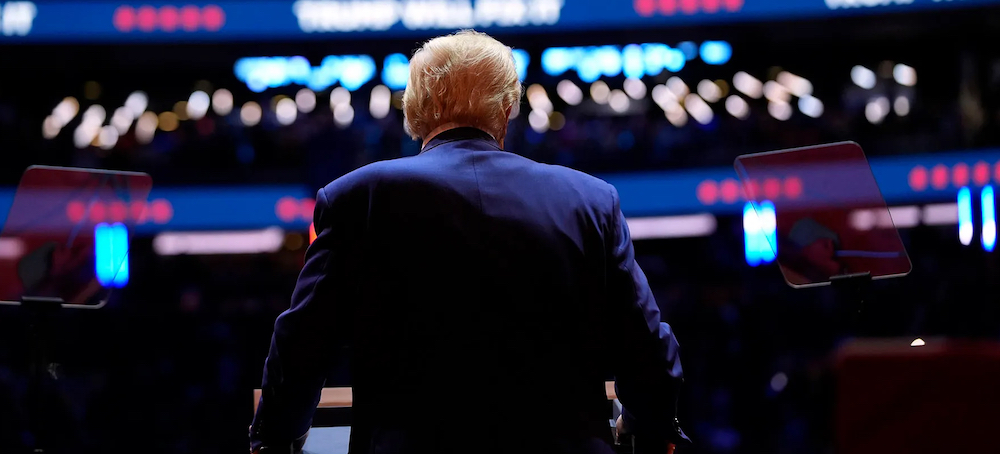 President Donald Trump speaks at a rally. (photo: Alex Brandon/AP)
America’s first foray into overthrowing a foreign leader began in Iran and came with long-term and unexpected consequences. Trump’s new war will likely come with a heavy price
At least Mosaddegh’s life was spared. (He spent the rest of it under house arrest.) America’s subsequent targets were generally not so lucky. Under Eisenhower and his successors, the CIA went after a series of nationalist leaders — Guatemala’s Jacobo Árbenz Guzmán (driven into exile), the Dominican Republic’s Rafael Trujillo (murdered with U.S. backing), Congo’s Patrice Lumumba (same), Chilé’s Salvador Allende (an apparent suicide). This is by no means an exhaustive list. Covert actions seemed, for a long moment in the American century, like the perfect, no-cost way of making the world more like you wished it. A president nodded, a hostile leader disappeared, and Americans, only vaguely aware of the news from far-off lands, continued to enjoy the prosperity of peacetime.
The moment didn’t last. What began as another covert operation against Ho Chi Minh in Vietnam deepened to become, over time, the most painful military debacle in American history. By the time that war officially ended, a congressional committee had begun its investigation into the CIA’s secret adventures, all of which spawned unintended consequences that led, inevitably, to suffering and instability. (This was shortly before the shocking takeover of Iran by radical Islamists, whose first act, after three decades of brutally repressive rule by the Shah and his secret police, was to seize 66 American hostages as payback.) The illusion of cost-free regime change dissipated like a cloud of Agent Orange.
Three times in the early part of this century — twice in Iraq and once in Afghanistan — the United States went to war with the idea of removing (or at least disarming) a foreign regime. But in the run-up to those wars, the two presidents leading the charge, both of them named Bush, made sustained cases to the public and managed to secure congressional approval. We can argue about whether those were good decisions or bad ones (the second Iraq war pretty clearly qualifies as the latter), but the point is that no one pretended they would be painless. The cowboy days of deposing dictators without putting “boots on the ground,” as it came to be known, were assumed to be over.
Even then, though, emerging technology was again changing the way America waged war — laser-guided missiles and precision drones, satellite imagery so refined that it could track a delivery driver from across the world. Perhaps no one in public life worried more openly about this than the late John McCain, the last of the American statesmen, who feared that America would be tempted into starting a new raft of secret wars, fought largely from remote CIA bunkers. “Since when is the intelligence agency supposed to be an air force of drones that goes around killing people?” he asked in 2013. McCain believed that if the military controlled these new gadgets, our leaders would be more accountable.
He was too optimistic. Thirteen years later, Donald Trump had no reservation about taking us into full-scale war without the consent of Congress or the voters, mainly because all of this seductive technology, now at the hands of the military, made it seem as painless as a phony coup. That’s not to say there hasn’t been sacrifice; as I write this, several American soldiers have died tragically (in ways that seem entirely preventable), and the death toll among Iranian civilians is soaring. But no one is contemplating an Iraq-style occupation, and Americans are waking up to their morning coffee with very little changed, beyond some minor fluctuations in the stock market and the price of gas.
As with their warm-up forays into Venezuela and Nigeria, Trump and his deputies talk about war in Iran as they would like us to perceive it — as a kind of video game involving mobs and mini-bosses, rather than actual people. As Pete Hegseth, our slim-fitted avatar of a defense secretary, put it: “America is winning decisively, devastatingly, and without mercy.” This adolescent bragging about cruelty — the kind of thing you’d expect to hear on a Discord chat during a heated round of Overwatch — would have made McCain’s head explode.
And so here we are, 70-plus years after the CIA drove out Mosaddegh, toppling another Iranian government, and this time killing its leadership, mostly because we can. Our methods of regime change are flashier and more devastating, but the essential proposition is exactly the same now as it was throughout the Cold War: why not make the world as you’d like it, as long as there’s no obvious cost.
FROM THE START, Trump’s rationale for suddenly going to war seemed almost like a focus-group exercise — keep tossing out ideas until something sticks. First the administration framed regime change as a moral imperative, since the Iranian regime was in the process of massacring many thousands of protesters. It was a hard premise to refute; the Ayatollah Ali Khamenei’s crackdown on dissent was evil, and no one outside of the purview of Sharia laws thought he deserved a much better fate than the one he got. And yet, like all arguments for humanitarian intervention, this one lacked moral consistency. Why Iran and not, say, Sudan? Why were the lives of Iranian protesters worth so much more than those of Palestinian children?
Not that anyone needed to seriously answer these questions, because before we could even think about them, Trump had moved on to another extremely dubious rationale: imminent threat. The idea here was that Iran was on the brink of having a nuclear weapon, and it was going to unveil ballistic missiles that could reach our shores. This might’ve been Trump’s strongest case — truly imminent danger being perhaps the only justification, legally and morally, for preemptive war — except that we’ve all been down this road before, and you really couldn’t find a single expert who agreed that Iran was anywhere close to menacing Alaska. The Pentagon’s own Defense Intelligence Agency estimated last year that it would be a decade before an Iranian missile could threaten us.
And then, finally, you had Marco Rubio, the secretary of state plus about 12 other titles, telling congressional leaders that Israel was going to strike at Iran anyway, so Trump decided we might as well ride shotgun. That immediately elicited howls of protest across the political spectrum, since it seemed to suggest that Trump was simply Louise to Bibi Netanyahu’s Thelma, and America was no longer in firm control of its own foreign policy. It took Rubio about 10 minutes to start desperately walking it back, and he hasn’t stopped.
The truth, as with everything about Trump’s presidency, is probably more personal than policy-driven. Trump has made mention a few times now of how the Ayatollah had planned to assassinate him. (“I got him before he got me.”) In foreign affairs, he seems to trust no one as much as he does his son-in-law, Jared Kushner, and his close friend Steve Witkoff, both of whom have deep business ties with Iran’s rivals in the region and strong relationships in Israel. In the end, Trump does everything in his own interest, and the only doctrine behind it is whatever bullshit you want to toss around after the fact.
Our past tells us, though, that interventionism is more physics than biology; you’re not excising a cancerous cell so much as setting in motion a chain of unpredictable reactions. The invasion of Iraq, itself a reaction to the terrorist attacks of 2001, led to a domestic political crisis, which led policymakers to ignore an economic bubble, which in turn led to a market crash and the election of our first Black president, which energized the reactionary movement that ultimately gave us Trump. In the alternative dimension where George W. Bush stood down, President McCain is getting his monument.
Trump’s war may yet hasten liberalism in Iran and the region, but it’s just as possible — or more so — that a harder-line regime will rise from the ashes. Domestically, this impression of Trump doing Israel’s bidding is already inflaming antisemitism on the extremist right, which will surely be echoed by pro-Palestinian Democrats; there’s the real possibility of dark days ahead for American Jews. And you have to wonder what effect all of this is having in Moscow and Beijing, where strongmen are taking cues from Trump about what’s now permitted in this post-ordered world. Will the Chinese move on Taiwan while America’s coalition is splintered and its forces depleted? Is Vladimir Putin suddenly thinking beyond Ukraine, to the borders of Poland or Finland?
The costs of regime change won’t be clear for some time. That there are always costs, always unforeseen, is the last century’s inescapable truth.