Red States Thought They Could Stop Abortions. They Ended Up Stopping Only the Lifesaving Ones.
Greer Donley and Yvonne Lindgren Slate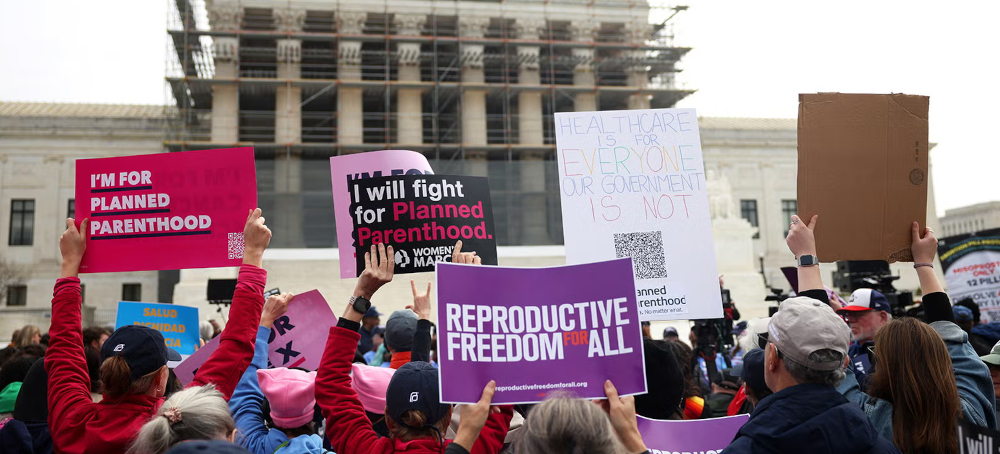 Abortion rights protesters gathering outside the U.S. Supreme Court during oral arguments for Medina v. Planned Parenthood South Atlantic on April 2, 2025, in Washington. (photo: Kayla Bartkowski/Getty)
This finding is consistent with the #WeCount data from the Society for Family Planning, the other organization tracking U.S. abortions. In fact, the SFP numbers get even more granular, showing that when one accounts for abortion travel and mailed medication abortion, abortion rates have increased in all but two states that have banned abortion.
Though overall rates have increased, there is one type of abortion that has become more difficult to access than ever before: abortions for medical reasons. Since Dobbs, horror stories of women dying, nearly dying, or birthing dying children have been reported on a regular basis in states with abortion bans. We know that these bans are increasing maternal mortality and morbidity, and at least six women have already died because of them.
In short, the only abortions that bans seem to be stopping are those that are medically indicated.
Though people predicted a massive reduction in the rate of abortion after Roe, the abortion rights movement responded with resilience and innovation. Abortion funds and logistics coordinators helped people travel for care. And blue-state legislators passed shield laws to assist those who couldn’t travel. Under these laws, providers are using telehealth and mailed medication abortion to ensure that those living in ban states can still get the health care they need. As a result, most people who need abortion in red states can access it through travel or mailed pills.
This doesn’t make abortion bans harmless. It is unjust and cruel to force people to flee their homes, hide their abortions, or endure legal risks to access health care recognized as a human right. But this result does strongly suggest that bans are failing at their most basic aim: saving fetal life.
This failure is significant on its own, and only more so when we acknowledge the serious costs that abortion bans impose on pregnant people. Though anti-abortion legislators and activists say otherwise, the impacts of their bans improperly overlap with other aspects of reproductive health care, like miscarriage management and ectopic pregnancy. (Three of the six deaths of pregnant woman directly attributable to bans were miscarriage patients.) And their exceptions are so vague that providers fear intervention, leaving pregnant patients at the mercy of whatever provider or hospital they seek help from. Sometimes they get help; sometimes they suffer or die. Maternal mortality and sepsis rates have risen in states with bans. The risks are significantly higher for women of color. (Five of the six women who have died from bans were Black or Hispanic.)
This post-Dobbs reality is entirely consistent with the experience of other countries that have banned abortion: Abortion rates do not decrease, but pregnancy becomes more dangerous.
Our nation’s pre-Roe history was similar, in that bans were known to be ineffective at stopping abortion. But there is one critical difference between the pre-Roe and post-Dobbs period: Before Roe, the safest place to get an abortion was at a hospital. It was abortions outside the medical system that were dangerous. Large city hospitals in that era had whole wards dedicated to treating patients injured from botched, illegal abortions. The coat hanger became the symbol for legalization.
Today, with the advent of medication abortion and the bravery of shield providers, the situation is flipped. Abortions outside hospitals are being done safely and effectively in people’s homes. Between 10,000 and 15,000 packages of abortion pills a month are shipped into states with abortion bans or tight restrictions. Anti-abortion advocates spread misinformation about the drugs’ safety, but if there were a serious issue, not only would it have come up in decades of rigorous research, but we would see it on the ground in these red states.
Instead, the danger seems to be in hospitals, where people are suffering or dying, surrounded by doctors who could help them but are afraid that doing so will risk their freedom or vocation. Thus, one of the greatest ironies of the post-Dobbs period is that the types of abortions the right spent years stigmatizing and campaigning against have gone up, while the ones that the right claims not to oppose—those done for medical reasons—have decreased so precipitously that they’ve cost women their lives and health. Anti-abortion legislators claim that these bans both save fetal lives and protect maternal health. The data shows that the opposite is true. More abortions are happening than before Dobbs, and maternal health is worsening. Abortion bans are unworkable and serve no rational purpose. They must be repealed.