Recycling Food Waste Could Dramatically Lower Greenhouse Gas Emissions: Study
Cristen Hemingway Jaynes EcoWatch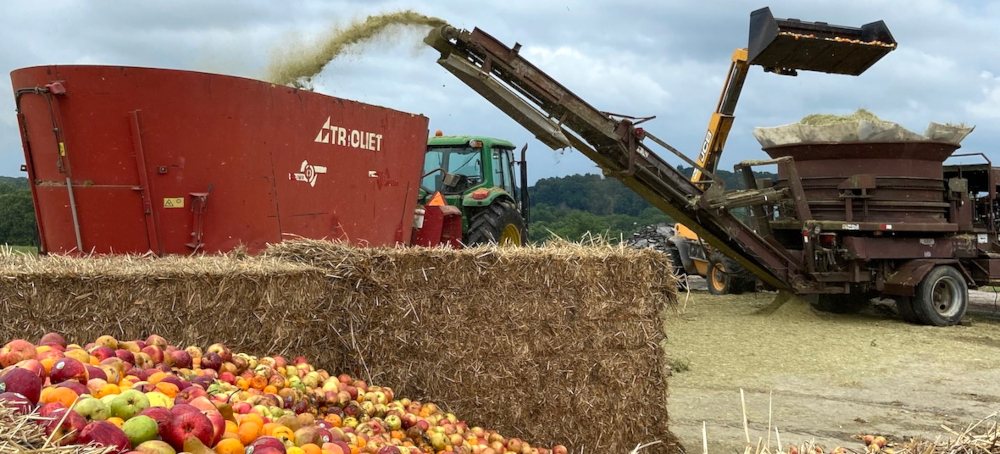 Almost a third of the food produced for human consumption is never eaten but lost or wasted, which not only impacts food security but also wastes resources such as land, water, and energy. (photo: Zhengxia Dou)
Pressures like population growth, land degradation and urbanization are putting strain on the global agrifood system, which is a major contributor to GHG emissions.
“Everyone is involved in the global agrifood system, since everyone eats food,” said co-author of the study Zhengxia Dou, an agricultural systems professor at University of Pennsylvania (Penn)’s School of Veterinary Medicine, in a press release from the university. “Everyone is a stakeholder.”
Nearly a third of food produced for humans is lost or wasted and never eaten, Dou said. This impacts food security while wasting land, water and energy resources.
“When finished eating, people tend to just toss what’s left: out of sight, out of mind,” Dou said. “But from the resource and environmental perspective, what happens after actually matters a lot.”
The researchers analyzed data from 91 field studies conducted in 29 countries in order to provide “a benchmark for countries developing food waste management strategies for a circular agrifood system,” the authors of the study wrote.
To determine the lifecycle-based effect of food waste recycling on GHG emissions, the researchers focused on three methods: composting; anaerobic digestion — a process where organic material gets broken down to produce a mixture of carbon dioxide and methane known as biogas, which can then be used as a source of renewable energy; and refeed, which uses suitable food waste as animal feed.
The results provided compelling evidence that food waste recycling using those methods can reduce GHG emission in comparison with landfill disposal.
Food waste contains organic compounds like carbohydrates, and when it gets buried in a landfill, these decompose anaerobically, producing the powerful GHG methane. Methane’s warming effect on the planet is 80 times more powerful than that of carbon dioxide over 20 years.
“Anything you can do with food waste recycling is better than sending it to a landfill,” Dou said.
The European Union, China and the United States all have enormous agrifood systems that produce incredible amounts of food waste and GHG emissions while using vast stores of natural resources, according to the study.
“They are what I would call methane ‘super emitters’ from food waste disposal,” Dou said.
The researchers found that completely eliminating food disposal in landfills in these countries could greatly reduce GHG emissions.
Dou noted that the estimated GHG emissions reduction in the U.S. would be equal to offsetting methane emissions from almost nine million dairy cows — over 90 percent of the country’s dairy cow population.
Dou said the findings on the benefits of refeed were most important.
“I am a big advocate for converting suitable food waste streams to animal feed because it has the additional benefit of reducing conventional feed usage, therefore sparing the use of natural resources and fertilizer,” Dou explained.
The study found that over five percent of the total cropland in China currently devoted to the production of soybeans and maize would no longer be necessary if suitable food waste was recycled through refeeding.
“This spared land could be used for producing human food to enhance food security or for taking land out of production for conservation purposes,” the authors wrote in the study.
The researchers also found that refeeding could replace some of the soybeans and maize in animal feed, which Dou said would be especially important for nations like China and some EU countries that rely heavily on feed imports.
“[F]ood waste composting, anaerobic digestion, and repurposing to animal feed are all practical and viable options that are field-proven, low cost, and highly effective in mitigating emissions with multiple resource conservation benefits,” the authors wrote.
Dou said reducing food waste begins at home.
“We are part of the equation. So, to solve the problem, we need to be aware of the food loss and waste issue and try to cut down our own footprint by reducing our own food loss and waste,” Dou added.
The study, “Food waste used as a resource can reduce climate and resource burdens in agrifood systems,” was published in the journal Nature Food.