Rambling Man: Trump’s State of the Union
The Intercept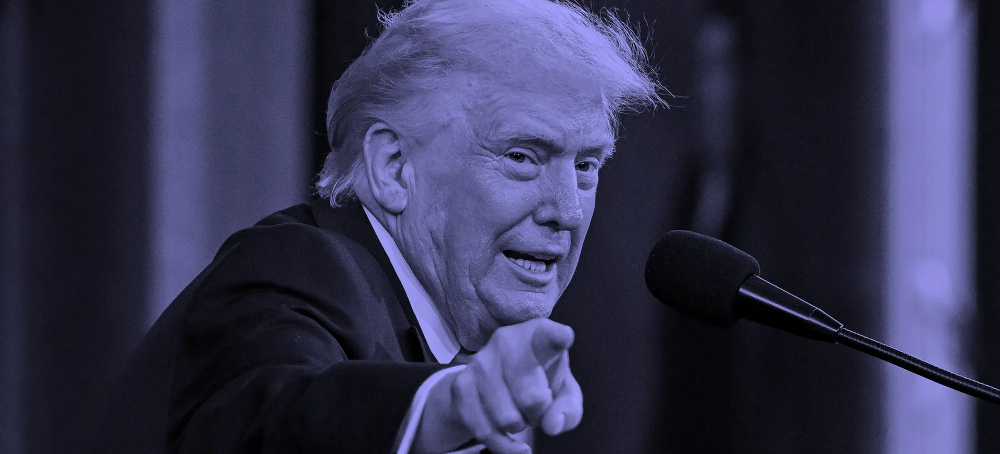 President Donald Trump delivers the State of the Union address during a joint session of Congress in the House Chamber at the Capitol on Feb. 24, 2026 in Washington, DC. (photo: Getty)
Akela Lacy, Jessica Washington, and Jordan Uhl on Trump’s speech and the Democratic Party’s response.
“This is who these people are. In some ways, they’re trying to sugarcoat what they’re doing, but in other ways they’re so blatant about doing really evil things around the world and being totally OK with it,” says Lacy, in reference to Trump talking about kidnapping Venezuelan President Nicolás Maduro. “It is really alarming to me how good they are at framing that in a positive light. And there were people cheering all over the room for us toppling a regime, doing regime change, while they’re telling you that we don’t do that anymore.”
Washington adds, “The whole thing, if you read it, if you listen to it, it reads like a white nationalist speech.”
The co-hosts also dissect the Democratic Party’s official response to the State of the Union, delivered by Virginia Gov. Abigail Spanberger.
Listen to the full conversation of The Intercept Briefing on Apple Podcasts, Spotify, or wherever you listen.
Transcript
Jordan Uhl: Welcome to The Intercept Briefing. I’m Jordan Uhl, Intercept contributor and co-host of this podcast, joined by my co-hosts.
Akela Lacy: I’m Akela Lacy, senior politics reporter at The Intercept.
Jessica Washington: And I’m Jessica Washington, politics reporter at The Intercept.
JU: Akela, Jessica, it is late. We just sat through — endured, rather —nearly two hours of Donald Trump’s State of the Union and the multiple responses. We’ll get into some of what will surely be the main takeaways from this speech, but in a word or a few words, what are both of your initial reactions to tonight’s State of the Union?
JW: My word is “long.” I don’t think it needs an explanation.
AL: This is not a word, but I kept having an image in my head of villains in a superhero movie, standing around, laughing at what they’ve accomplished. [laughs]
JW: No, but you’re totally right because that one line about the food stamps. So there was this line from the very long speech that we’re describing where Donald Trump says that, he — I can’t remember exactly what word he gave.
AL: “Lifted off.” I think he said “lifted off.”
JW: Lifted off.
AL: Yeah.
JW: Lifted off 2.4 million people from food stamps as like an economic accomplishment. And that does give like Disney villain in a very specific way.
AL: “Dark” — dark is my one word.
JU: Yeah, that was certainly one way to frame plunging millions of people into food insecurity. And of course that was an applause line.
My takeaway would be the weaponized contrast. One thing I thought was a significant departure from past State of the Unions was how Trump specifically leaned into Democrats not standing and clapping for certain talking points. Now in the state of the union’s past, of course, the opposition party for the most part remains seated, but tonight felt like a slight departure from that partisan tradition where he singled them out. Repeatedly pointed out that they weren’t standing and clapping, and even on some points remarked how he was surprised that they even clapped.
Trump delivered his last [joint session of Congress] address a year ago in a very different environment, coming off winning the presidency for a second time and major GOP wins that year. Things aren’t so rosy this time around. What do you both think has been the biggest change for Trump? What was the primary obstacle that he needed to clear or try to spin in tonight’s speech?
JW: There’s a lot that he had to clear up. I think there’s his loss on tariffs, obviously he’s still smarting from that, now saying that he’s going to do it anyway. A little bit confusing on what he means by that.
I think his “anti-war” agenda that he’s been trying to spin himself as very anti-war is difficult when he just did what he did in Venezuela and when we’re watching the preparations for a very likely strike on Iran. So he’s got a lot that he has to spin because he’s tried to create this image of himself as anti-war, as good on the economy — and those things are not panning out even remotely close to what he’s promised.
AL: And the Epstein files blowing up in his face. There was reporting today that apparently DOJ scrubbed allegations against Trump sexually abusing a minor, and we have some Democrats, I think Rashida Tlaib was yelling at him during this to release the Epstein files. And this is high on many Democrats’ mind, but obviously not that he would address this, but that’s in the background here. Not even in the background, it’s in the foreground right now.
And then, yeah, his approval ratings are lower than they were at this point in his first term. His disapproval ratings, I would say are higher, and his approval is about the same.
And there are two very different stories being told about the economy right now. Obviously, Democrats are — we’ll get to the response later — but trying to focus on affordability issues. And you have Trump pretty much making a mockery of that and trying to throw that in their faces while claiming that everything is fine and dandy when we know very clearly that it’s not, people have lost their health care, are paying exorbitant amounts just to get through on a day-to-day basis.
And I feel like this didn’t really come through. If you haven’t been paying attention, and you might have just been watching the State of the Union for pleasure — which I don’t know many people who are doing that — but he was able to get the One Big Beautiful Bill. As Jessie mentioned, the tariffs are falling apart. That was another major part of his economic agenda.
But you also have Republicans who are saying that they’re not necessarily going to go through with his pressure to have them codify tariffs or codify any of these other things into law. And this is not a “Let’s hand it to Republicans” moment, but they have also broken with him on Epstein in very small numbers. But not everything is hunky dory with him and the Republican caucus right now as well.
JU: I think any Republican opposition in Congress to another attempt to institute tariffs isn’t out of concern for those costs being passed on to the consumer. It’s simply out of fealty to corporate interests, the Chamber of Commerce, their donors.
That’s where he would meet opposition, not out of any purported concern for their base. And like you’re saying, there are two different stories about the economy. He’s bragging, similar to Pam Bondi in the Epstein hearing, about the Dow hitting 50,000. He’s bragging about the stock market.
Donald Trump: The stock market has set 53 all-time record highs since the election. Think of that, one year.
JU: Those gains rarely affect the average working person. And then on the other side, you have “60 Minutes” reporting that SNAP and Medicaid benefits are facing the biggest federal funding cuts in history.
Another part of the speech that stood out was the focus on militarism. Along those lines on these funding cuts for these social safety net programs, we’re seeing a massive uptick in military spending. He’s committing to 5 percent of GDP in our military spending. And we saw a report over the past few days from Jeff Stein of the Washington Post that said a requested $500 billion increase in military spending is slowing down the budget process because the military doesn’t even know how they would spend that additional $500 billion.
So I’m curious, from both of your perspectives, how do you think this lands in the minds of the average voter? Granted, like you said Akela, who’s watching this for fun? But we live in a shortened attention span economy where people will see clips, and surely some of these narratives will filter out. So when they see him bragging about the economy saying it’s robust and strong, meanwhile they’re looking at their bank accounts and they see a totally different story but ratcheting up military spending, how does this land?
JW: Yeah, I think that kind of stuff backfires. I think you’re talking about kind of two separate but connected things, which is military interventions, which we know are unpopular with a lot of, even the Republican base, a lot of Trump’s base is uninterested in that.
And then there’s also — which is the same mistake that the Biden administration made — which is telling people what the economy looks like for them. And I interviewed members of the Biden administration during the presidential election. And something that they kept saying was, people feel great, the economy is strong, people are doing fine. And people didn’t feel that, and they didn’t vote that way.
And so I think they’re going to run into the exact same problems that every administration runs into, when they’re campaigning on their accomplishments, which is, it actually has to match up with how people are feeling economically, and the indicators just aren’t there.
I also listened to Summer Lee’s rebuttal for the Working Families Party, and this was something she brought up really directly. And I think this is something that has been talked about in our politics a lot recently, which is, we have money for bombs overseas, but we don’t have money for health care. We don’t have money to actually provide a good life for our citizens. And that’s something that Summer Lee brought up. They’re trying to distract you with all these different issues when the real problem is we’re giving money to corporations, we’re spending money on bombs, and we’re not spending money feeding people as Donald Trump himself pointed out. And we’re also not spending money on people’s health care.
Summer Lee: Don’t let anybody tell you we can’t afford it. We somehow find endless money for ICE, for private prisons to warehouse Black and brown people and for bombs to be sent abroad. But we’re told health care and childcare are too expensive. And when we begin questioning those priorities, the powerful try to divide us once more. But that old playbook is losing its grip.
AL: I was reading some reporting in Punch Bowl on Tuesday that Republicans were talking about how they wanted Trump to frame this military spending. This is talking about him wanting to increase Pentagon funding by 50 percent. And they’re like, we don’t want him to sit to say the number $1.5 trillion. We want him to talk about it as a percentage of GDP and how it compares to past decades of military spending. Basically so it doesn’t sound as bad, but they also want him to frame it as what we’re doing to modernize the military and counter threats from our enemies around the globe.
Which we did hear him, reverting to this, what is a theme for him, painting this image of himself as a strongman, like policing the world while also telling everyone that he’s not policing the world and he’s the president of peace. So it’s an artful exercise in cognitive dissonance the way that they’re trying to frame this stuff to people.
But to their credit, Republicans are at least acknowledging openly that you have to frame this in a way that makes sense to the American public, whether it’s accurate or not. And I think that is the one thing that if you’re someone who is already giving Trump the benefit of the doubt and you listen to this, that sounds good, right, on its face?
JU: Yeah. It’s much more abstract when you’re talking about percentages of GDP than a $1 trillion-plus military budget.
JW: You guys can’t forget that he ended the war in the Congo, though. That was a key accomplishment from the speech. [laughs]
JU: Oh, who could forget? Where were you?
AL: Can we talk about the Venezuela thing? Because that —
JW: Please,
AL: Freaked me out to my core. Like jokingly, let’s not forget about our buddy Venezuela, when you kidnapped the fucking president, and JD Vance and Mike Johnson are behind him, like, laughing. I don’t know, that moment for me was just so blatantly, this is who these people are. In some ways, yes, they’re trying to sugarcoat what they’re doing, but in other ways, they’re so blatant about doing really evil things around the world and being totally OK with it. And it is really alarming to me how good they are at framing that in a positive light. And there were people cheering all over the room for us toppling a regime, doing regime change, while they’re telling you that we don’t do that anymore.
JW: Yeah.
JU: Yeah. Not just that, but the deliberate reckless killing of fishers. Yeah, that was a laugh line. Yeah. Oh, we decimated their fishing industry, and you get hardy laughs from the Republican caucus.
DT: We have stopped record amounts of drugs coming into our country and virtually stopped it completely coming in by water or sea. You probably noticed that. [Laughter]
We very seriously damaged their fishing industry. Also nobody wants to go fishing anymore. [Laughter]
JW: The Intercept’s reporting, which we’ve done a lot of great reporting on this from Nick Turse. But we’re talking about these strikes where people were clinging, dying with no relief. Just like these strikes are horrific, if you read about them the strikes have now passed over 150 dead. So just to keep that in mind for the laugh line there.
JU: The deliberate cruelty that they found humor in stood out to me as yet another departure from past State of the Unions, and we saw that also in how they talked about the Somali population in Minnesota. Trump made, if you want to call it a joke, that once they crack down on Somali fraud in Minnesota to a sufficient extent, we will balance our budget. And this served as a segue to brutal crackdowns in our cities, the deliberate targeting of certain populations in places like Minneapolis and St. Paul. And what was also interesting to watch in this part of the speech was the vocal opposition from Rep. Ilhan Omar and Rep. Rashida Talib. Now, what were both of your reactions during this part and what stood out to you?
AL: What really stood out to me beyond the disgusting racism was the fact that he telegraphed that they’re going to do this in other states. At the end of that whole thing, he was like, oh, the number of this fraud is much higher in California, Massachusetts, and Maine. Places where he’s also been sending ICE. There’s been ICE agents terrorizing people all over those states and ramping up operations in Maine, particularly after Minneapolis. So that was alarming.
DT: There’s been no more stunning example than Minnesota. Where members of the Somali community have pillaged an estimated $19 billion from the American taxpayer. Oh, we have all the information, and in actuality, the number is much higher than that, and California, Massachusetts, Maine, and many other states are even worse.
This is the kind of corruption that shreds the fabric of a nation, and we are working on it like you wouldn’t believe. So tonight, although started four months ago, I am officially announcing the War on Fraud to be led by our great Vice President JD Vance.
AL: We’ve been talking about this and doing a lot of reporting on this, but a perfect and fully disturbing example of how the racist conspiracy theories that incubate in the far-right corners of the internet, become policy like that in this administration. And where like where this whole thing came from is a far-right influencer who started peddling this online. Chris Rufo picked it up and a couple months later, ICE agents killed two people in Minneapolis.
Like these are the consequences of this. And I think people understand that is directly linked to what he’s doing with ICE. This is obviously not about fraud. This is about creating a pretext to unleash this country’s military power on its own citizens.
JU: Chris Rufo, of course, for those unfamiliar, is with the Manhattan Institute and has been a key player in nationalizing right-wing controversies and culture wars, specifically the rights fight against “DEI” — diversity, equity, and inclusion — initiatives among other “hot-button issues.” He really does have a significant and outsized ability to shape narratives on the right.
AL: And while we’re talking about DEI, there was raucous applause to Trump saying we ended DEI. I think that was the most applause that I heard the whole time. And like, people were cheering.
JU: Kitchen table issue.
AL: You can also thank Chris Rufo for that.
JW: To your point, the whole thing, if you read it, if you listen to it, it reads like a white nationalist speech — not all of it, but large sections of it. Particularly when he says that Somali pirates are coming to commit fraud and also to ruin the culture. The cultural elements of the ways he was talking about Somali people, I think are some of the most kind of clearly racist elements.
But I have been just thinking about the State of the Union in the light of Trump posting that really racist image of the Obamas, because in some ways he’s broken the racism barrier is the way I would think about it is that he’s done something so blatantly racist in our culture. And just to be clear, I’m referring to the photo, sorry, the AI image that he posted on Truth Social of the Obamas as apes. So he’s already broken this racism barrier. So there is almost no point. to a certain extent, in even talking about him saying that Somali people are ruining the culture, the kind of Hitler-esque things that he said before about immigrants poisoning the blood — there is no deniability at this point about who and what he is. And so this white national speech, it just makes sense. It’s in character and it’s almost un-newsworthy in that way.
AL: It just makes me so upset because each of these things are issues where Democrats seeded so much ground in the beginning that like allowed him to just be like, OK, actually yeah, now we’re just doing racist stuff because you guys let us get really far on immigration and claiming this was a problem and claiming there were people flooding in.
They’re like, some people are ruining the culture, not quite in the way that you’re saying it. Some people are creating all this crime problem, not quite in the way that you’re saying it, and like that being their strategy to win back voters is like to seed ground on these issues effectively. And it just makes me really mad when I think about it for too long. That’s what you saw in my eyes.
JW: On that point, I do want to talk about his anti-trans rhetoric. Speaking of Democrats seeding ground on issues, Donald Trump brought a Liberty University college student at one point, who he had brought as a guest, to make this point about transgender children, essentially. And so he had said that a school had enabled her to transition, which had then led her to run away and be kidnapped and sex trafficked. Now the mom and this girl are suing multiple entities that they hold responsible, including the school. But Donald Trump really used this moment to try and fearmonger against trans children.
This kind of idea on the right that they’re going to kidnap your children and make them trans — I think this is really an issue where we’ve seen a lot of Democrats seed ground. Obviously there was the infamous Seth Moulton comment about not wanting his kid, his young daughters, to play with males — referring to trans children that they would potentially be playing soccer with, trans girls.
So we’ve seen Democrats really seed ground on this issue and say it’s fair that people have these concerns. It’s fair that people are scared about their children being kidnapped and turned trans — which is not a thing that’s happening.
But it’s really just this massive seeding of ground. We’ve seen obviously outlets like The Atlantic, the New York Times have obviously really contributed to this paranoia. And it’s legitimizing this fearmongering that Republicans have invested millions and millions of dollars, and it’s doing the work for them instead of actually talking about this issue directly or not just throwing trans kids under the bus is another option. So that’s my little rant.
AL: I’ll also just add one thing on that, I am not a fan of Abigail Spanberger. She’s a moderate and she’s an ex-CIA agent. We’ll leave it at that. But the fact that she delivered the Democratic response after winning a gubernatorial election, in which her Republican opponents repeatedly tried to bait her on trans issues and weaponize this issue against her — We did some reporting on that, talking with analysts about how her win was an example of Democrats sticking to their values on this issues is not necessarily a liability. I can’t speak to her record throughout Congress on this stuff, but at least in charting the path for midterms for both parties tonight and the Democratic response, I just thought that was interesting, that like after doing this whole dog-and-pony show over trans stuff, like they picked someone who stood firmly on that to give the response.
JW: I will also say anecdotally, so I’ve been covering the Senate primary race between Seth Moulton and Ed Markey, and I would say anecdotally, people are still really upset about those comments that Seth Moulton made about trans children.
And so there’s this idea that there’s only political upside to throwing part of your base and parts of your base that your base also cares about, right, even if they aren’t a large part of your voting block. I think there is a political penalty for that that Democrats don’t see, and I think that’s true with immigrants. That is true on issues related to transgender people. They only see the upside of winning over this kind of mythical moderate and they never seem to see the downside, where you lose people who actually thought that you supported their values.
[Break]
JU: One of the other areas on the topic of seeding ground that I’m really fascinated by that Trump talked about in this speech were his purported desires to ban private equity in Wall Street from buying single-family homes and his calls for Congress to pass a ban on congressional stock trading. Now the devil’s in the details with these sorts of things and with the stock trading ban further reporting shows that he opposes a version of this bill that would also apply to himself, the White House and the judiciary.
Then while he says he wants to stop Wall Street and private equity from buying single-family homes, he’s calling on Congress to do that. And similar to the expected opposition from Republicans in Congress on tariffs at the behest of corporate interests, I expect similar opposition on this. But in rhetoric alone, I do think those are two things that resonate with the average American. What did you both make of those two points tonight?
AL: It’s one of those things where he knows what to say. He knows to say the right thing. Less than 1 percent of the population is going to be like, is this true? Maybe that’s ungenerous, but you know what I mean. Democrats, on the flip side, tangle themselves up in the these particular issues, not only because they’re doing the thing that’s bad, like they’re doing insider stock trading, they’re siding with corporate landlords and fighting or doing everything they can to not really do anything on housing, but they’re so afraid to say something that isn’t poll tested that again, they’re seeding ground to him on this when he’s clearly lying and enriching himself and doing all these things that would negate this behind the scenes, particularly for himself, as you’re saying.
But the fact that Democrats are also hypocrites on this doesn’t really work because they won’t say the thing. It’s not that hard to go toe to toe with him. It’s actually very simple, but you’re so concerned about making sure that you’re not turning off again, this middle of the road person, that you don’t take this low-hanging fruit.
And like you saw Elizabeth Warren standing up. This is the only part that they panned to her during this. I don’t know if she stood otherwise, but she was like pointing at him, being like, what about you? OK, let’s get that. Let’s get that in the response. Let’s get Abigail Spanberger hitting that on the head.
JW: Yeah. To your point, Akela, in her response for the Working Families Party, Summer Lee brought up the fact that Democrats are hamstrung by their commitment to corporate donors.
SL: The Democratic Party is at a crossroads. On one side are millions of working people demanding bold action, lower costs, higher wages, Medicare for all. On the other side are corporate donors and consultants who are terrified of upsetting the very interests that rigged this economy in the first place.
JW: You cannot be sworn to the American public, sworn to working people and to their benefit, and also sworn to corporations that we cannot bring down MAGA while also making billionaires comfortable. And I think she’s really poking at that weak center point of the Democrats that you keep mentioning, which is that they are unwilling to, I think there’s both the issue of everything needs to be tested, but they’re also unwilling to throw off the shackles of corporate money, corporate interests.
JU: And to add some context to Trump’s investments, specifically Dave Levinthal in NOTUS has a piece from December 23, 2025, where he wrote that Trump has invested tens of millions of dollars into corporate and government bonds, including those of companies and local governments his administration’s decisions could affect according to a new financial disclosure. So it’s not just that he’s enriching himself off of dealings with other governments, dealings with other oil Gulf state figures. He’s also making money in the market and his own decisions influence the performance of those investments. So of course, he’s going to oppose applying a stock trading ban to himself.
But I also want to go back to Spanberger and the Democratic Party’s decision to pick her to deliver the official response. Like you said Akela, you’re not necessarily a fan, she’s extremely moderate, we’ll say, former CIA official. What do you think this says at a time where we’re seeing surprising flips in state legislatures in red states, massive swings in favor of Democrats, poll numbers for Trump in the tank, you’re seeing Trump voters, some of Trump’s loudest supporters switch? They’re changing their tune entirely. They’re criticizing him over his handling of the Epstein files, of ICE and other federal law enforcement agencies’ presence and actions in cities across this country. That seems like a window where they can shift things more to the left, but here they rolled out Abigail Spanberger. Does that send up a red flag for you going into the midterms?
AL: I’m of two minds about this because you can’t ignore the fact that she just won her race and that Glenn Youngkin was the governor of Virginia. For a while, Democrats thought they had it in the bag. She was openly talking about her win in her response, pointing to the fact that they had Republican voters, Independent voters, Democratic voters, this big tent. And that’s important in a state like Virginia.
Is that a roadmap? Is that what’s going to help them win back the house? Wild card Senate even might be up for grabs. Republicans seem really concerned about this. I don’t think so, but I do think, again, the fact that she didn’t see it on some of these “cultural war” issues in her last race is a positive sign. Do I think that means that’s how Democrats are going to play this? Absolutely not.
I’ll also mention that Abigail Spanberger was a pretty big recipient of corporate PAC money while she was in the House and during the 2023 to 2024 cycle. AIPAC was her top single donor. So these are all issues that we know have lost Democrat support and mixing that with a couple of things that are positive and helped her win her election, I don’t think that’s enough to get them where they want to be.
I was not shocked at all that they pick someone like Abigail Spanberger. They typically pick a moderate. I was pleasantly surprised, I would say, because the bar is on the floor, the fact that she was saying Trump is not telling you the truth, talking about the fact that he’s enriching himself, talking directly about the impact that him unleashing federal agents on U.S. cities has had.
Abigail Spanberger: In his speech tonight, the president did what he always does. He lied, he scapegoated, and he distracted, and he offered no real solutions to our nation’s pressing challenges, so many of which he is actively making worse. He tries to divide us. He tries to enrage us to pit us against one another, neighbor against neighbor. And sometimes he succeeds.
And so you have to ask who benefits from his rhetoric, his policies, his actions, the short list of laws he’s pushed through this Republican Congress? Somebody must be benefiting. He is enriching himself, his family, his friends. The scale of the corruption is unprecedented.
AL: She didn’t say this explicitly, but shortly after being sworn in as governor, she said Virginia law enforcement was going to stop cooperating with ICE. These are things that we know are moving Democrats. And so whether that translates into the whole party getting on board with this, I think the answer is a pretty clear no. But it wasn’t like, didn’t Elissa Slotkin give the response one year? And I just remember sitting there and being like, this is worse than the State of the Union, and I didn’t feel that way coming out of this. So what does that mean? I don’t know.
JU: I guess that’s good.
JW: That was a ringing endorsement from Akela [laughs]: The speech didn’t make me feel like it was worse than the two-hour speech we all just listened to from the president.
AL: Sorry, the thing that pissed me off the most about Abigail Spanberger’s speech, I will say, and I think this gets to the heart of the issue, was that she’s in Virginia, she’s in Williamsburg where I went to college. So I understand sort of the nerdy allusions to what our Founding Fathers would’ve wanted.
But she was using this like trite device to be like, Trump is ruining the America that our Founding Fathers wanted for us. And we could sit here and talk about all day how stupid that is. But that is like the model: It’s just like third-grade patriotism — a couple of jabs here and there, and we’re going to get everyone back on board. Again, I just don’t think it’s enough.
JW: Like you said, I’m not at all surprised that they picked her. They want a moderate. It obviously looks good for the Democrats to have a woman combating Trump. So that’s clearly part of the calculus as well. Spanberger did just win her election, flip the governor’s mansion, if you want to call it that. But with Spanberger’s election, you also have to keep in mind the context of Trump and what he did to the federal government.
He decimated the economy of D.C., Maryland, and Virginia. The massive layoffs, the anger at Trump in this area is astounding, so it’s not at all shocking, frankly, that she would win in this exact moment. Is that something that can be replicated throughout the country? Are they feeling the same direct impacts of Trump? I think in some ways, they are. When you look at SNAP cuts, when you look at cuts to Medicaid, Medicare, when you even just see videos of the violence happening in cities from ICE. But it doesn’t have that same direct impact, and so I don’t know if she’s as exciting [for] somewhere that’s not Virginia.
JU: As we wrap, we’re all exhausted. We’re fed up. What was the bright spot tonight for both of you? Was there a funny moment?
JW: This is not necessarily funny, but it made me think of a funny joke, when he brought out the U.S. men’s Olympic hockey team. Now, they’d also had this kind of video stunt where the team had also been hanging out with Kash Patel, the FBI director; they had Trump on the phone where he made a joke about, I’ve gotta invite the women’s hockey team [or be impeached] — which, by the way, declined.
But the only thing that kept going through my mind was that this was terrible hockey PR. And “Heated Rivalry” had worked so hard to get us all into the spirit, to get all of us woke people who are too woke for hockey into it, and they’ve just tarnished the reputation of hockey. Once again, it can’t recover.
JU: Akela, what about you?
AL: I’m somewhere between the communist mayor of New York City, his little homage to Zohran Mamdani, who he’s obsessed with, and I just think it’s funny. And said again, I don’t like his policies, but I like him a lot [laughs] which honestly probably applies to like more than 75 percent of people outside of New York in his age demographic. They’re like, there’s something about this guy, I like him.
Either that, or this is just my brain being broken, because this made me laugh — this is not funny at all, but the response was funny — when he was like, “This should have been my third term.” And in the audience, you hear — I heard — like a mixture of what sounded like “Awww” and like boos. And I was just like, yeah, that sums it up pretty much.
JU: Someone did yell out “Four more years,” which is —
JW: Oh, great.
JU: Disconcerting. I’d say mine was, again, not funny subject matter, but the reaction was funny when he was talking about Iran yet again, trying to escalate tensions there, making not-so-veiled threats. Credit to the camera people and the control room for the event because somebody wisely fixated their camera on Lindsey Graham, who looked like he had reached another plane — like just the bliss that was so visible on his face throughout his body did make me laugh, as horrifying as it is. And that one was mine.
AL: “Operation Midnight Hammer.”
JU: Yeah. Good Lord. I want to thank you both for suffering through this with me, and hopefully we saved the listeners two hours of their precious lives.
JW: Thanks, Jordan.
AL: Thanks, Jordan.
JU: That does it for this episode.
This episode was produced by Laura Flynn. Sumi Aggarwal is our executive producer. Ben Muessig is our editor-in-chief. Maia Hibbett is our managing editor. Chelsey B. Coombs is our social and video producer. Desiree Adib is our booking producer. Fei Liu is our product and design manager. Nara Shin is our copy editor. Will Stanton mixed our show. Legal review by David Bralow.
Slip Stream provided our theme music.
This show and our reporting at The Intercept doesn’t exist without you. Your donation, no matter the amount, makes a real difference. Keep our investigations free and fearless at theintercept.com/join.
And if you haven’t already, please subscribe to The Intercept Briefing wherever you listen to podcasts. Do leave us a rating or a review, it helps other listeners to find us.
Let us know what you think of this episode, or If you want to send us a general message, email us at podcasts@theintercept.com.
Until next time, I’m Jordan Uhl.