Prof Robert Pape | Why the Ceasefire Keeps Failing
Prof Robert Pape Substack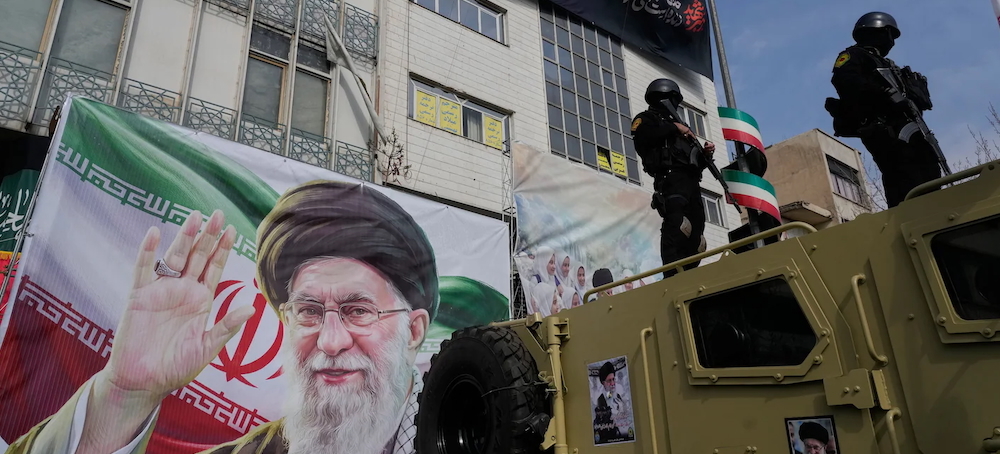 Policemen watch over a rally for Ayatollah Mojtaba Khamenei as participants hold banners depicting his father, the late Ayatollah Ali Khamenei, in Tehran. (Vahid Salemi/AP)
Zero-Sum War, Not Fragile Diplomacy
Then the structure reasserted itself. The United States insisted its naval blockade of Iran would remain fully in place, signaling that economic and military pressure would not ease in parallel with diplomatic gestures. Within hours, Iran reversed course—reimposing control over Hormuz, warning vessels to coordinate with Iranian authorities, and opening fire on ships that did not comply. New reporting indicates that U.S. forces are now preparing to board vessels carrying Iranian oil, moving from blockade to direct interdiction.
In a matter of a day, the system snapped back to escalation. This is not a story about fragile diplomacy or poor sequencing. It is a story about zero-sum conflict, where the core issues cannot be divided, traded, or deferred without forcing one side to accept a strategic loss—a direct contest over relative power.
Zero-Sum Logic: The Nuclear Issue
At the center of the war is a fact that cannot be negotiated away: Iran either retains a nuclear capability on the threshold of weapons, or it does not. There is no stable middle ground that satisfies both sides. For the United States, allowing Iran to sustain that capability would fundamentally alter the regional balance of power, weaken deterrence, and undermine the credibility of long-standing nonproliferation commitments. For Iran, relinquishing that capability—especially under coercion—would expose the regime to future pressure and potential regime-threatening vulnerability.
This is not a bargaining problem where incremental concessions can produce equilibrium. It is a zero-sum condition, where the outcome directly determines the security of both sides—because it determines their relative power. Any ceasefire that leaves this issue unresolved is therefore structurally unstable. It postpones confrontation but does not remove the underlying incompatibility. The moment either side perceives that delay strengthens the other’s position, the incentive to escalate returns.
Zero-Sum Logic: Control of Hormuz
The same zero-sum logic applies—more visibly and more immediately—to the Strait of Hormuz. Before the war, Hormuz functioned as a global commons, carrying roughly one-fifth of the world’s oil supply. That assumption is now broken. Iran has demonstrated that it can shift from disruption to conditional control, allowing passage under its terms while restricting or denying access when it chooses. The United States, in response, is attempting to preserve open navigation through blockade and interdiction.
But these positions cannot be reconciled. Either Hormuz operates as an open international passage, or it is governed by Iran. It cannot be both simultaneously. When Iran declared the strait “open,” it did so under its own authority, requiring coordination and signaling that access was contingent. When the United States maintained its blockade, Iran responded by closing the strait again and enforcing that decision with force. The oscillation is not confusion—it is the direct expression of a zero-sum struggle over who controls one of the most critical chokepoints in the global economy—and thus a lever of relative power.
Preference for Escalation
Zero-sum conflicts do not automatically escalate. They escalate when both sides reveal that losing is worse than fighting. That threshold has now been crossed. The United States has steadily expanded its operational scope—from airstrikes to a naval blockade, and now toward direct interdiction of Iranian oil shipments. Iran has responded symmetrically, moving from indirect pressure to direct control of maritime flows and military enforcement against shipping.
These actions are not reluctant or reactive. They are signals of preference. Each side is demonstrating that it is willing to absorb the costs of escalation rather than accept an outcome that undermines its core objectives—its position in the balance of power. Once that preference is revealed on both sides, ceasefires lose their function as pathways to resolution. They become temporary pauses within a larger trajectory of competition.
The pattern of the past seven weeks—incremental escalation, brief pauses, renewed escalation—is therefore not accidental. It is the natural rhythm of a zero-sum conflict between actors that prefer escalation to concession. Each move tests limits, each response resets the baseline, and the overall trajectory tightens over time.
Conclusion: The Return of Inevitability
The question is not why the ceasefire has ups and downs. It is why a stable path to peace appears so unstable. As long as the central issues remain zero-sum—and as long as both sides continue to prefer escalation to strategic defeat—short-term agreements cannot produce lasting stability. They interrupt the conflict, but they do not resolve it.
What follows is not necessarily continuous war, but recurrent escalation: blockade followed by countermeasures, interdiction followed by retaliation, each step justified by the last and narrowing the space for restraint. External actors may push for de-escalation, and markets may demand stability, but those pressures cannot override the underlying structure—the struggle over relative power.
That structure is decisive. It points not toward resolution, but toward continued tightening of the conflict over time.
This war is not stabilizing. It is tightening.
Next Live Briefing, Sunday April 26 at 4pm CT (5pm ET)
In my next briefing, I’ll show how this zero-sum logic translates into specific escalation pathways over the next 30–60 days—and why the risk is not linear, but accelerating.