Private Jet Owned by Trump Friend Used by ICE to Deport Palestinians to West Bank
Harry Davies, Alice Speri and Sufian Taha Guardian UK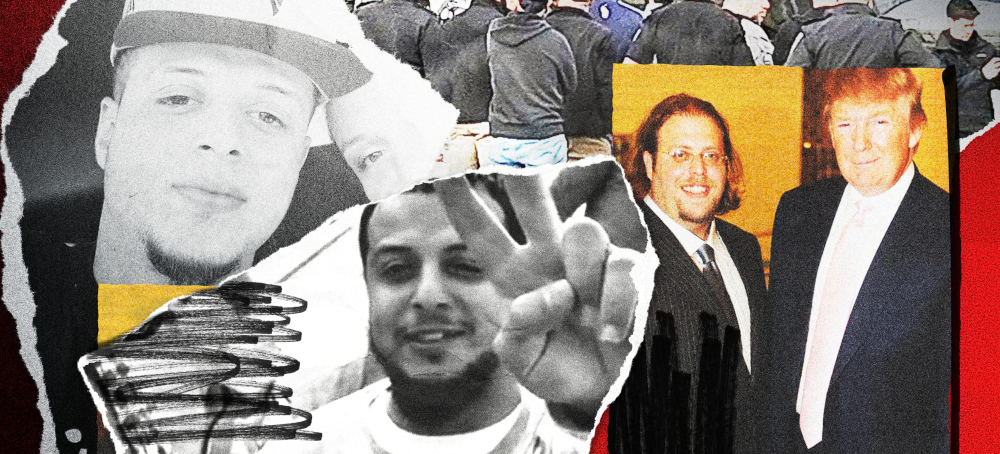 A new investigation has established the flight was part of a secretive US government operation to deport Palestinians arrested by ICE. (photo: Getty)
Exclusive: Luxury aircraft owned by property tycoon close to US president’s family has twice flown Palestinian men from Arizona to Tel Aviv
Hours earlier, they had been sitting with their wrists and ankles shackled on the plush leather seats of a private jet owned by the Florida property tycoon Gil Dezer, a longtime business partner of Donald Trump.
Dezer is also a Trump donor, friend of Donald Trump Jr and member of the Miami branch of Friends of the Israel Defense Forces.
His sleek Gulfstream jet – which he has called “my little rocket ship” – was used to transport the men from an airport near a notorious removal centre in Arizona to Tel Aviv. The jet made three refuelling stops en route: in New Jersey, Ireland and Bulgaria.
A Guardian investigation has established the flight was part of a secretive and politically sensitive US government operation to deport Palestinians arrested by Immigration and Customs Enforcement (ICE) to the Israeli-occupied West Bank.
One of those deported on the January flight was Maher Awad, a 24-year-old originally from the West Bank, who had lived in the US for nearly a decade. Speaking to the Guardian in the town of Rammun, Maher shared photos of his girlfriend and newborn son in Michigan.
Awad is one of several men onboard two recent flights who have been identified by the Guardian and the Israeli-Palestinian publication +972 Magazine. “I grew up in America,” he said. “America was heaven for me.”
On Monday this week, Dezer’s 16-passenger luxury jet was used a second time to transport another group of Palestinian deportees. They landed at Tel Aviv’s Ben Gurion airport and also appear to have been taken to the West Bank.
Former US officials and immigration lawyers said the flights – and Israel’s assistance in returning Palestinians to the occupied territory – marked a shift in policy driven by the Trump administration’s aggressive mass deportation campaign.
A photograph published by the Israeli newspaper Haaretz, which first reported the January flight, shows the men were met at Ben Gurion airport by a huddle of Israeli security personnel. From there, according to Awad, armed guards took them to a checkpoint near the West Bank village of Ni’lin.
“They dropped us off like animals on the side of the road,” Awad said. “We went to a local house, we knocked on the door, we were like: ‘Please help us out.’”
Mohammad Kanaan, a university professor whose house is near to the checkpoint, recalled the moment Awad appeared in the village. Kanaan, who was wearing a red keffiyeh scarf to protect from the cold wind, took a selfie with the men.
“I was shocked to see them walking towards my house and the village. The Israeli army usually doesn’t release prisoners at this checkpoint,” he said. “They stayed at my place for only two hours. During that time, we fed them. They called their families who either came to pick them up or arranged transportation for them.”
He added: “They did not have any contact with their families for a long time. Their families considered them missing.”
‘I was at his wedding. He was at my wedding’
The tail of the private jet used by ICE to deport the Palestinian carries the logo of Dezer Development, a real estate company established by the Israeli-American developer Michael Dezer and today run by Gil Dezer, his son.
The Dezers first partnered with Trump in the early 2000s and have since built six Trump-branded residential towers in Miami. Together, father and son have made more than $1.3m in donations to support his presidential campaigns, filings show.
Gil Dezer is an influential figure in Miami’s luxury property scene. At his extravagant 50th birthday party last year, attended by celebrities including the rapper Future, performers dressed as Trump mingled with guests. Previously, Gil Dezer also attended Donald Trump Jr’s 30th birthday party.
In a recent interview Dezer spoke of his “love” for Trump. “I’ve known him now for twentysomething years. I was at his wedding. He was at my wedding. We’re good friends. Very proud that he’s in the office. Very proud of the job he’s doing.”
Dezer’s aircraft, which he has described as “my favourite toy”, was chartered by ICE through Journey Aviation, a Florida-based company (which declined to comment on the flights to Israel). Public records show Journey is frequently contracted by US agencies to charter private jets.
According to Human Rights First (HRF), which tracks deportation flights, Dezer’s jet made four “removal flights” – to Kenya, Liberia, Guinea and Eswatini – starting last October, before its two recent trips to Israel.
In an email, Dezer told the Guardian he was “never privy to the names” of those who travelled onboard his jet when it was privately chartered by Journey, or the purpose of the flight. “The only thing I’m notified about is the dates of use,” he said.
He did not respond to further questions about the use of his jet by the Trump administration to deport Palestinians through Israel.
US officials did not answer questions about the cost of the two recent flights to Israel but, according to ICE, chartered flight costs have ranged between nearly $7,000 and more than $26,000 per flight hour in the past. Aviation industry sources estimated the flights to and from Israel would have cost ICE between $400,000 and $500,000.
Savi Arvey, HRF’s director of research and analysis for refugee and immigrant rights, said Dezer’s jet was “part of an opaque system of private aircraft facilitating” a mass deportation campaign that “has blatantly disregarded due process, separated families, and is operated without any accountability”.
Flown across the world in shackles
Aircraft tracking data shows that both the 21 January and 1 February flights to Israel made refuelling stops at Shannon airport in Ireland and at Sofia airport in Bulgaria. Those stops may raise questions for the authorities in those countries about the legal status of the passengers transited through their territory.
The eight Palestinians had their ankles shackled on the 21 January flight, according to Awad and another man onboard, Sameer Isam Aziz Zeidan, a 47-year-old grocery worker. Awad said he was forced to wear a body restraint, with his wrists handcuffed to his stomach. Both men said the restraints made it difficult to eat, requiring them to bend their heads forward to put food in their mouths.
In an interview, Zeidan’s uncle said he had left the West Bank for the US in the early 2000s and, until he was deported, lived in Louisiana with his wife and five children. He said Zeidan, who served time in prison about a decade ago and failed to renew his green card, was detained by ICE more than a year ago. “Now he cannot go back to the [United] States. His whole family is there,” he said.
Like Zeidan, Awad has family in the US, including a four-month-old son whom he’s never met as he was born while Awad was in ICE detention.
Awad said he was 15 when he left the West Bank and travelled alone to the US on a tourist visa, joining siblings and extended family. He went to high school in Michigan and later worked at the family’s various businesses – including a popular shawarma shop in Kalamazoo – as well as selling cars.
He said he obtained a US social security number, paid taxes, and got a driving licence. He met and moved in with an American woman he planned to marry. “Everything I know, everything I experienced was in the United States,” he said.
They had only recently learned they were expecting a child when Awad called the police in February 2025 to report a break-in at their home. When the officers showed up, they apparently arrested Awad in relation to a domestic violence charge from the previous year.
Awad was detained for two days. When he was released from the local jail, ICE agents were waiting for him outside. The charge was later dropped, but he spent the next year being shuffled between immigration detention centres across the country, including in Michigan, Texas and Louisiana.
Readjusting to life in the West Bank, where military and settler violence has soared in recent years, Awad has been spending his days making video calls to his partner, Sandra McMyler, and their baby. He said when Israeli soldiers stopped him at a checkpoint recently, all he had to show was his Michigan driver’s licence.
His life, he said, was in the US. “I don’t want to be here. I’m looking forward to going back as soon as possible.”
In Michigan, McMyler told the Guardian she was struggling without Awad and missed his cooking and the way he made every day feel like it was her birthday. “He wants to be able to help me take care of his baby. He wants to hold him, kiss him, talk to him, everything,” she said. “I want my family back together.”
A spokesperson for the US Department of Homeland Security (DHS) did not answer questions about the deportation flights to Israel, but said: “If a judge finds an illegal alien has no right to be in this country, we are going to remove them. Period.”
The US Department of State declined to comment beyond saying it “coordinates closely with DHS on efforts to repatriate illegal aliens”. Both Israel’s foreign ministry and prison service declined to comment on their involvement in the operation.