Pristine Forest and Endangered Gorilla Habitat at Risk as Half of DRC Opened to Bids for Oil and Gas Drilling: Report
Cristen Hemingway Jaynes EcoWatch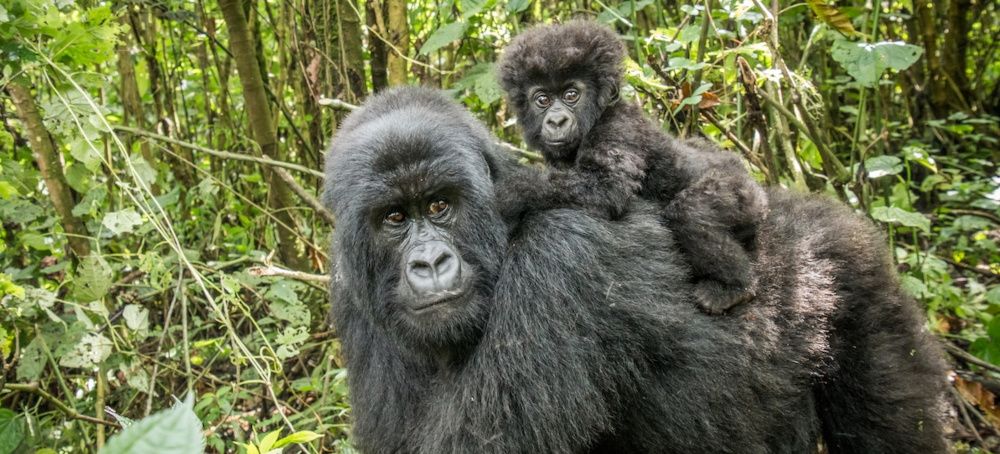 A baby gorilla on his mother's back in the Virunga National Park, Democratic Republic of Congo. (photo: Getty)
DRC’s government began an auctioning round for 52 oil blocks — in addition to three that had been previously awarded — threatening 64 percent of the country’s pristine forest, according to a new report by Earth Insight: Forests to Frontlines: Oil Expansion Threats in the DRC.
“Towering rainforest canopies, winding river systems, and vast carbon-rich peatlands make the Democratic Republic of Congo (DRC) one of the most ecologically significant places on Earth. Home to the second-largest tropical rainforest on the planet, the DRC harbors an astonishing wealth of biodiversity including elephants, great apes, endemic birds, and thousands of plant species that thrive in its intact ecosystems,” a press release from Earth Insight said. “Its Cuvette Centrale peatlands store massive amounts of carbon, critical to fighting climate change. The landscapes that form this rich mosaic of life are also a lifeline for millions of people, supporting local livelihoods, cultural identity, and climate resilience.”
It is estimated that the area being auctioned off is home to about 39 million people, including many forest-based and Indigenous communities who depend on the tropical forests and rivers for their survival.
“Imagine: 39 million Congolese people… and 64% of our forests could be directly affected by the awarding of these oil blocks,” said Pascal Mirindi, Notre Terre Sans Pétrole’s campaign coordinator, as The Guardian reported. “And all this while the government is promoting the Kivu-Kinshasa ecological corridor. Where is the logic? Where is the coherence? We are reminding our leaders that the Congolese people are the primary sovereign. We will not remain silent while certain people organise themselves to sell off our future.”
Oil blocks overlap with 20.5 million acres of protected areas, 21.3 million acres of Key Biodiversity Acres and 165.1 million acres of intact tropical forests. Meanwhile, 72 percent of the recently established Kivu-Kinshasa Green Corridor intersects with oil blocks. This jeopardizes its ecological integrity and undermines its sustainable development credibility as a climate solution.
The majority of Cuvette Centrale — the largest tropical peatland complex in the world and a critical carbon sink that stores roughly 30 gigatons of carbon — is also part of the newly designated oil blocks and at extreme risk of degradation.
“The ecological health of the DRC is deeply intertwined with the health of the planet, playing an outsized role in regulating the global climate and preserving biodiversity. Yet despite strong national and international opposition, the DRC has continued to pursue fossil fuel development across ecologically sensitive areas. In 2022, the government launched a controversial auction for 30 oil and gas blocks, many of which overlapped with protected areas, peatlands, and Indigenous and local lands,” Earth Insight said.
The latest round of auctions is a drastic expansion of the controversial 2022 auction and is a direct threat to the DRC’s conservation goals, undermining its global commitments to the protection of biodiversity and climate action.
“The DRC’s new oil licensing round calls into question the country’s stated commitment to environmental protection and social progress. Rather than steering away from fossil fuel expansion, the government has dramatically widened the reach of oil concessions, putting at risk the ecological integrity of the Congo Basin,” Earth Insight said. “More than half of the country (53%) is now covered by oil blocks, threatening vast areas of ecological importance, disrupting local livelihoods, and threatening lands of cultural and spiritual significance, undermining the country’s potential for sustainable development.”
The report proposes that “[i]n line with the demands of Congolese Civil Society,” the DRC government and its international partners cancel the 2025 licensing round and stop all future hydrocarbon expansion.
It also asks that the rights of local communities and Indigenous Peoples be respected and upheld, and that donor support and international financing be aligned with the country’s commitments to biodiversity, rights and climate. It highlights the need for communities and civil society to be involved in environmental governance, decision-making and monitoring, with a guarantee of meaningful participation and transparency.
“Oil and gas development in these fragile ecosystems would have devastating impacts on biodiversity, communities, land rights and the global fight against climate change,” said Anna Bebbington, an Earth Insight research manager, as reported by The Guardian.
The Earth Insight report is a partnership with DRC-based Coalition des Organisations de la Société Civile pour le Suivi des Reformes et de Action Publique (CORAP) and Our Land Without Oil, along with Rainforest Foundation UK.