‘Nothing Has Changed’: Minneapolis on Edge Despite Trump’s De-Escalation Vow
Shrai Popat Guardian UK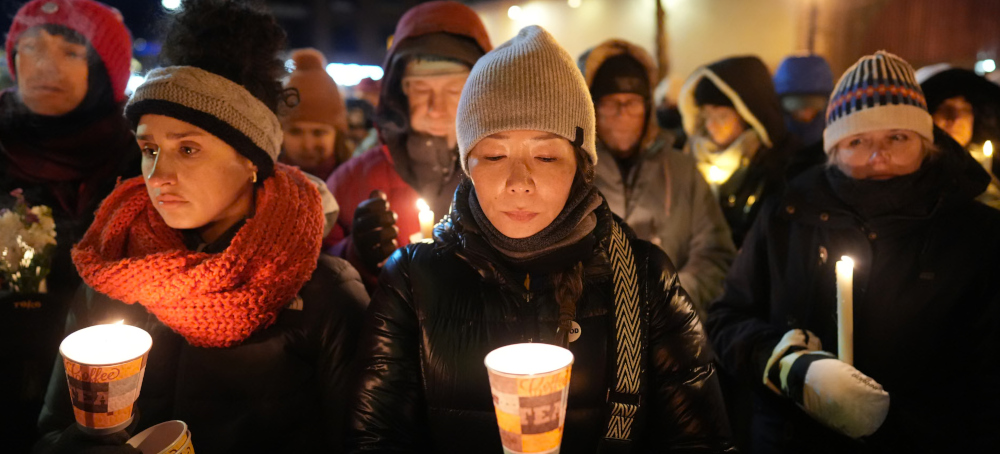 People at a vigil for the ICE shooting victims in Minneapolis on Wednesday. (photo: Adam Gray/AP)
ALSO SEE: ICE Officers in Minnesota Directed Not to Interact With 'Agitators'
The departure of Greg Bovino has not quelled ICE’s raids – and hope that tensions are easing feels distant
In St Paul, city council member Molly Coleman is still taking shifts to watch for ICE agents at her son’s daycare. “People are really guarding against false optimism,” she said. “I don’t think anybody in Minnesota is under any illusions that we are suddenly safer than we were this time last week – that constitutional observers are safer, that immigrants are safer, that anybody who looks brown or Black on the streets is safer.”
For Elizabeth, a parent in south Minneapolis who asked the Guardian to use only her first name to protect her identity, “nothing has changed” since Bovino’s departure. Her neighborhood Signal group chat, used to flag ICE sightings, buzzes constantly. “We’re still seeing the vehicles in the neighborhood,” she said, adding that on Wednesday afternoon she received an alert about increased federal presence at her nearest bus stop.
In the days after the killing of the 37‑year‑old ICU nurse Pretti, signs emerged that the Trump administration understood how quickly anger at federal immigration agents could ignite across Minnesota and the nation.
Early in the week, the president touted “very good” phone calls with the Minnesota governor, Tim Walz – whom Trump routinely disparages – and the Minneapolis mayor, Jacob Frey.
By Tuesday, Bovino – who was initially tasked with running the immigration crackdown in Minnesota – was replaced by Trump’s so‑called “border czar”, Tom Homan. Homan, who served as acting director of ICE during Trump’s first administration, and as a senior official of removal operations under Barack Obama, also had meetings with Walz and Frey to discuss the federal immigration operation. “While we don’t agree on everything, these meetings were a productive starting point and I look forward to more conversations with key stakeholders in the days ahead,” he wrote on X.
Despite Trump’s claims that he would “de‑escalate” the situation with a “more relaxed” operation, raids have persisted. Just two days after his supposedly cordial call with Frey, Trump lashed out at the mayor on Truth Social, accusing him of “playing with fire”, after Frey reiterated that local police should not enforce federal immigration laws.
On Wednesday, the attorney general, Pam Bondi, also said she was in Minneapolis, and claimed 16 people had been arrested for allegedly assaulting federal officers and “impeding” law enforcement, adding that more arrests were expected.
Walz, visiting the makeshift memorial where Pretti was killed, told reporters on Wednesday he had seen no evidence ICE was pulling back. “I’m not so interested in a shift in tone,” he said. “We just need them out of here, and we need accountability for what’s happened.”
A Department of Homeland Security spokesperson said the agency does not “disclose resources or numbers of personnel on the ground” for “operational security” – declining to say how many border patrol officers had left the city at the time of publication.
Throughout the surge, Elizabeth has continued delivering groceries and shuttling children to school for families too afraid to leave their homes. “Many of them haven’t left their home in seven to eight weeks,” she said, noting that some had fled the city entirely.
Teachers across Minnesota are seeing the same fear play out in classrooms. Brenda Lewis, superintendent of the Fridley public school district about 10 miles north of Minneapolis, said she had expanded remote learning for students too frightened to attend in person. “This is about children, predominantly children of color, being treated as less than human,” Lewis said at the state capitol this week. “Our school district has been directly targeted, and we cannot pretend otherwise.”
Hope that tensions are easing feels distant. Coleman, in St Paul, said any signs of the administration relenting amount to “one small victory in a much, much longer fight”. She worries about the long‑term fallout – from learning loss to economic strain to the health consequences for families who have missed critical medical appointments. “We will be dealing with the consequences of this for years,” she said. “I don’t think anybody knows what that will look like, or is fully prepared for it.”
That climate of fear and volatility has now reached Minnesota’s elected officials as well. On Tuesday, the Democratic congresswoman Ilhan Omar was attacked by a man spraying an unidentified liquid while she addressed constituents at a town hall. Early reports show that the alleged attacker, Anthony James Kazmierczak, followed several rightwing activists and commentators.
Despite lawmakers from both parties condemning the assault, Trump remained belligerent and unsympathetic.
“I think she’s a fraud. I really don’t think about that. She probably had herself sprayed, knowing her,” he said, without evidence, in an interview with ABC News. Just hours before the attack, Trump had denigrated Omar again. “She comes from a country that’s a disaster,” he said of Somalia, where Omar fled as a refugee.
Omar attributed the town hall incident to the president’s persistent rhetoric. “The facts of the situation are that I wouldn’t be where I am today, having to pay for security … if Donald Trump wasn’t in office, and if he wasn’t so obsessed with me,” she said.
For Elizabeth, the events of the last week have only reinforced her belief that efforts by the governor and mayor to make headway with Trump are futile. While she still trusts her neighbors to “show up” for one another while their “community is being held hostage,” Elizabeth sees little chance of meaningful change from the administration.
“We’re dealing with a bully, and right now, if they leave Minnesota, they lose,” she said. “And I don’t think he’s going to leave if he’s gonna come across as a loser.”