“No Kings” Seeded a Mass Movement Against Trump, Backed by Labor
Luis Feliz Leon In These Times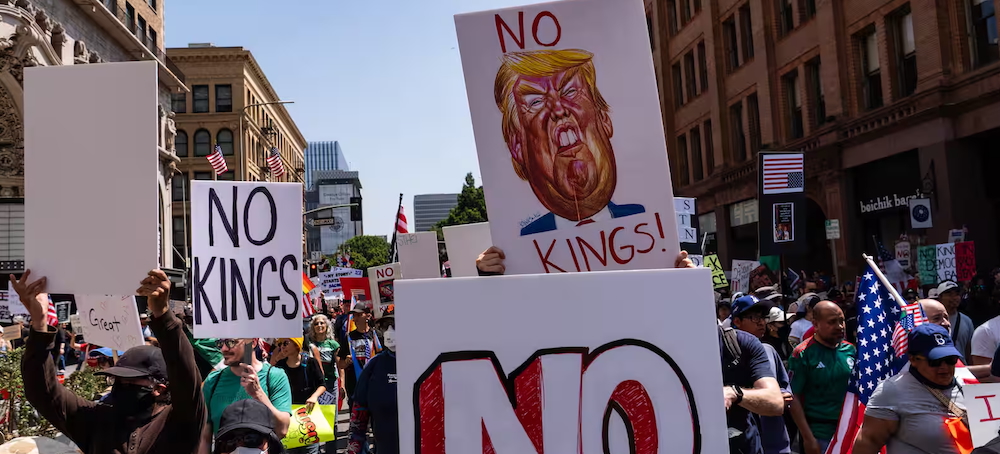 “No Kings” rallies spanned the country in communities big and small. (photo: Salwan Georges/WP)
The major protests in mid-June rallied millions in defense of immigrant workers and against authoritarianism. Now what?
Indivisible, the ACLU and the 50501 Movement were key organizers of the nationwide rallies and marches denouncing the Trump administration, which were timed to coincide with a military parade in Washington, D.C., that President Trump co-opted as a 79th birthday celebration. Storytelling is part of all social movements, and the organizers chose the country’s founding as a touchstone to organize the resistance against what they describe as an authoritarian regime.
In New York City, a small group of demonstrators dressed in Revolutionary War-era garb, including tri-corner hats, marched alongside a brass band, imbuing the protest with a joyful air of the carnivalesque. One woman who only gave her name as Kate wore a black birdcage veil.
“We are in mourning for the dying of our democracy,” she says.
Protester Louise Wollman came as part of the Democratic Party-aligned Downtown Nasty Women Social Group to decry Trump’s abuses of power and deportation raids.
Protestors nationwide championed various causes in their signs and chants, decrying attacks on trans people, cuts to social programs like Medicaid that working people rely on, the United States supplying the bombs and political support for Israel’s ongoing genocide in Gaza, book bans and prohibitions against teaching about systemic racism, and the takeover of government by billionaires. But the main messages in New York City, Chicago and Los Angeles were about defending immigrants from ICE abductions that have torn families apart, and the defense of democracy, including the right to due process, political speech and dissent.
“The fight is hitting too close to home,” says Gladys, a 12-year public school teacher who requested to use only her first name, when asked why she participated in the New York rally. “A lot of our [immigrant] students are very scared.” She says absence rates at her school have been high.
“As a teacher, I feel like I’m a mom to all of these kids,” Gladys continues. “Citizens, people that are permanent residents — my own family members — are also scared. And I think that’s what’s different now, like there are no laws that are being followed, and it’s just not fair.”
“What we saw in Chicago on No Kings Day was a great showing of solidarity with immigrant workers,” says Jorge Mújica, an organizer with the workers’ center Arise Chicago. Mújica highlighted the importance of marchers, many of them white, lifting the banner of solidarity with immigrants as Trump stokes fear through provocations like the brazen, sweeping and coordinated raids in Los Angeles that began on June 6.
“I saw tourists joining us — no signs, no political T-shirts, just people coming to visit our beautiful city and willing to march with us while on vacation because we are all tired and fed up with what’s going on in our communities,” says Marcelina Pedraza, a member of United Auto Workers Local 551 at Ford’s Chicago Assembly Plant.
Tahtebah Gonzalez, a worker leader with the Union of Southern Service Workers who rallied in Atlanta, was inspired by the Los Angeles protestors the previous weekend who stood up to local law enforcement and federal agents to oppose the raids, facing down tear gas and flash-bang grenades.
“The city of Los Angeles is fighting for their community,” he says. “Families are being torn apart. People are being taken from courthouses, their jobs and even schools. At the same time, public programs like Medicaid, SNAP and Social Security are also being targeted, affecting some of our most vulnerable communities.”
The Los Angeles crowd was diverse but predominantly people of Mexican and Central American descent, says Reverend Edgar Rivera Colón of the advocacy group Clergy and Laity United for Economic Justice. “My sense is that the rage, the sadness, the love and willingness to fight were palpable. The young people were ready for anything. I think we have the elementary building blocks for a popular rebellion that centers itself in self-defense in the most practical way: caring and militant vigilance for neighbors.”
“I was in clerical attire and I was shocked by how many people thanked me for being there and even asked me to bless them,” Colón adds. “One kid asked me to bless his gas mask.”
Overall, the No Kings protests were vastly larger but more subdued than the initial Los Angeles protests against the raids earlier this month, although there were incidents of repression and political violence over No Kings weekend as well, in cities across the country. Police in tactical gear lined New York sidewalks and three protestors were arrested. In Riverside, Calif., a mood of “joyful/ optimistic resistance” turned to terror when the driver of an SUV plowed into a demonstrator, says University of California Riverside professor Kaya Arro.
“There was a bizarre, three-block-long instance of ‘telephone’ when the attack occurred,” says Arro. “A palpable bolt of fear shot through the crowd.” The demonstrator suffered “significant injuries” but is in stable condition; the police are investigating the incident as a felony hit-and-run.
And both during the peaceful protests and elsewhere over the No Kings weekend, demonstrations took place against a backdrop of intimidation, political violence and a sense of escalating war: a political assassination in Minnesota, a fatal shooting in Utah, a man driving an SUV through a crowd of protesters in Virginia, far-right Proud Boys showing up to a demonstration in Georgia, squeaky 60-ton tanks grinding down the avenues of the nation’s capital, and Israel launching airstrikes on Iran while starving and killing people in Gaza, threatening to set off an out-of-control regional conflagration.
In Philadelphia, tens of thousands turned out to fill Benjamin Franklin Parkway. Keon Liberato, a high school social studies teacher and member of the Philadelphia Federation of Teachers, says he participated to model what he teaches in the classroom about self-determination and democratic rights.
“One thing I want to show students is that the way you actually enforce your rights is through collective action, and you actually have to put your body on line to make sure that you actually have those rights,” Liberato says. “It’s pretty clear that the seeds of fascism have been nourished pretty well in the United States. So I think that the only way to put a check against the damage is meeting fascism with mass democratic action.”
Liberato also noted that organized labor has an important role to play in resisting the actions of the Trump administration. “We know that when organized labor is defeated, it usually means open season for everybody else. They’re not done attacking organized labor and trying to dismantle what remains of working class organizations, and so this is actually, in my opinion, a little bit late to the game,” he says. “We should have been out doing a lot earlier. But, you know, here we are. We’re doing something, and hopefully we can build a movement.”
Labor
For the most part, unions didn’t mobilize members to participate in the No Kings protest as organized groupings. The American Federation of Teachers (AFT) was prominent in Philadelphia and the Service Employees International Union (SEIU) in California and the South. (In Los Angeles, an SEIU-organized music truck featured Ozomatli and an appearance by Tom Morello.) In New York City, the most organized groupings were PSC-CUNY, the Communication Workers of America and federal workers, who have been at the center of Trump’s efforts to destroy the labor movement.
Beating back those attacks will require “making the political cost too high to do certain things like the budget cuts pushed by Congress, and continually making it almost impossible for the president to keep the facade that he’s a competent ruler and that he could actually make the country better,” says Danny, an American Federation of Government Employees member at the New York City march who asked not to use his last name for fear of retaliation.