'Mishap' or Policy: Inside the IDF's 'Double Tap' Strike on Gaza's Nasser Hospital
Linda Dayan Haaretz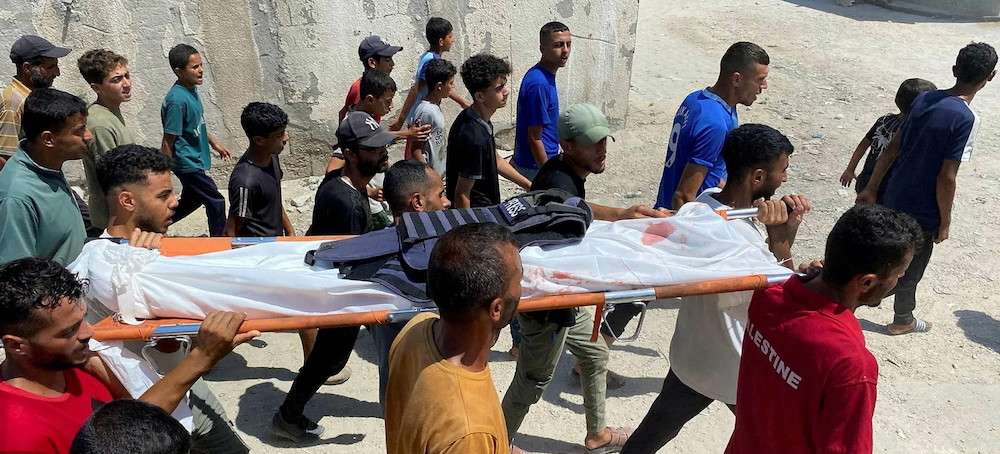 Mourners carrying the body of one of five journalists killed in the strike. (photo: AFP)
Israeli strikes on the Khan Yunis hospital last Monday killed at least 20, including medics and journalists, in successive hits that sparked outrage. Experts say the incident could reflect the IDF's declining discipline, but also a broader, accepted policy of disproportionate attacks on hospitals and other critical infrastructure
What happened at Nasser Hospital?
Before the strike, Israeli troops operating in Khan Yunis spotted a camera filming the soldiers from a balcony at Nasser Hospital. According to the Israeli military, they believed the camera was being used to direct Hamas fire at the forces. The only damaged video camera seen in videos of the aftermath of the strike is the one used by a Reuters photojournalist. According to a New York Times video analysis published on Sunday, both Reuters and the Associated Press recently used the location of the strike to livestream images of Palestinians in the area.
Maj. Gen. (res.) Tamir Hayman, Director of the Institute for Security Studies (INSS), explained that the troops initially received authorization to destroy the camera with a drone equipped with a small, precise explosive. This was ineffective, he said, and a tank was brought in a few days later.
"They thought that if had approval for the drone, they could do the same thing with a tank," Hayman told Haaretz. But there is a significant difference between a small explosive charge and tank shell.
BBC footage analysis released on Friday indicated that Israel may have struck the hospital "at least four times." The first two shells hit staircases almost simultaneously. What was initially believed to be a single follow-up strike was actually two separate impacts, milliseconds apart, in the same area.
Roughly nine minutes later, as journalists and first responders gathered on the eastern staircase, Israeli forces struck again. Two projectiles hit the stairwell in quick succession. Experts quoted by BBC disagreed on the exact munitions used in these latter strikes.
The events of Monday's strike have not been conclusively verified. In a report of their own published two days before the BBC's reconstruction, CNN analyzed the footage and found that the attack consisted of three strikes: An initial tank shell, and two more launched almost simultaneously afterward. The IDF has also not concluded its own probe of what happened that day.
The Hamas-run Gaza Health Ministry reported that at least 20 people were killed by the Israeli strikes. Among them were five journalists: Mariam Dagga and Moath Abu Taha, who worked with the Associated Press and Reuters as visual journalists; Reuters cameraman Hussam Al-Masri; Al Jazeera cameraman Mohammad Salama and freelance journalist Ahmed Abu Aziz.
The IDF said that six Hamas terrorists were killed in the hospital strike, including one who infiltrated Israel on October 7, 2023. "At the same time," the military statement read, "the Chief of the General Staff regrets any harm caused to civilians."
Was this an accident, or Israeli policy?
The international media – including CNN, The Telegraph, BBC and Al Jazeera – have dubbed the attack a "double-tap," meaning that it was composed of two separate strikes: the first on a target, and the second on medical staff and rescue crews who respond to the first strike.
Hayman vehemently rejects this label. "That's a very inaccurate depiction of a dire event that shouldn't have happened," he said. Instead, he points to a deterioration of military discipline, a "wild west" in which soldiers and commanders who make dire missteps – or knowingly commit unethical acts – are not properly disciplined. This has only intensified as the war crawls toward its third year.
Perhaps Israel needs to more quickly and clearly articulate the reasons why it conducts its strikes in Gaza, Hayman said, "But most of all, we can't make silly mistakes. These things can be prevented. The expectation is that army commanders would be stricter when it comes to [troop] discipline, more professional, and investigate these matters in depth. They need to use the punishments at their disposal when they see things done unprofessionally – and especially, God forbid, unethical behavior. These things happen, and war is very chaotic, but we absolutely must deal with this – otherwise, we'll be in a really bad place."
In contrast, Yagil Levy, Head of The Open University Institute for the Study of Civil-Military Relations, argues that the strike reflects broader Israeli policy in Gaza.
"This attack reflects the accepted policy: systematic damage to medical facilities and medical staff. The use of a simulated threat – in this case, cameras placed on the roof of the hospital – in order to justify a disproportionate attack," he said.
"After all, the medical infrastructure in Gaza was not destroyed in its own right – there is always a justification in the form of a real or simulated threat, such as the presence of Hamas members in the hospital, in order to harm it. The destruction of infrastructure, including medical infrastructure, is part of a policy to render entire areas uninhabitable and thus force the population to leave."
The IDF is investigating the event – what does that mean?
IDF Chief of Staff Eyal Zamir said that the military will probe the incident to try to understand how it occurred. As part of this, Hayman explained, "they will have to check exactly what caused the second tank to take such a deadly strike where it wasn't supposed to fire." They will assess if the tank fire was caused by human error, a technological malfunction, or something more malicious. "If it turns out that it was done for reasons that are unprofessional or unethical, then the sanctions will be very, very serious," he said.
The IDF will also examine how the initial authorization to use a small charge to disable a camera led to the firing of tank shells in a location as sensitive as Nassar Hospital. "They'll look into why that change happened, and what the considerations were, and whether or not they asked for authorization again." They will also examine which specific individuals were responsible and to what extent.
If someone is found to be responsible for the strikes, "possible sanctions could range from ouster from their role to a prison sentence," Hayman said. The military "may also come to the conclusion that this was a terrible event, but that it was an accident made in good faith, as such things can happen on the battlefield. And perhaps nothing will happen."
Levy is less convinced that a military investigation will suffice. A real investigation, he said, would reveal that the attack that even Netanyahu dubbed a "tragic mishap" is not out of the ordinary in the context of military activity in Gaza. Such an investigation, he said, "would direct the blame toward the senior commanders, including the commander of the [IDF Southern] Division. This is a front that the Chief of Staff would not want to open" due to internal conflicts in the military. The southern command wants to continue the war, he added; Zamir does not.
"At most, responsibility will be placed on the soldiers who fired without authorization," Levy said. If one of them is punished for it, it could cause fissures within Israeli society, not unlike in the case of Elor Azaria – the soldier who was sentenced to jail after killing an incapacitated Palestinian attacker in 2016. As it did then, prosecuting the soldiers could cause "a right-wing protest against the army."
What makes this case so different?
In other incidents with high civilian death tolls – including some, like Monday's strike, that were captured on film – the backlash has not been as intense, and the military and government were not as quick to express regret.
Levy said that what set this event apart, in his view, was the number of journalists killed. "It attracts more international criticism than killing medical staff. Journalists have a sense of solidarity with their colleagues in Gaza," he noted. "Global criticism has led the army and Netanyahu to respond differently."
This may also reflect some of the aforementioned tensions within the military. "It's also possible that this is an opportunity for him [Zamir] to discipline the Southern Command, which has long been criticized by the Air Force for its illegal policy of opening fire," Levy added.
It could also point to shifting international opinion on the war. Perhaps, Levy noted, "The chief of staff is beginning to understand the significance of labeling the army as committing genocidal acts, and therefore wants to minimize the damage." Even Trump has spoken out against this strike, saying he was "not happy" about it. "This could turn out to be a defining event that accelerates the end of the war."