Milei Took a Chainsaw to Argentina’s Health System. Now It’s ‘Bleeding to Death’
Phoebe Hennell Telegraph UK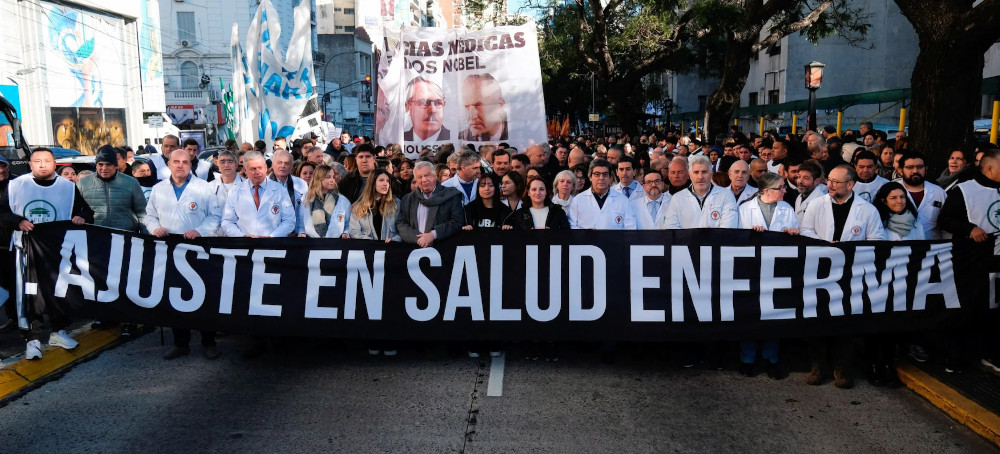 Medics and health workers demonstrate in defence of public education and healthcare in Buenos Aires. (photo: Alessia Macciono/Reuters)
Once a proud Peronist pillar in the nation’s constitution, Argentina’s hospitals are crumbling thanks to its libertarian government
Once a proud Peronist pillar in the nation’s constitution, hospitals are crumbling after Mr Milei waved his subsidy-slashing chainsaw. The libertarian government has sliced the health budget by half in real terms, halted free cancer drugs and fired 2,000 health ministry employees – a quarter of its workforce.
HIV-positive patients are left waiting months for antivirals after Milei axed HIV, TB and STI funding by 76 per cent, and once they arrive they are often expired. This has coincided with new HIV infections climbing for the first time in over a decade with a 25 per cent spike and syphilis cases hitting a three-decade high.
Now the public health system is “bleeding to death in silence”, said Argentina’s Federation of Health Professionals’ (FESPROSA) President María Fernanda Boriotti.
Formally employed Argentines are eligible for social security, funded by payroll contributions, which in theory provides some medical coverage and subsidies. But less than half of the employed population hold registered salaried jobs, leaving the rest to the mercy of public hospitals.
Even for those who supposedly have medical coverage, the bureaucratic nightmare often means they end up paying catastrophic sums out of pocket anyway – after a long wait in the queue.
Ms Pilla was turned away from the oncology hospital after waiting two months for an appointment. “I was number 312 that day at the hospital, and there were just as many people waiting behind me.
“When they finally saw me, the doctor didn’t even want to check me. I had a five centimetre lump in my breast.
“My insurance says it covers medicines, but the pharmacy tells me it doesn’t. So I end up buying everything as if I had no insurance at all.”
Facebook groups have sprouted up where desperate cancer patients like Mrs Pilla and their families plea for donations from those with spare medication. To bypass Facebook rules against advertising prescription drugs, the words are embedded with emojis.
“Even if you have social security, you are forced to keep calling, emailing and fighting to get them to recognise what you are owed.”
Director of the public oncology clinic Hospital María Curie, Dr Gustavo Jankilevich, explained: “We are in a moment of transition, moving from one healthcare system to another.”
“Depending on where a person lives, the healthcare experience can be very different. In some public hospitals, patients can receive treatment for free, while in other regions, this is not the case,” he explained. “There’s a significant issue with very high-cost medications.”
Argentina’s reforms echo the USA, as Milei becomes the pet project of Trump and Elon Musk. During US Health Secretary RFK Jr’s trip to Buenos Aires in May, Argentina confirmed it was following in Trump’s footsteps in quitting the WHO. A joint statement revealed a shared commitment to Make America Healthy Again’s values.
After his election victory in 2023, Milei swooped in to remove price caps in an attempt to deregulate a plethora of industries, promote a market-driven economy and propel the privatisation of state-owned companies.
“Everything that can be in the hands of the private sector will be in the hands of the private sector,” Mr Milei vowed on the radio.
However, medicines and prepaid health premiums prices skyrocketed even quicker than inflation – to such an extent that in an uncharacteristic move, Milei intervened months later to roll back the surges, castigating healthcare providers for “abusing prices” and turning into “cartels”.
But it was too late for patients already priced out of private hospitals, leading to clinics like Hospital María Curie being flooded with patients.
Previously, Argentina provided free care to everyone, residents and foreigners alike. This month, a decree came into effect demanding travellers show proof of travel insurance upon entering the country.
Unlike Britain’s centrally managed NHS, Argentina has long had medical disparities between the formally and informally employed, and the system was gradually being decentralised.
But Mr Milei has accelerated the fragmentation by slashing federal funding and leaving each district to manage its own health department, with a vision of a smaller, more efficient state.
However, the effect has been a postcode lottery, forcing patients to travel across the country to hospitals with more resources.
By law, free HIV tests and medication have been universally available as a basic right since the 1990s – but it rings hollow when shortages and austerity measures have left patients scrambling for tests, antiretrovirals and even condoms.
Claudio Mariani, 59, is a prominent HIV activist who has been living with the virus for over 30 years. He recently received four boxes of expired medication, and he isn’t alone.
“During the country’s economic collapse in 2001, I left for Europe because Argentina had no medication. Now people are receiving their medication one or two months late.”
He is part of a collective that documented 103 cases of patients deprived of their daily antiretroviral pills for weeks at a time last year. “Once we see that someone is missing something, we set up alerts, tour pharmacies and speak with infectious disease specialists across the country.”
With modern medicine, people living with HIV can now achieve a near-normal life expectancy and an undetectable viral load, which means that there is not enough of the virus in body fluids to pass it on during sex.
However, the national shortage of certain antivirals has left 48,000 people at risk of becoming transmissible, according to a new report by the GEP Foundation.
The Huésped Foundation is a major STI and TB charity in Argentina filling in the gaps with tests and education campaigns that the government is failing to provide, amid rising cases.
Tuberculosis cases have increased by 38 per cent in comparison with the last five years.
The Huésped director, Leandro Cahn, said: “For at least 10 years, the number of new HIV diagnoses was around 5,000 a year. But the latest figures jumped to 6,500. Given that the proportion of late diagnoses has climbed too, we think that it isn’t an outlier.”
Last year, the government provided 25 million free condoms to the public. This year, it has provided only 3 million condoms for a country with a population of 45 million.
In Argentina there are more than 140,000 people living with HIV, of which 93 per cent know they are infected – compared to the UK’s 107,000. The vast majority (98 per cent) of infections are due to unprotected sex, making condoms a key strategy to curbing the spread.
But safe sex is now a luxury. At pharmacies, a box of 12 condoms typically costs 12,500 pesos (£7.60), which is almost an entire day’s pay on the daily minimum wage (£8.80).
“The federal government didn’t buy a single condom, and gave no explanation,” said Cahn. “None of the decisions made by this government have helped in creating a more integrated system.”
Patients with disabilities that have high care costs are fighting to keep their disability allowances. Victoria Rojo, a 23-year-old woman from a town near Córdoba in central Argentina, has Hanhart syndrome, which means she was born with three limbs missing.
“I took the insurance company to court because they said my prosthetic limbs were too expensive,” she said. Ms Rojo uses Instagram, on which she has 190,000 followers, to increase visibility for people with disabilities.
“I went through the whole process to get disability benefits, but when Milei came to power he scrapped my progress and I had to start again. I waited over a year, and even that was lucky – it would’ve been longer if a politician hadn’t helped me out.” She receives just £165 per month, which is less than the region’s average rental price.
Parkinson’s medication is supposedly still free, but as the wife of one 65-year-old patient, Nélida García*, from a suburb of Buenos Aires said, “all the other costs will bankrupt you”. Parkinson’s disease is a disorder of the nervous system that primarily affects movement.
Mrs García had to send their daughter to the UK to earn enough money to cover her husband’s medical expenses. “We spend over $2,000 USD per month on caregivers alone. My children cover 80 per cent of that. Add consultations, supplies, food and transport and it becomes impossible.”
“Caregivers used to be free. Now the public system pays outsourced companies so little that no one takes the jobs. Patients are left without care. If you have no family, you’re simply abandoned.
“If you own a car, you lose access to many other free medications. The system punishes people for simply having a vehicle.”
Argentina is also seeing a wave of medical professionals leaving public hospitals for the private sector and abroad.
FESPROSA President María Fernanda Boriotti said: “I don’t recall in my 30-plus years in public health seeing such a marked migration of professionals from various disciplines who are leaving public health in this manner.
“We are gradually dismantling the public health system, closing doors, losing professionals, and losing medications. Bit by bit, we are losing everything.”