Maine Progressive Graham Platner's Surge Threatens Susan Collins as Janet Mills Bows Out
Andrew Stanton and Alex J. Rouhandeh Newsweek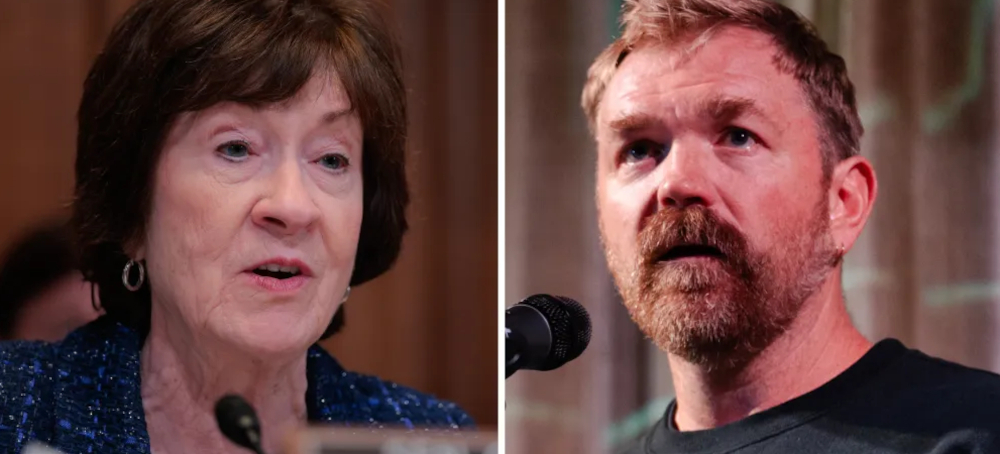 Senator Susan Collins speaks in Washington, D.C., on December 9, 2025. R: Graham Platner speaks in Ogunquit, Maine, on October 22, 2025. (photo: Getty)
The Senate race in Maine is a top Democratic target and is expected to be among the most competitive in the midterm elections. Mills' announcement is a blow for Collins, as polling has given Platner a wider lead over her compared to Mills.
"[Platner] caught fire because people are desperate for somebody to speak plainly about how broken the system is, right?” State Representative Valli Geiger, a Democrat from Rockland, told Newsweek, in part.
RealClearPolitics’ polling aggregate shows him with an average 7.6-point lead over Collins as of Thursday morning. At the same time, Collins held a 0.2 point lead over Mills in the polling average.
Maine backed former Vice President Kamala Harris by about 7 points in the 2024 presidential election and is generally viewed as Democratic-leaning but with an independent streak. Despite this, Republican Collins has won reelection thanks to her personal popularity and bipartisan credentials. Democrats believe she may be in for her toughest race yet, given President Donald Trump’s declining nationwide popularity.
Newsweek reached out to the Collins and Platner campaigns for comment via email.
Janet Mills Suspends Senate Campaign
Mills announced she would suspend her campaign on Thursday in a statement posted to social media.
“While I have the drive and passion, commitment and experience, and above all else – the fight – to continue on, I very simply do not have the one thing that political campaigns unfortunately require today: the financial resources. That is why today I have made the incredibly difficult decision to suspend my campaign for the United States Senate,” she wrote.
Platner had carved out a lead in Democratic primary polls against Mills, who had been viewed as the favorite among more centrist Democrats. She had the backing of Senate Minority Leader Chuck Schumer, a New York Democrat. But she had stalled in the polls. Some Democrats in Maine raised concerns about having a freshman senator who would be 79 years old in 2027, viewing Platner as part of a new generation of Democrats who could juice turnout among the base. Mills' approval rating had also declined in recent years.
However, Mills' supporters touted her previous electoral victories in the 2018 and 2022 gubernatorial races, when she won by nearly 8 points and more than 13 points, respectively, as evidence that she is a strong statewide candidate. Her backers believed she could win over moderates who had backed Collins in the past.
They also view Platner as an untested statewide candidates and believe some of his resurfaced social media posts discussing rural Americans, women and Black people could alienate moderates in the general election.
Mills sought to use those posts to chip away at Platner's support in the primary by launching attention-grabbing attack ads. But they did not resonate particularly well in Maine, a state known for retail politics, where attack ads typically do not land. Platner's support in polls held firm, while Mills struggled to break through despite those controversies.
Dan Shea, professor of political science at Maine's Colby College, told Newsweek that Mills’ withdrawal from the race has a “major” impact.
“Her supporters in Maine will consolidate quickly behind Graham Platner, and just as importantly, national donors and party groups will follow. Everyone understands that Maine is pivotal, so you’ll see a rapid influx of outside attention and resources,” he said.
State Representative Matthew Beck, a Democrat from South Portland, told Newsweek Mills’ announcement gives Platner a “longer runway to the general election,” allowing him to start consolidating Democratic support.
“When the governor's campaign stopped running TV spots of any kind, it was conspicuous by its absence,” he said. “Not being on the airwaves at all seemed to be a bellwether of things to come.”
State Representative Valli Geiger, a Democrat from Rockland who was an earlier supporter of Platner, told Newsweek that “centrists are dead” in light of Mills’ announcement.
“He's a phenomenon,” she said. “But it's not just, he is the right messenger for the right message. He caught fire because people are desperate for somebody to speak plainly about how broken the system is, right?”
His message resonates with voters who are tired of Democrats saying “just enough to make you vote for us” but not doing enough to actually change their lives, she said.
“Everything is broken. Everything is collapsing, unless you are a member of the elite, and people have finally, we've reached a tipping point,” she said.
Graham Platner v. Susan Collins: What Polls Show
A recent Emerson College poll gave Platner a lead over Collins. In that poll, 48 percent of respondents said they would back Platner, compared with 41 percent who said they would vote for Collins. At the same time, the Emerson poll gave Mills only a three-point lead over Collins. Forty-six percent said they would back Mills, compared to 43 percent supporting Collins.
It surveyed 1,075 likely voters from March 21-23, 2026, with a margin of error of plus or minus 3.1 percentage points.
Meanwhile, a Maine People's Resource Center survey gave Platner a 9-point lead over Collins. Forty-eight percent of respondents said they would back Platner, compared to 39 percent supporting Collins. Collins led Mills by about three points in that poll, winning 45 percent support compared to the governor's 42 percent.
The poll surveyed 1,167 likely voters from March 20-31, 2026, with a margin of error of plus or minus 2.9 percentage points.
Shea said he views Platner as having an advantage for the general election, pointing to Maine’s Democratic lean, growth in the Democratic-favorable southern part of the state and Trump’s poor approval rating.
“Collins will try to separate herself from him, but that may be harder to do this time. My guess is that dog won't hunt this time around,” he said.
Turnout, Shea said, will be critical.
“Democratic voters are energized, while Republican enthusiasm appears more muted, especially without Trump on the ballot. Lower overall turnout in a midterm-style environment could also tilt things toward Democrats in Maine, as it might elsewhere across the map,” he said.
Platner, Collins React to Mills Suspending Campaign
Platner wrote in a statement that he is “eternally grateful” for Mills’ service in Maine politics
“We both got into this race because we knew how critical defeating Susan Collins is. And her decision today reflects that commitment. I look forward to working with her between now and November to do just that,” he said. "This race has never been about me or about any one person. It’s about a movement of working Mainers who are fed up with being robbed by billionaires and the politicians they own, and who are taking back their power."
Platner said during a press conference that he had reached out to the Democratic Senatorial Campaign Committee but has not spoken to anyone yet.
"We need a politics now that not only represents people, working people in the state, but a politics that is representative of them. We need people who work for a living in places of power, because we are the ones who know the daily struggles of the system they're living in," he said during a speech Thursday.
Collins wrote in a statement, “I’m sure this was a difficult decision for Governor Mills, and I thank her for her decades of service to the people of Maine.”
GOP Criticizes Platner as Mills Drops Out
Republicans were quick to criticize Platner following Mills' announcement.
"Graham Platner is a silver spoon charlatan who fantasizes about sexual assault, admires Nazi storm troopers, and role-plays as a working class Mainer when he went to a 70k-per-year private boarding school," Alex Latcham, executive director of the GOP-supporting Senate Leadership Fund, wrote in a statement. "Now with Chuck Schumer‘s reluctant support, Platner’s attempt at the Senate will be yet another fantasy that will end when Susan Collins grinds this fraudster into dust."
Platner has faced backlash following the revelation that he had a tattoo resembling the Totenkopf, or “death’s head,” a symbol adopted by the Nazi SS.
Platner has apologized for the posts and previously told Newsweek regarding the tattoo: “I absolutely would not have gone through life having this on my chest if I knew that—and to insinuate that I did is disgusting. I am already planning to get this removed."
Platner’s resurfaced Reddit posts will be a “liability” but are “already largely baked in with Maine voters,” Shea said.
But he may also be able to generate more enthusiasm among younger voters than Mills, he said.
“That said, Democrats have often overestimated the reliability of youth turnout. It’s a familiar gamble. The political graveyard is filled with pols who stake their races on young voters. So whether it pays off this time remains to be seen,” he said.
The Democratic-aligned Senate Majority PAC spokesperson Lauren French wrote in a statement that Platner has “brought a new energy to the campaign, and we will continue our fight to defeat Collins with him as the presumptive nominee."
“Senate Majority PAC announced earlier this year a $24 million television reservation for the fall in Maine. This is in addition to a significant digital investment. Majority Forward has been up in Maine since early 2025 and is currently on air with an ad urging Collins to drop her support of the Iran War as it continues to raise prices on Maine families,” she wrote.
Maine Is Top Target for Democrats
Democrats believe Maine is among their best opportunities to flip a seat in the midterms. Historically, the party in the White House loses seats during the midterms, and Trump's nationwide approval rating has slipped amid ongoing concerns about the cost of living and the economy. Only 39 percent of Mainers approve of Trump, while 57 percent disapprove of his job performance, according to the Emerson poll.
But Collins is still viewed as a formidable opponent. She has won comfortably in the past despite the state's blue lean. In 2020, she defeated her Democratic challenger Sara Gideon with nearly 51 percent of the vote. She outperformed her polling in that race, giving Gideon a lead throughout the campaign. Former President Joe Biden won Maine by about 9 points on the same ballot, underscoring how Collins has won in tough environments in the past.
It's a must-win for Democrats hoping to reclaim a Senate majority. Republicans currently hold a 53-47 majority, so Democrats must flip four seats in the midterms to regain control. In addition to Maine, North Carolina's Senate seat vacated by retiring Senator Thom Tillis is viewed as a top flip target, as Trump won the state by only 3 points in 2024.
There are no other Harris-won or single-digit Trump seats up for grabs, so Democrats must target more conservative states like Alaska, Iowa, Ohio and Texas to flip an additional two seats to clinch the majority.