MAGA Was Supposed to Be Antiwar. Nope.
Kristen Soltis Anderson The New York Times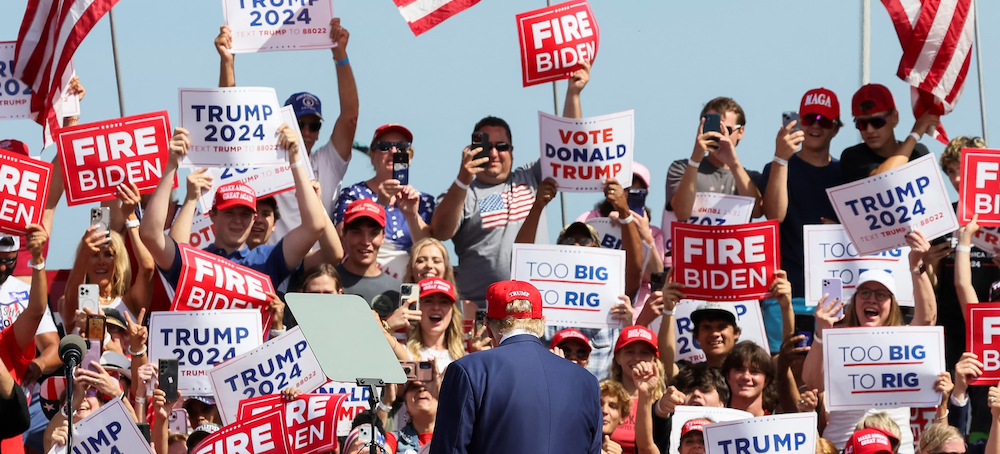 Donald Trump speaks to supporters at a rally. (photo: Brendan McDermid/Reuters/Redux)
The message coming from some of the most prominent MAGA voices is clear. Representative Lauren Boebert, former Representative Matt Gaetz and the commentators Megyn Kelly and Tucker Carlson all have indicated that going to war with Iran was at odds with Mr. Trump’s “America first” platform.
The data, however, says something different. A recent CBS News poll found that 92 percent of MAGA Republicans expressed support for military action against Iran, compared with only 70 percent of non-MAGA Republicans.
This might come as a surprise, given that Mr. Trump returned to office pledging to avoid forever wars. But it tells me that America first means pretty much whatever he says it means — and that it might be time to ditch some of our common assumptions about Republicans.
We’ve come to think of non-MAGA Republicans as the (increasingly endangered) species of voters who may have pulled the lever for Mr. Trump, but still yearn for Reagan-style Republicanism based on the “three-legged stool” of cultural conservatism, free-market capitalism and hawkish national defense. We’ve come to think of MAGA Republicans as voters who prefer the president’s populist pitch and who bemoan endless wars.
Seen through the lens of the war with Iran, the throwback Republicans would presumably be the hawks calling for the destruction of the Iranian regime and its military capabilities, while MAGA Republicans would stand aghast. Certainly, quite a few prominent MAGA-aligned opinionators have adopted such a view.
But like the CBS News poll, my polling shows that MAGA thinks Mr. Trump got it right when it comes to Iran. When I separate Republican respondents on whether they think of themselves as a Trump supporter or a Republican Party supporter first, I find that more than nine in 10 Trump-first Republicans support the Iran strikes, compared with only 72 percent of party-first Republicans. When explicitly asked if the war counts as an America-first policy, only 9 percent of Mr. Trump’s most loyal backers say it does not.
There were signs of this even before the current war. Last year, in the middle of the 12-day war in which Israel and the United States struck targets in Iran, my polling showed that Trump-first Republicans were overwhelmingly in favor of joining Israel’s efforts to degrade, if not destroy, Iran’s ability to develop a nuclear weapon. They were significantly more open to bombing Iran than party-first Republicans.
As recently as the start of the year, when voters were asked how they felt about a hypothetical strike on Iran, Trump-first Republicans were more supportive of such a move.
In January, my polling asked Republicans which statement they agreed with more: that Mr. Trump “is right to focus on international threats, such as Venezuelan President Nicolás Maduro and Iran” or that he “is focusing too much on global affairs and should focus more on issues in the U.S.” While just over half (52 percent) of party-first Republicans said the president was right to focus on overseas threats, nearly three-quarters (74 percent) of Trump-first Republicans did.
You might surmise that last year’s strikes against Iran created a MAGA mind-set shift — a permission structure — specifically in favor of military action against Iran. If Mr. Trump does it, it can’t be bad, the thinking might go. But MAGA’s support isn’t limited to after-the-fact rationalizations.
Take, for instance, the issue of responding to a Chinese invasion of Taiwan, a hypothetical that is instructive since there’s no position on the matter that is obviously Trump-coded. In the 2025 national defense survey conducted by the Ronald Reagan Presidential Foundation and Institute, MAGA Republicans were the most supportive of a variety of interventions in Taiwan. Nearly two-thirds said they would support “committing U.S. forces to the defense of Taiwan,” compared with only 49 percent of non-MAGA Republicans. Nowhere in the survey do the MAGA respondents betray a hint of isolationism relative to their non-MAGA brethren.
If you want to know who’s most worried about the risks of American entanglements overseas, don’t look to MAGA — look to the rest of Mr. Trump’s 2024 coalition.
The Reagan Foundation survey found that the group most opposed to committing American forces to the defense of Taiwan was political independents. Mr. Trump’s non-Republican supporters — both independents and Democrats — are the most averse to establishing a no-fly zone over Taiwan, or even economic sanctions against China. This was the case even more so than for Kamala Harris’s voters. (When it comes to committing American forces — which could mean sending in ground forces — the different groups aren’t as far apart.)
The thing to remember is that it wasn’t only MAGA or Republicans who sent Mr. Trump back to the White House. In 2024, he built a coalition that included independents and even Democrats who found some, if not all, of his message appealing, or at least hoped he would do something about the high cost of living.
Independents are open to military strikes to degrade Iran’s ability to hurt America or obtain a nuclear weapon. Many, however, don’t seem to think that the present conflict is justified. Note also that around half of Mr. Trump’s voters oppose using ground troops to achieve these objectives. Keep an eye on that as Marine expeditionary units and soldiers from the 82nd Airborne make their way to the Persian Gulf. And don’t underestimate the political toxicity of sky-high gas prices and other disruptions to Americans’ lives that may unfold as fighting continues.
But for now, if the war is causing Mr. Trump a political problem, it isn’t because his MAGA base is leaving him. His base eventually may be all he has left.