Louisiana Lawmakers Pass a Congressional Map to Dismantle a Majority-Black district
Sam Gringlas NPR Voters at a polling precinct. (photo: Jessica McGowan)
Louisiana lawmakers raced to eliminate one of two majority-Black congressional seats in the state after the U.S. Supreme Court ruled the current map unconstitutional in a sweeping decision last month that severely weakened Section 2 of the Voting Rights Act of 1965.
Following that ruling, and just days before early voting was set to begin — and with tens of thousands of voters having already returned mail ballots — Republican Gov. Jeff Landry pushed to delay the House primary elections scheduled for May 16, allowing the legislature to redraw the map.
The rescheduled primaries are now set for Nov. 3.
Republicans in the Louisiana legislature have approved a new congressional map ahead of the midterms that will likely net their party one seat in the race to control the House.
Louisiana lawmakers raced to eliminate one of two majority-Black congressional seats in the state after the U.S. Supreme Court ruled the current map unconstitutional in a sweeping decision last month that severely weakened Section 2 of the Voting Rights Act of 1965.
Following that ruling, and just days before early voting was set to begin — and with tens of thousands of voters having already returned mail ballots — Republican Gov. Jeff Landry pushed to delay the House primary elections scheduled for May 16, allowing the legislature to redraw the map.
The rescheduled primaries are now set for Nov. 3.
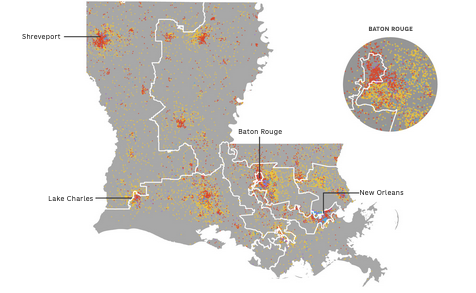
Source: NPR analysis of 2020-2024 American Community Survey 5-year data, U.S. Census Bureau
Credit: Rahul Mukherjee/NPR
The new map includes one majority-Black district that will encompass most of New Orleans, stretching out to predominantly Black neighborhoods in Baton Rouge.
Baton Rouge's Black population is split between two districts. And Shreveport is absorbed into the rest of northwest Louisiana.
The current Baton Rouge-based district is represented by Democratic Rep. Cleo Fields, who won the seat in 2024 and represented a similar district from 1992 until it was dismantled following a federal court decision in 1996. Democratic Rep. Troy Carter represents the other majority-Black district, centered around New Orleans.
Louisiana is the latest Southern state to redraw its maps, targeting Black Democrats, following the Supreme Court ruling.
Tennessee eliminated its sole Democratic-held seat, a majority-Black district in Memphis. Alabama got Supreme Court approval to revert to its 2023 map, which eliminates one largely Black district, though it's now been blocked again. Governors in Georgia and Mississippi also plan to propose redraws of their congressional maps, to take effect after the midterms.
The rush to redistrict across the South comes on the heels of a broader redistricting war nationwide, spurred by President Trump's effort to build an advantage as Republicans try to maintain control of a narrowly divided House this fall.