Looting Was Part of Every Israeli War. What’s New Is the Total Indifference
Adam Raz Haaretz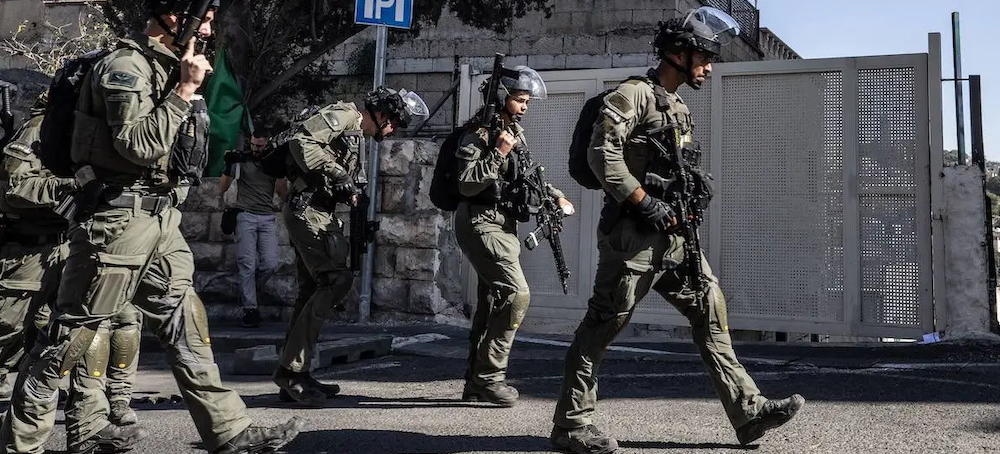 Israeli soldiers. (photo: Mostafa Alkharouf/Anadolu Agency)
Cases of looting by Israeli soldiers rarely lead to punishment. Officers look the other way, and the crime serves its purpose
"It's on a crazy scale," one soldier said. "Anyone who takes something – televisions, cigarettes, tools, whatever – immediately puts it in their vehicle or leaves it off to the side, not inside the army base, but it's not hidden. Everyone sees it and understands."
The troops are looting everything from motorcycles to carpets, and both junior and senior commanders are aware of it but aren't doing anything to prevent it. Chief of Staff Eyal Zamir, who addressed the phenomenon at a conference this week, declared that it was a moral stain on the IDF and said it "will not be an army of looters."
But looting and the systematic disregard that enables it are not new features of Israel's wars. As early as 1948, an official named Y. Gefen in the Minorities Ministry wrote Police Minister Bechor-Shalom Sheetrit about Jewish raids in occupied Jaffa: "Throughout the day, I walked the city's streets inspecting guard posts. I saw soldiers, civilians, military police and battalion police looting and pillaging, breaking through doors and walls," Gefen wrote. "Officeholders failed to act in accordance with standing orders with respect to captured thieves, and suspects accused of looting were released without an investigation, merely because they were acquainted with one of the commanders."
Geffen also suspected that military police were transporting stolen goods from Jaffa into Tel Aviv, and recounted how one officer, upon hearing of an Arab merchant who sought the police's help in preventing theft, offered a chillingly creative solution: shooting the Arab man.
Large-scale plundering also occurred in 1956 and 1967. The IDF deputy chief of staff, Haim Laskov, reported during the Sinai Campaign in '56 that extensive looting was being carried out by soldiers in the Gaza Strip. Furthermore, a complaint filed with the United Nations by Syria in June '67 described "unimpeded robbery and looting [in the Golan Heights]. Searches focused on women's jewelry, gold and televisions. Every shop in Quneitra was robbed. Most homes were looted, and even furniture that appealed to the invaders was not left behind and was transported to occupied Palestine by trucks."
Spontaneously organized convoys of civilians, along with groups organized by official institutions, also made their way from Israel to Qalqilyah, in what is now the West Bank, after its Palestinian residents were expelled in '67, and the town was stripped bare. Some of the property was stolen in an organized fashion, as reflected in correspondence between the mayor of Kfar Sava and the IDF: "Equipment that had been in the schools in Qalqilyah was refurbished and is currently in use in several schools in Kfar Sava."
Fifteen years later, countless homes and businesses in Lebanon were looted by Israeli troops in the first Lebanon war. Reserve officer Dov Yermiya recounted in his war diary how officers looted property and added that "it is very important to preserve Israel's beautiful image. Therefore, the entry of the press must be prevented as much as possible."
Testimonies from the period of the first intifada, which began in 1987, also attest to a widespread phenomenon of violence, vandalism and looting. In testimonies compiled by Rolly Rosen and Ilana Hammerman, a 28-year-old reserve soldier said television reports of the uprising did not reflect the truth. "They don't show what's really happening… No journalists are allowed in, no access here and no access there, all to keep from showing what the [soldiers] are doing."
Testimonies accumulated over the years point to a clear pattern: Looting is illegal and yet in practice it has been tolerated – from the time the state was established to the present day.
During the 1948 war, Minister Golda Meir told members of the ruling party Mapai, in a closed meeting, that the army had done little to stop the plundering of Haifa, "apart from setting up a roadblock on the way to Mount Carmel, where they did not even ask for identity papers." The reason was revealed by the chief prosecutor of the Alexandroni Brigade, who declared that "the looting is wholesale, has gone on for years and reaches nearly to the highest levels of government."
In 1950, Dov Shafrir, the custodian of abandoned property, lamented the widespread phenomenon, writing that "only decisive action, exercising the full powers of the military, administrative, civil and judicial authorities, might have saved not only the property itself, but the soul itself from moral failure. That decisive action never came."
Indeed, it did not come 78 years ago, nor in the wars that followed.
Following publication of the article last week in Haaretz, the IDF ordered the opening of a Military Police investigation into the claims. Perhaps it will also be decided to address another missive to the combat forces, like the one the chief education officer published in October 2024, condemning the looting that had spread like wildfire in the Gaza Strip after the war broke out. But sending a missive is not equivalent to taking real action that would curb the phenomenon – action that has not been evident in either Lebanon or Gaza.
It is no wonder, then, that in April 2025, the anti-occupation Breaking the Silence organization published testimony from a soldier who served in Gaza, to the effect that "among the higher ranks, there is absolute disregard [of looting]. They are not interested in dealing with it, and it's even fine by them."
Soldiers serving in Lebanon today offer two explanations for the blight of plundering there. First, amid a deepening manpower shortage, military commanders prefer to look the other way and resolve such incidents quietly, hoping reservists will agree to show up for yet another round of fighting. Second, the destruction the IDF is inflicting on southern Lebanon is so sweeping that soldiers likely justify taking property by telling themselves it will be destroyed anyway.
These explanations may sound reasonable at a micro level. But from a broader perspective, plundering and vandalism serve a policy aimed at prolonging the war in southern Lebanon. The soldiers who steal essentially become stakeholders in destruction and in prolonging the war. They may devise all manner of ideological justifications for themselves – that taking property is preferable to seeing it destroyed, or that looting is a kind of compensation for the hardship and the lengthy stretches of the service demanded of them. But often, and without realizing it, they are also turning themselves into communities of criminals.
The Israeli government benefits from this state of affairs. By means of the looting, and the abuses that accompany it, it achieves outcomes it cannot openly take credit for due to legal and diplomatic constraints: Lebanon lies in ruins, countless crimes have been committed there and hundreds of thousands of citizens have been driven from their homes and displaced. The government does not actively encourage the plundering – but neither does it act against it.
Since Israel launched its wars in Gaza and Lebanon, only one case of looting has led to an indictment, and even that, as reported by Haaretz, ended in a plea deal. Officers look away, the crimes continue and the criminality serves its purpose.