Lies, Damned Lies, and Trump-Era Labor Statistics
Jon Allsop The New Yorker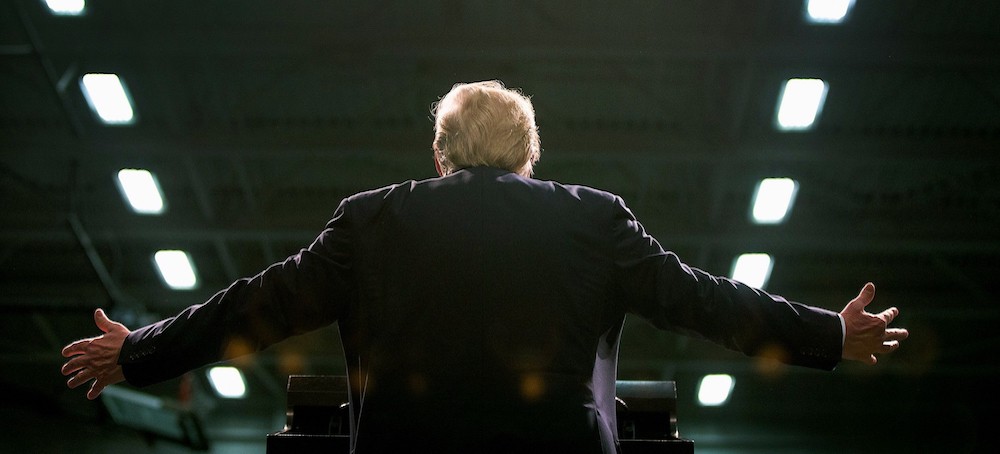 Donald Trump. (photo: Intercept)
Last year, Donald Trump exploited the perception that the economy was bad, even though many indicators were good. Is it possible to do the opposite?
As the media critic Jack Shafer recently observed, the question of job statistics has been a political football ever since a Bureau of Labor was created, in 1884, under the Presidency of Chester A. Arthur. According to an in-house history, the bureau “was the culmination of almost two decades of advocacy by labor organizations that wanted government help in publicizing and improving the status of the growing industrial labor force.” Samuel Gompers, the famed union leader, suggested that lawmakers wouldn’t be able to justify ignoring workers if they had access to hard data about them. Allegations of Presidential meddling have a history, too. Howard Goldstein, an assistant B.L.S. commissioner under Richard Nixon, was suspected of having undermined a reported drop in the unemployment rate in remarks to the press; Nixon privately raged against Goldstein, demanding that he be fired, and, as my colleague Fergus McIntosh noted earlier this week, subsequently set in motion a “Jew count” at the agency. When the B.L.S. reported a dip in unemployment ahead of the 2012 Presidential election, some Republicans suggested that the department had cooked the books to help President Barack Obama’s reëlection chances. These critics included Donald Trump, who, as McIntosh reported, would cast further doubt on official jobs numbers during the launch event for his Presidential candidacy, in 2015. (“Our real unemployment is anywhere from eighteen to twenty per cent,” he said, shortly after descending the golden escalator at Trump Tower.) Last year, after the B.L.S. revised jobs numbers downward, he claimed that the Biden-Harris Administration had previously covered up the true figures for political gain. If so, they did a pretty inept job, since the new numbers came out in August—two and a half months before the election.
This behavior culminated, last week, in Trump’s decision to fire Erika McEntarfer, the current B.L.S. commissioner, after the agency released a jobs report that showed pretty anemic growth for July, and sharply lower figures for May and June than the agency had initially reported. Trump’s advisers did their best to put a rational gloss on an irrational decision, but Trump himself, as he always does, roared the quiet bit out loud, suggesting that McEntarfer was a Democratic partisan who had rigged the numbers to make him look bad. McIntosh described the firing as “the next step in Trump’s project of making the federal bureaucracy, and the information it produces, into a tool of his own authority.” Other observers agreed, stressing the increasingly authoritarian nature of this authority, and the feeling that McEntarfer’s ouster had compounded a dark moment for those who value the truth. On ABC, Larry Summers, the former Treasury Secretary, described it as “way beyond” anything Nixon ever did. “Firing statisticians goes with threatening the heads of newspapers. It goes with launching assaults on universities. It goes with launching assaults on law firms that defend clients that the elected boss finds uncongenial. This is really scary stuff.”
All true enough. (Well, in the absence of a “Jew count,” I think one could make a case that what Nixon did actually was worse.) But McEntarfer’s dismissal also struck me as by far the most self-defeating of Trump’s recent authoritarian maneuvers. Even if the jobs report doesn’t turn into Pravda overnight—the process of putting it together, experts suggest, is hard to blatantly rig—the perception that it has been altered to massage Trump’s ego, or feasibly could be, might undermine confidence in the economy, making bond markets jittery, for example, or lowering U.S. leverage in international trade negotiations. (Already, Trump’s conduct has led to the publication of this incredible sentence, in the Wall Street Journal: “Efforts to estimate economic data in China, which publishes famously unreliable government statistics, could provide a road map for U.S. firms if the integrity of domestic data comes into question.”) All this risk to mask the supposed embarrassment of a jobs report that, while not great, was hardly catastrophic.
The firing is harmful for other reasons, too: as one observer put it to the Times, “Democracy can’t realistically exist without reliable epistemic infrastructure.” In a less lofty sense, it also strikes me as a politically pointless act from the President’s perspective. Often, when Trump has undermined confidence in America’s shared epistemology, doing so has rebounded to his advantage. Now that he’s back in office, however, he’s finding that this isn’t always the case. (Exhibit A: the somehow still ongoing Epstein imbroglio.) Casting doubt on official macroeconomic data doesn’t seem likely to work for him either; as Trump should know better than anyone, having ridden this wave back to office, how people feel about the economy matters most. Trump, with his absolutist approach to Presidential power and majorities in Congress, owns the economy now. Increasingly, it looks like the tin can tied to his coattails.
In 2022, Kyla Scanlon, an economic commentator, coined the term “vibecession,” which she would later define as the “idea that economic data is telling us one story and consumer sentiment is telling us another.” The concept quickly took off in media coverage as evocative shorthand for a puzzling phenomenon: by many traditional metrics, the economy of the Biden years was strong, especially by the second half of his tenure, when high rates of inflation started to slow. And yet many people were unenthusiastic about the economy as a whole.
There have been different interpretations of this apparent discrepancy. A popular one held that the media was overemphasizing negative data points (inflation, mostly) and unrepresentative anecdotes (a CNN segment about a family of eleven that went through twelve gallons of milk a week, for example), and failing to communicate the bigger picture. White House officials were among those pushing this idea, including Biden himself, who suggested, in increasingly tetchy terms, that the press wasn’t covering the economy in “the right way.” Others blamed the Administration for not doing enough to sell its economic accomplishments. (Biden would later express regret that he didn’t put his name on newly finished infrastructure projects or pandemic-era stimulus checks.) Either way, surveys consistently showed that even people who felt pretty good about their financial situation, or that of their state or local area, thought the national economy was going in the wrong direction. Last year, in the spring, a majority of respondents to one poll said that the U.S. was in a recession. It definitively was not.
A different school of thought held that voters were not misinformed about the economy, and that it was patronizing to suggest they were. According to this view, the high inflation of the Biden years had left both psychological scars and a lasting imprint on prices, even after the rate of increase tailed off. And the top-line numbers reported by entities like the B.L.S. failed to communicate the struggles of lower-income families, particularly after early Biden-era programs, such as an enhanced child tax credit and a moratorium on evictions, were struck down or weren’t extended. Even those who said in polls that their personal financial circumstances were fine might have had very legitimate grounds to look around and see an economy that appeared to be skewed, broken—rigged, even. In a country with such a ragged safety net, you didn’t have to be a diehard Biden skeptic to think so.
There are aspects of truth in both of these views. But, however legitimate the bad vibes were, Trump clearly benefitted from them; he won the election, in no small part, based on oversimplified promises not only to end inflation but to bring prices back down. Trump has often proved adept at harnessing vibes, as I explored in a recent column, certainly much more so than Biden and many other top Democrats. (Toward the end of his first term in office, for instance, Trump did put his name on stimulus checks.) And he has managed to remain the tribune of many who think the economy is stacked against people like them, if not necessarily against them personally—part of a broader anti-establishment appeal built on doing things like, say, firing technocrats who run government statistical agencies. Last year, on the campaign trail, he seemed also to tap into a latent nostalgia for the strong pre-COVID economy that he oversaw. After he won the election, optimism about the economy soared, at least among his voters. The vibecession was declared over.
Now that Trump is back in office, however, his economy needs to perform to keep the good vibes going, and while its over-all health is, for now, uncertain, he has done a lot to maximize that uncertainty, not least through the whiplash execution of his tariff policies, which, as Kyle Chayka wrote in this magazine, in April, has turned “recession indicators” into a widespread meme. The tariffs have been widely expected to drive an increase in consumer prices, and there are early indications that this might be happening, along with some warning signs in recent growth and jobs data. Wherever we go from here, Trump yelling about macroeconomic data—made-up or real—doesn’t seem likely to change how most people feel. Ironically, he seems to be repeating the mistake that Biden made, even if Trump’s version of urging the press to report data “the right way” is brazenly firing an official for doing just that.
If last year’s election suggested that voters’ subjective impressions far outweigh high-level economic statistics, it’s tempting to see this as yet another step into a post-truth age. Trump—a man who has said that his “feelings” affect how he assesses his own net worth, and who said that it was his “opinion” that the recent B.L.S. data was B.S.—is a compelling avatar for the idea that vibes are increasingly winning out over facts. But most people do tend, still, to be tethered to their daily realities—and if the bottom falls out of Trump’s labor market, or inflation bites again, those facts will be keenly felt. The logic of the vibecession surely cannot work in reverse. If the economy enters an actual recession, or just slows down, the vibes are all but guaranteed to be bad for Trump.
B.L.S. jobs reports have never been gospel truth. As McIntosh noted, the methodological decisions that inform data collection reflect political priorities; in recent years, that collection has been hampered by declining response rates in the surveys that the B.L.S. sends out to businesses, in addition to budgetary constraints. To acknowledge this isn’t to lapse into some postmodern view that the numbers are all fake anyway, and that Trump’s attacks thus don’t matter. But it is to say that the reality they reflect is a complicated one. If, in the Great Depression, a time traveller had told Ethelbert Stewart about the “vibecession,” he’d surely have thought they were from Mars. But he’d have understood the basic idea. “The only things that make human life human do not lend themselves readily to the statistical method,” he once said. For decades, he added, he had struggled “to put some flesh upon the bony skeleton of mere tabulations—it’s about human lives.”