Leaked Memos Reveal Just How Much the Supreme Court Has Betrayed the Constitution
Charles P. Pierce Esquire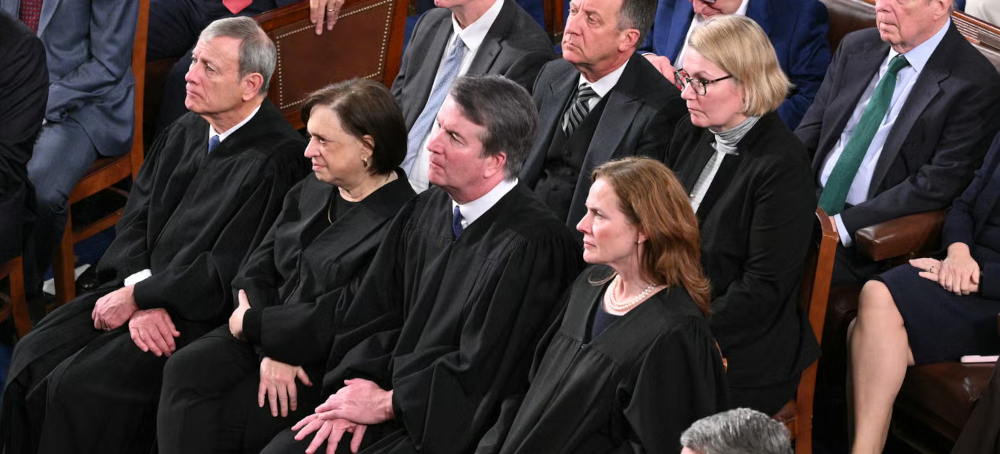 "All in service of its corporate patrons." (photo: Mandel Ngan/Getty)
The report is an astonishing leak of private communications between the justices. It bespeaks a court at war with itself, completely out of the control of Chief Justice John Roberts. The best evidence of the latter contention is the fact that Roberts emerges from these memos as a complete hack. The Times traces the invigorated shadow docket back to when Roberts used it to block an environmental program from President Barack Obama.
For two centuries, the court had generally handled major cases at a stately pace that encouraged care and deliberation, relying on written briefs, oral arguments and in-person discussions. The justices composed detailed opinions that explained their thinking to the public and rendered judgment only after other courts had weighed in.
But this time, the justices were sprinting to block a major presidential initiative. By a 5-to-4 vote along partisan lines, the order halted President Barack Obama’s Clean Power Plan, his signature environmental policy. They acted before any other court had addressed the plan’s lawfulness. The decision consisted of only legal boilerplate, without a word of reasoning. At the time, the ruling seemed like a curious one-off. But that single paragraph turned out to be a sharp and lasting break.
That night marks the birth, many legal experts believe, of the court’s modern “shadow docket,” the secretive track that the Supreme Court has since used to make many major decisions, including granting President Trump more than 20 key victories on issues from immigration to agency power.
This is where Roberts comes in.
In public, Chief Justice John G. Roberts Jr. has cultivated a reputation for care and caution. The papers reveal a different side of him. At a critical moment for the country and the court, the papers show, he acted as a bulldozer in pushing to stop Mr. Obama’s plan to address the global climate crisis. When colleagues warned the chief justice that he was proposing an unprecedented move, he was dismissive. “I recognize that the posture of this stay request is not typical,” he wrote. But he argued that the Obama plan, which aimed to regulate coal-fired plants, was “the most expensive regulation ever imposed on the power sector,” and too big, costly and consequential for the court not to act immediately.
Chief Justice Balls ’n’ Strikes seems a bit confused. He’s not supposed to care about the economic impact of a presidential initiative. He’s only supposed to decide whether the initiative itself is constitutional. And, in any case, it’s an issue that deserved to be debated by the full court in open session.
Since that breakneck February 2016 exchange, the emergency docket has swelled into a major part of the court’s business, as the justices have short-circuited the deliberations of lower courts. The decisions are technically temporary, but are often hugely consequential. Rulings with no explanation or reasoning, like the sparse paragraph from that February night, have become routine. The emergency docket is now a central legacy of the court led by Chief Justice Roberts.
Justice Stephen Breyer raised a mild objection only to get steamrolled by the chief.
Justice Breyer responded later that day to the chief’s memo but did not address all its points. Such stays were unusual, he wrote, stating his objections mildly. He skipped over the question of whether the plan was lawful, asking only: Why the rush? The circuit court had already set a date to hear the case in June. The first deadline for power plants to reduce their emissions was six years away; full compliance was not required until 2030. That was plenty of time for the case to play out through the legal system.
The chief wrote right back the next day sounding irritated and blunt. Speed was vital, he said, because environmental regulation was going to be very expensive for states and the power industry. The sums involved could approach $480 billion, he asserted, and industry groups would have to start preparations immediately.
“Without a stay of the EPA’s rule, both the states and private industry will suffer irreparable harm from a rule that is—in my view—highly unlikely to survive,” he wrote. He was predicting the ultimate outcome of a case that had barely begun to be litigated.
Not a lawyer, but that doesn’t sound like calling balls and strikes. That sounds like an umpire unilaterally declaring that a batter gets four strikes, or five, or nine. When Justice Elena Kagan chimed in to support Breyer’s position, the Memo War went to DEFCON 1.
Court action at this point in the process would be “unprecedented,” she added. She mentioned that she was inclined to find that the Obama plan was lawful, but she said the thin briefing made it difficult for her “to determine with any confidence which side is ultimately likely to prevail.” Justice Alito issued a salvo on the same day as Justice Kagan, with neither of them addressing the other. Echoing the chief justice’s sense of insult and suspicion about the Obama administration, he wrote that the EPA appeared to be trying to render the court irrelevant.
Enter Justice Anthony (Weathercock) Kennedy.
The chief justice and Justices Scalia, Thomas, and Alito wanted to halt the Obama plan, according to people familiar with the deliberations. Justices Breyer, Ginsburg, Sotomayor and Kagan were opposed. (It is not clear whether Justices Scalia, Thomas or Ginsburg set out their reasons in writing.)
As usual, the decision would come down to Justice Kennedy. On February 9, he dashed off a quick, three-sentence note. He believed that the Supreme Court would ultimately stay the Clean Power Plan soon anyway, and that there was no reason to put off the inevitable. He was voting with the chief justice.
Once Roberts got his way on this case, the NYT story argues, the floodgates were open. And, once El Caudillo del Mar-a-Lago got elected, the levees broke entirely. The ongoing impact is measured by the good folks at the Brennan Center. It will last a very long time, and, if the court ever again lurches to the left, even only to the point that it reaches only the old middle, expect young conservative lawyers to have conniption fits. ’Twas ever thus.