Kamala Harris and Tim Walz Are Taking a Bus Tour Through Rural Georgia.
Nicholas Nehamas and Maya King The New York Times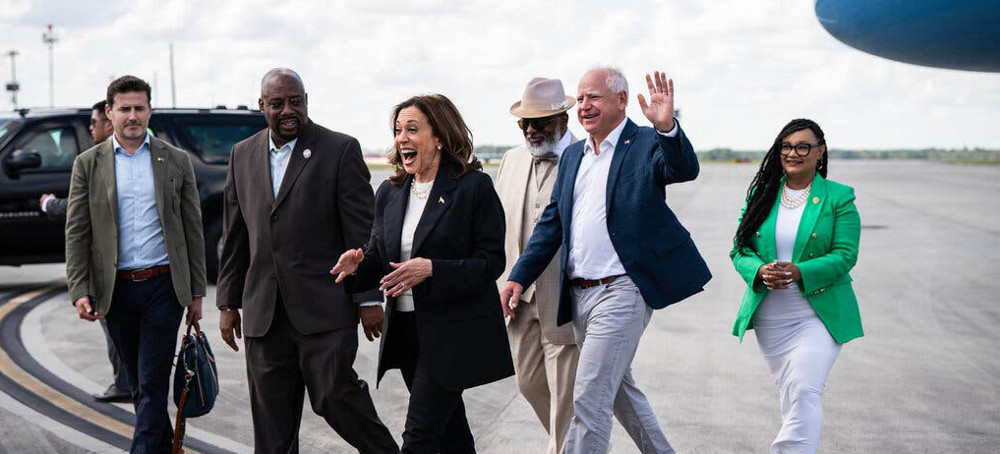 Vice President Kamala Harris and her running mate, Gov. Tim Walz of Minnesota, arriving in Georgia on Wednesday. The state is now considered a tossup. (photo: Haiyun Jiang/The New York Times)
The vice president on Wednesday began a bus tour in the rural southeastern corner of the state, as her campaign focuses heavily on Georgia and North Carolina, another Sun Belt battleground.
Ms. Harris’s trip emphasizes a growing sense of optimism among Georgia Democrats that she could hold on to the state, which President Biden narrowly won in 2020. The Democratic ticket’s standing in the polls there has increased significantly since Mr. Biden dropped out of the race, although Ms. Harris still trails Mr. Trump, according to a New York Times polling average. Her running mate, Gov. Tim Walz of Minnesota, joined her for the two-day bus tour, which is meant in part to mobilize rural Black voters and will culminate with a rally in Savannah.
The bus carrying Ms. Harris and Mr. Walz is emblazoned with the words “A New Way Forward,” which has become one of their campaign slogans as Democrats try to portray Mr. Trump as a creature of the past.
In her first stop on Wednesday, Ms. Harris visited a high school in Hinesville, Ga., a city of roughly 35,000 where nearly one in two residents are Black, to hear the school band play. After the performance, she stressed the importance of practice to the student musicians — comments that could have reflected on her own sudden journey from serving as vice president to becoming the Democratic nominee.
“It requires a whole lot of rehearsal, a whole lot of practice, long hours, right?” said Ms. Harris, adding that she, too, had played in school bands. “Sometimes you hit the note, sometimes you don’t, right? But all that practice makes for beautiful music, and that is a metaphor — that is symbolic — for everything that you all will do in your life.”
The bus tour’s route takes the candidates through a part of the state not often visited by Democrats, underscoring the campaign’s efforts to motivate rural voters. That is true not just in Georgia, but also in nearby North Carolina, a demographically similar Sunbelt state.
Both states have significant populations of Black voters, including many who live in rural areas. Democrats have said that they must drive up turnout outside major cities and suburbs to defeat Mr. Trump statewide. Polls show Ms. Harris performing far better in North Carolina than Mr. Biden did, and her allies in the state have compared the energy of her campaign to Barack Obama’s in 2008, the last time a Democrat was victorious there.
Her swing through Georgia with Mr. Walz carries echoes of Bill Clinton’s 1992 presidential campaign, in which he and Al Gore, his running mate, traversed the Peach State’s rural towns with their wives, as Mr. Clinton leaned on his Southern bona fides. Mr. Clinton later won Georgia by less than one percentage point, making him the last Democrat to take the state before Mr. Biden’s victory in 2020.
Mr. Biden won Georgia by fewer than 12,000 votes and lost North Carolina by under 75,000, his closest defeat in 2020. The two states, which had been leaning toward Mr. Trump before Ms. Harris’s rise, are now considered tossups. One of Mr. Trump’s clearest paths to victory would involve holding North Carolina and flipping Georgia and Pennsylvania, which, with 19 electoral votes, is the most valuable of the battleground states.
The Harris campaign knows that winning Georgia or North Carolina would almost certainly guarantee her the White House. A Democrat who can defeat Mr. Trump in those traditionally moderate states is likely to face a far easier route to victory in the union-heavy blue wall of Michigan, Pennsylvania and Wisconsin.
Republicans know that, too. Mr. Trump and his allies have invested heavily in advertising in Georgia and North Carolina.
“If Harris wins North Carolina, she’s the next president of the United States,” that state’s governor, Roy Cooper, a Democrat, said in an interview this month.
There has been some tension between Democrats in Georgia and North Carolina as they lobby their national party for resources.
North Carolina Democrats have been particularly motivated by the Republican candidate for governor, Lt. Gov. Mark Robinson, who is from his party’s far-right wing and has called for banning abortion at six weeks, before many women know they are pregnant. In contrast, Georgia has no competitive statewide races this year, unlike in 2020, when the Senate campaigns of Raphael Warnock and Jon Ossoff helped turn out Democrats alongside Mr. Biden.
That is part of why Democrats have set their sights beyond the deep-blue Metro Atlanta area and are trying to mobilize voters in Georgia’s southeast and coastal regions, where there are many Black voters whose support will matter at the margins.
“The coast matters,” said Aaron Whitely, the chair of the Democratic Party in Chatham County, which includes Savannah, a smaller Democratic stronghold. “It is not surprising to us that the blue wave is in full effect here.”
New York Times/Siena College polls this month found Mr. Trump leading Ms. Harris by four percentage points among likely voters in Georgia, but trailing her by two points in North Carolina. A previous Times/Siena survey of the Sun Belt states — which did not include North Carolina — found Mr. Trump beating Mr. Biden by eight points in Georgia.
Although Mr. Biden won in 2020 thanks in large part to turnout from Black voters, his support from them dimmed amid high inflation. Ms. Harris, who is Black and of South Asian descent, has re-energized many of them, polls show.
Black voters make up roughly one-third of the electorate in Georgia and one-quarter in North Carolina — higher levels than their representation nationwide. In 2020, about 13 percent of Americans who cast ballots were Black.
Georgia and North Carolina aren’t the only states where the Harris campaign is targeting rural voters. She and Mr. Walz also took a bus tour this month through a conservative county outside Pittsburgh.
Ms. Harris is raising money at a faster pace than Mr. Trump, allowing her to flood the airwaves in the battleground states. She has also built a more robust infrastructure of campaign offices and staff than Mr. Trump, which Democrats say will give her the advantage in getting out the vote. The Trump campaign is relying more on a force of volunteers and well-funded efforts from outside super PACs.
Later on Wednesday, Ms. Harris and Mr. Walz stopped at a barbecue restaurant in Savannah. There, Mr. Walz displayed the kind of folksiness that Democrats hope will draw working- and middle-class voters, chatting about his children and “farm country.”
The Minnesota governor, a former high school social studies teacher and football coach, also found a table of patrons that included fellow teachers, who asked him for selfies.
“Can we do a teacher one?” a woman asked, before posing for a photo with Mr. Walz.