Justice John Roberts Has Almost Completed His Life’s Work of Destroying the Voting Rights Act
Charles Pierce Esquire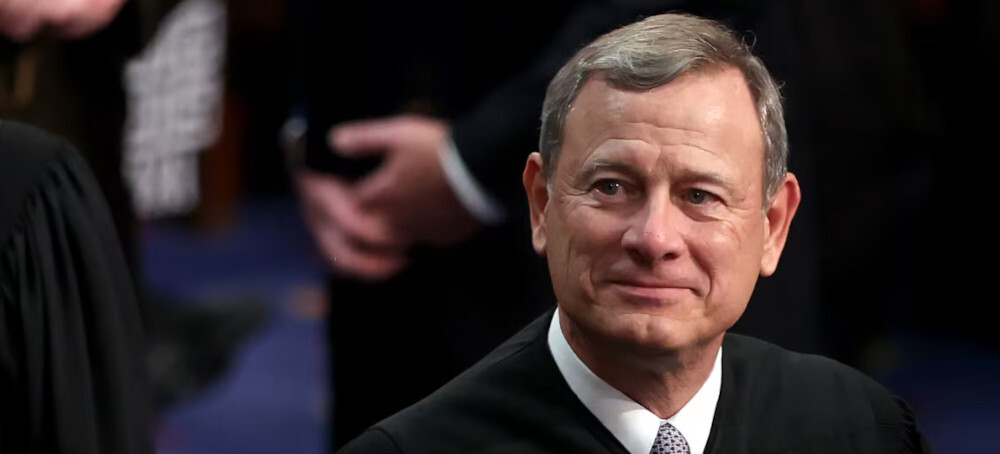 The Supreme Court’s decision in Louisiana v. Callais is almost certainly going to be a nightmare. (photo: Mandel Ngan/Getty)
The Supreme Court’s decision in Louisiana v. Callais is almost certainly going to be a nightmare.
The court’s newest justice, Jackson delivered a lengthy assessment of roughly two dozen court orders issued last year that allowed President Donald Trump to put in place controversial policies on immigration, steep federal funding cuts and other topics, after lower courts found they were likely illegal. While designed to be short-term, those orders have largely allowed Trump to move ahead—for now—with key parts of his sweeping agenda. ... Last week, Justice Sonia Sotomayor similarly talked about emergency orders in an event Tuesday at the University of Alabama that also took issue with the conservatives’ approach.
She referred to orders, which often are issued with little or no explanation as “back-of-the-envelope, first-blush impressions of the merits of the legal issue.” Worse still, she said, was that the court then insists that “those scratch-paper musings” be applied by lower courts in other cases. The orders suffer from an additional problem, she said, a failure to acknowledge that real people are involved, making them “seem oblivious and thus ring hollow.” She also pushed back on the court’s assessment that preventing the president from putting his policy in place also is a harm that often outweighs what the challengers to a policy might face.
“The president of the United States, though he may be harmed in an abstract way, he certainly isn’t harmed if what he wants to do is illegal,” Jackson said during a question-and-answer session with law school dean Cristina Rodriguez. ... In recent years, the Supreme Court has taken a decidedly different approach to addressing emergency stay applications. It has been noticeably less restrained, especially with respect to pending cases that involve controversial matters.”
So Stern took these recent episodes and concluded that they were flares sent up from the court’s left side that the Callais decision is going to be another nightmare. And John Roberts’s Day of Jubilee will be complete.