Judge Warns Border Patrol Leader Bovino That Tear Gas Use Appears to Violate Court Order
Kim Bellware, David Nakamura and Robert Klemko The Washington Post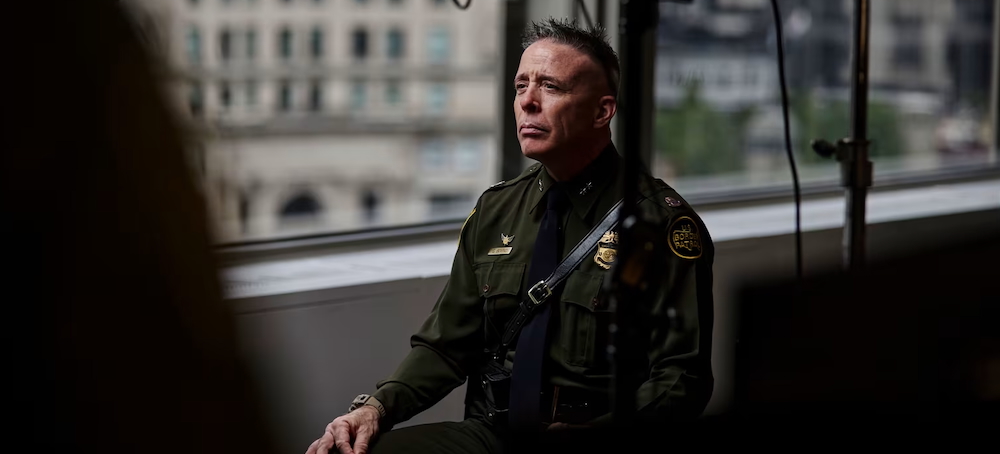 US Border Patrol Chief Greg Bovino. (photo: Mustafa Hussain/CNN)
U.S. District Judge Sara Ellis pressed U.S. Border Patrol official Gregory Bovino over recent incidents in which agents have deployed tear gas in Chicago communities.
U.S. District Judge Sara Ellis referred to several recent incidents, including one over the weekend in which U.S. Border Patrol official Gregory Bovino was recorded throwing without any warning what appeared to be tear gas canisters into a crowd in a Chicago neighborhood. She said the actions appeared to violate her temporary restraining order (TRO) prohibiting federal officers from using chemical munitions on protesters or journalists who do not pose a threat.
On the witness stand, Bovino demurred when the judge asked about the incidents, saying he would want to know more details on each before speaking about them. Ellis responded: “The facts that I have right now — if I were looking only at those facts — that would tell me this is violating certain provisions of the TRO. And no one wants to violate the TRO.”
“That’s correct, ma’am,” said Bovino, who is in charge of “Operation Midway Blitz,” a targeted immigration enforcement operation that the Trump administration launched in Illinois in early September. The operation has resulted in more than 1,500 arrests, federal authorities said, sparking widespread protests over the tactics used by federal officers.
Reporters and members of the public packed the courtroom and an overflow space Tuesday to hear Bovino testify. Protesters gathered outside carrying signs and shouting through bullhorns. U.S. marshals and other federal law enforcement patrolled the area, some accompanied by bomb-sniffing K-9s.
Bovino’s testimony came after Ellis, of the Northern District of Illinois, demanded that he answer questions about whether the Trump administration is abiding by her orders. The judge is overseeing a lawsuit brought by the Chicago Headline Club, a nonprofit journalism organization, and several individual legal observers and journalists who have accused the administration of using inappropriate levels of force.
Ellis’s temporary restraining order bars federal agents from using “any riot control weapon” without giving two separate warnings “when feasible” at a volume level that those being told to disperse can hear. She expanded the order to mandate that immigration officers wear some form of identification, such as a name or badge number, and body cameras that record their interactions with the public.
“They don’t have to like what you’re doing. And that’s okay. That’s what democracy is,” Ellis told Bovino about the protesters. “They can say they don’t like what you’re doing, they don’t like how you’re enforcing the laws — that they wish you would leave Chicago and take the agents with you. They can say that, and that’s fine. But they can’t get tear-gassed for it.”
“I think we’re on the same page, right?” she asked.
“I understand what you’re saying, your honor,” Bovino replied.
Ellis ordered Bovino to appear in court each day at 6 p.m. until Nov. 5, when another hearing is scheduled, and to brief her on daily operations and provide information about each arrest. She gave federal authorities until Friday to provide all use-of-force reports from Customs and Border Protection from Sept. 2 through Oct. 25 and all body-camera footage.
“I don’t jump to conclusions … but I’m also not afraid to enforce this TRO,” Ellis told the federal government lawyers. “I am going to expect that [federal agents] know and understand their responsibilities in terms of use of force. And if they’re using tear gas, they better be able to back it up. And if they can’t, they are going to lose that as something they can use.”
Ellis appeared to be the most troubled by how the use of chemical agents is impacting vulnerable bystanders like children. Ellis cited an incident over the weekend in which agents deployed tear gas in a Northwest Side neighborhood, sowing fear among young children gathering for a Halloween parade.
“Kids dressed in Halloween costumes walking to a parade do not pose an immediate threat to the safety of a law enforcement officer,” Ellis told Bovino. “They just don’t. And you can’t use riot-control weapons against them.”
She emphasized that she does not want to hear reports that federal officers took action including using tear gas in areas where children are trick-or-treating during Halloween on Friday.
Federal officers have increasingly clashed with residents reacting to aggressive immigration enforcement in confrontations that quickly morph into on-the-spot protests.
Following the judge’s restraining order in October, officers at ICE’s facility in Broadview decreased their use of tear gas, according to observers. But they have continued to deploy it when confronting protesters while carrying out immigration enforcement activities throughout Chicago, activists and residents said.
On Friday, Tricia McLaughlin, a spokeswoman for the Department of Homeland Security, said Bovino and other agents were surrounded during an enforcement operation in Little Village and that someone struck Bovino in the head with a rock. Someone also fired fireworks in the direction of officers, she said, adding that agents issued warnings before using chemical irritants. Such warnings are required under Illinois law, unless authorities determine a warning may create a more urgent safety risk.
The plaintiffs in the lawsuit called McLaughlin’s statement “a lie” in a court filing Monday. They argued that protesters were acting peacefully and not shooting fireworks and that Bovino and other federal officers provided no warnings before dispensing the tear gas.
Numerous immigration arrests in Chicago and elsewhere have led to immediate pushback from bystanders and, in some cases, violent confrontation. These scenarios, in which officers can find themselves quickly surrounded on all sides by angry members of the public, are not an emphasis in federal law enforcement training, experts said.
The emergence of chaotic protest environments coupled with the surge to hire 10,000 new immigration enforcement agents may lead to civil rights abuses and tragedy, said Ian T. Adams, a former police officer and an assistant professor of criminology and criminal justice at the University of South Carolina.
“Recent times have really exposed that there’s a big difference between federal officers and more traditionally trained municipal police — their experience levels vary quite a bit as to how they approach these situations,” Adams said. “ICE isn’t going to be the type of agency that has a great deal of experience in dealing with large-scale social unrest. And these officers are now being thrust into that environment.”
At the court hearing Tuesday, Ellis also asked Bovino whether immigration officials are wearing clearly visible information identifying themselves as federal officers and whether they are wearing body cameras, per her restraining order.
Bovino told the judge he has not yet received a camera or training about how to use it, prompting some chuckles in the courtroom.
“I suspect if you ask for one, you could probably get one without having to pull too many strings,” the judge replied.