Judge Strikes Down Kennedy’s Vaccine Policies
Apoorva Mandavilli The New York Times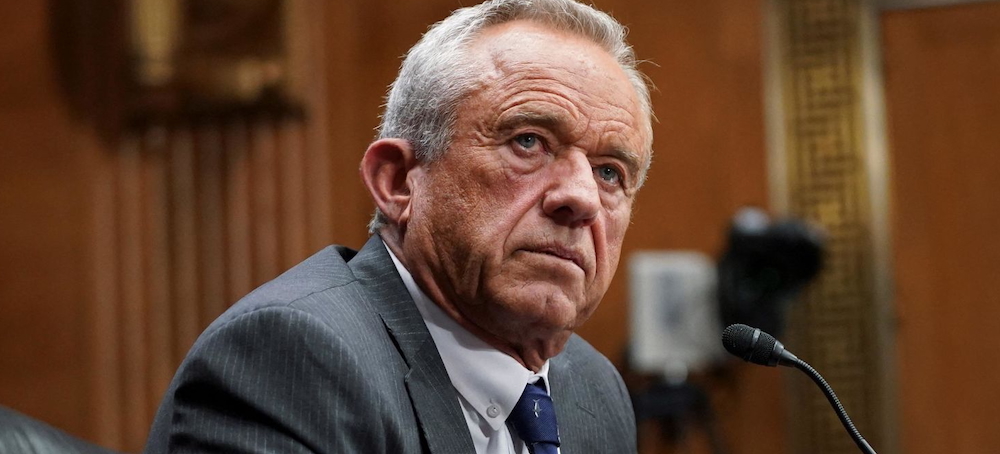 Robert F. Kennedy Jr. (photo: Nathan Howard/Reuters)
Ruling on a lawsuit brought by several prominent medical organizations, a district court said the federal government had not based its decisions on science in limiting Covid shots and revising the childhood immunization schedule.
The ruling also reversed, at least for the time being, all decisions made by the panelists that Mr. Kennedy appointed to the Advisory Committee for Immunization Practices, which makes recommendations on which vaccines Americans should take. The court decision will prevent the committee from meeting later this week, as it was scheduled to do.
The judge’s ruling brought an abrupt halt to the major changes that Mr. Kennedy, who has long been skeptical of vaccines, had set in motion, upending national vaccine policy and making sweeping revisions to the recommendations for what shots are given and when. Those included cutting down the number of diseases covered by routine immunization, and restricting access to Covid vaccines, two pillars of Mr. Kennedy’s vaccine agenda.
In his decision, Judge Brian Murphy, of the U.S. District Court for the District of Massachusetts, noted that the vaccine committee has historically made decisions through careful review of scientific evidence, “a method scientific in nature and codified into law through procedural requirements." But, he added “unfortunately, the government has disregarded those methods and thereby undermined the integrity of its actions.”
The ruling by Judge Murphy, who was appointed to the federal bench by former President Joseph Biden, a Democrat, will almost certainly be appealed. Andrew Nixon, a spokesman for the Department of Health and Human Services, said, “H.H.S. looks forward to this judge’s decision being overturned just like his other attempts to keep the Trump administration from governing.”
Judge Murphy made the ruling in a lawsuit brought by six medical organizations, that contended Mr. Kennedy and his appointees had made “arbitrary and capricious” changes to the childhood vaccine schedule, bypassing the careful, evidence-based practice that in the past has underpinned the recommendations.
The lawsuit also argued that the panelists Mr. Kennedy appointed did not have the qualifications to recommend vaccinations and that their decisions endangered the health of Americans.
In his decision, Judge Murphy wrote that only six of the 15 panelists “appear to have any meaningful experience in vaccines — the very focus of A.C.I.P.”
Lawyers for the federal government, for their part, had argued that changes to the vaccination schedule represented reasonable disagreements about health policy. They noted that the states — not the vaccine committee or the federal government — are the ultimate authority in decisions about which vaccines are required.
In a hearing this month, Isaac Belfer, a lawyer for the Trump administration, argued that Mr. Kennedy and the committee had “unreviewable” — or absolute — authority to make vaccine policies, even if that included recommending that people become infected with measles instead of getting vaccinated.
Judge Murphy was clear in his dismissal of that argument. “Suffice it to say that the Court disagrees,” he said.
The decision was the clearest outcome yet in an escalating battle between the medical establishment and the Health Department, which under Mr. Kennedy has embraced anti-vaccine conspiracies, including debunked theories that childhood shots cause autism, asthma or other diseases.
“This is a significant victory for public health, evidence-based medicine, the rule of law, and the American people,” Richard Hughes, a lawyer for the plaintiffs, told reporters after the court made its ruling.
The government may appeal the decision, Mr. Hughes noted, “but for now, we get to celebrate a rare bit of good news.”
The vaccine committee’s decisions powerfully influence states’ vaccination requirements for entry into day care and elementary school and shape insurance coverage of the shots.
The panel was initially scheduled to meet in February, but the Health Department did not file the necessary federal notices for the meeting and postponed the session.
The lawsuit was filed in July by the medical organizations, including the American Academy of Pediatrics, after Mr. Kennedy announced on social media that Covid vaccines would no longer be recommended for healthy children or pregnant women.
The medical organizations had asked the court to restore the immunization schedule from a year ago, before Mr. Kennedy began making revisions.
The goal is “to stop dangerous vaccine policies and to restore science to our nation’s vaccine decision making,” said Mark Del Monte, chief executive of the American Academy of Pediatrics.
The pediatrics academy lauded the court’s ruling on Monday, saying it “effectively means that a science-based process for developing immunization recommendations is not to be trifled with and represents a critical step to restoring scientific decision-making to federal vaccine policy that has kept children healthy for years.”
The lawsuit addressed a series of changes made by Mr. Kennedy and his associates over the last year. In June, Mr. Kennedy fired all 17 previous members of the vaccine committee and selected new panelists, most of whom shared his skepticism of vaccines and mandates.
In three meetings since then, the panelists rescinded several recommendations for childhood shots, including the immunization of all newborns against hepatitis B, a highly infectious virus that can severely damage the liver.
Separately, Jim O’Neill, whom Mr. Kennedy had installed as the C.D.C.’s acting director at the time, announced a new schedule for childhood vaccines in January that rescinded recommendations for some shots, effectively reducing the number of diseases against which children are routinely immunized to 11 from 17.
Mr. O’Neill and other federal officials said mistrust in vaccines had led to declining immunization rates and argued that the truncated schedule would restore the public’s faith. The shots dropped from the routine schedule would still be available after consultation with a doctor.
The revision of the schedule bypassed the vaccine panel entirely. Changes to the vaccination schedule are typically made by the vaccination committee after a careful review of the benefits and potential risks, in a process that can take months or years, said Dr. Giridhar Mallya, a senior policy officer at the Robert Wood Johnson Foundation, which supports universal health care.
“We cannot say the same for the changes that were made to the vaccine schedule just in the past year,” Dr. Mallya said.
After the lawsuit was filed last summer, it was expanded to include the additional vaccine developments, with the medical organizations asking the court to throw out the revisions to the schedule. The suit also gained supporters: An amicus brief representing more than 100 public health experts and organizations, including the Robert Wood Johnson Foundation, was filed in February.
“We really see vaccines, particularly childhood vaccines, in this nation as a true crown jewel of public health,” Dr. Mallya said. “Seeing a set of drastic, arbitrary and poorly reasoned changes to those recommendations is of real concern to us.”
Judge Murphy seemed to agree with that assessment.
“It is undisputed that Director O’Neill issued the January 2026 Memo without sufficiently consulting A.C.I.P.,” he wrote in his decision. “Therefore, he lacked authority to issue the January 2026 Memo and, in so doing, acted contrary to law.”
“The C.D.C. cannot simply bypass A.C.I.P. in altering the immunization schedules,” he added.
Many of the members Mr. Kennedy appointed are physicians, but unlike previous panelists, they have little to no expertise in vaccines or immunology.
Last month, the vaccine panel’s chair, Dr. Kirk Milhoan, a pediatric cardiologist, suggested that all childhood vaccines, including the shots against polio and measles, should be optional, because the diseases no longer pose the dangers they once did — a position most public health experts immediately denounced as dangerous.
Other committee members have suggested, contrary to the scientific consensus, that Covid shots are deadly, and should be taken off the market.
Allowing the panelists to make decisions about vaccines is “just as reckless as letting a group of amateur pilots dictate how our airplanes should fly,” said Dr. Tina Hartert, a co-chair of the American Thoracic Society’s vaccine advisory committee. “The stakes in both scenarios are life and death,” Dr. Hartert said. The thoracic society joined the amicus brief.
“The medical and scientific backlash against this hasn’t changed anything, so I think it really is going to take some critical legal defense to protect the health of our nation,” she added.
The pediatrics academy and many other organizations, including the American Medical Association, have banded together to provide the public with information and evidence that would normally be offered by the vaccine panel and by the Centers for Disease Control and Prevention.
Last month, the pediatrics academy issued its own new immunization schedule, which largely mirrors the previous C.D.C. vaccination schedule. Most physicians’ groups, states and insurance companies have also committed to following the previous schedule.
“We would prefer to be collaborating with federal health officials instead of appearing in a courtroom to challenge their actions,” Mr. Del Monte, the pediatrics academy’s chief executive, said.